.webp)

Sandeep Singh Sisodiya
Webflow
March 13, 2026


Insights, ideas, and expert perspectives shared by the author on design, development, and digital growth.
The internet has changed the way businesses communicate with customers, sell products, and build lasting brand identities. Behind every successful online business is a well-designed, high-performing website. But for most business owners, building that website has historically meant one of two frustrating paths: hiring a team of developers and spending tens of thousands of dollars on custom code, or settling for a generic, limiting template inside a basic website builder that never quite looks the way you envisioned it.
That gap between creative ambition and technical capability has been one of the most persistent problems in digital business. Until recently, truly professional websites required professional developers. Beautiful, custom designs required serious budgets. Fast, SEO-optimized pages required a skilled engineering team. For small to medium-sized businesses, these realities often meant their websites fell short of what they actually needed to compete.
Webflow emerged as a direct answer to that problem. Founded in 2013 and growing rapidly through the 2020s, Webflow has redefined what a website builder can be. It is not a drag-and-drop page builder full of limitations. It is not a basic template system with cookie-cutter results. Webflow is a professional-grade web design and development platform that gives designers and business owners unprecedented control over how their websites look, feel, and function, without requiring them to write a single line of code.
In 2026, Webflow has firmly established itself as one of the most important platforms in the web design industry. Agencies, freelancers, enterprise teams, and solo entrepreneurs are all turning to Webflow as their preferred tool for building everything from simple landing pages to complex, content-rich business websites and e-commerce stores. If you are a business owner trying to understand what Webflow is, whether it is right for your business, and how it compares to the other options available to you, this guide was written specifically for you.
We will walk you through exactly what Webflow is, how it works, what makes it different from other platforms, what kinds of businesses it is best suited for, and what the practical process of building and managing a Webflow website actually looks like. By the end of this guide, you will have a clear, honest understanding of whether Webflow belongs in your business strategy.
At its core, Webflow is a visual web development platform. It allows users to design websites using a visual interface while simultaneously generating clean, production-ready HTML, CSS, and JavaScript code in the background. Think of it as a bridge between design software and a coding environment. You work visually, the way a designer would, but the output is real, professional code that meets modern web standards.
This is fundamentally different from traditional website builders like Wix or Squarespace, which generate bloated or proprietary code and give you only as much design flexibility as they decide to allow. It is also different from coding everything from scratch, which requires technical knowledge most business owners do not have and significant time investment. Webflow sits in a unique position: it gives you design freedom that approaches what is possible with custom code, while keeping the process accessible enough that non-developers can learn and use it effectively.
Webflow is also a hosting platform. When you build a site in Webflow, you can host it directly through Webflow's infrastructure, which runs on Amazon Web Services and Fastly's global content delivery network. This means your website gets enterprise-grade hosting, fast load speeds, automatic SSL certificates, and global performance optimization built into the platform itself. You do not need to find a separate hosting provider, configure servers, or deal with complex technical setup.
Additionally, Webflow includes a built-in Content Management System, known as the Webflow CMS. This lets you structure and manage dynamic content, such as blog posts, team member profiles, product listings, case studies, or any other type of repeatable content your business needs to publish. You can design how that content looks once and then let editors add or update content through a simple, non-technical interface without ever touching the design.
The website platform market in 2026 is crowded. WordPress, Shopify, Squarespace, Wix, Framer, and dozens of other tools all compete for business owners' attention. Understanding where Webflow fits requires understanding what each category of tool is actually optimized for.
WordPress is still the world's most widely used content management system, powering an enormous percentage of the internet. However, WordPress is a framework, not a finished product. To use it well, you typically need plugins for almost everything, a theme to control your design, a developer to customize that theme, and ongoing maintenance to keep plugins updated and security vulnerabilities patched. WordPress is powerful and flexible, but it comes with real complexity and technical overhead.
Shopify is the clear leader for e-commerce, particularly for businesses whose primary need is selling products online at scale. If your business is primarily a store, Shopify is often the right answer. But Shopify is not optimized for content-heavy business websites, service businesses, or companies that need highly customized marketing pages alongside their commerce functionality.
Squarespace and Wix are beginner-friendly platforms that make it easy to get a simple site online quickly. However, both platforms impose significant design constraints. You are largely working within their systems, their templates, their layouts. When you want to do something outside those boundaries, you often find yourself unable to, or forced into workarounds that produce unsatisfying results.
Webflow occupies a different category entirely. It is built for people who want genuine design control and professional-quality output without relying entirely on developers. The learning curve is steeper than Squarespace or Wix, but the ceiling of what you can achieve is dramatically higher. Businesses that outgrow their basic website builders consistently find Webflow to be the natural next step.
Why are so many businesses choosing Webflow in 2026 specifically? The answer comes down to several converging trends that have made Webflow's particular set of strengths especially valuable.
First, performance has become more critical than ever. Google's Core Web Vitals have been a ranking factor for several years now, meaning the speed and user experience of your website directly affects how well it performs in search results. Webflow's clean code output and optimized hosting infrastructure make it easier to achieve excellent performance scores compared to WordPress sites loaded with plugins or Wix sites running on shared infrastructure.
Second, the cost of developer time has continued to rise. Skilled web developers are expensive, and the traditional model of paying developers for every small change to a website is increasingly unsustainable for growing businesses. Webflow reduces dependency on developers by empowering marketing teams, content creators, and business owners to make updates, launch new pages, and manage content without technical help.
Third, design quality has become a competitive differentiator. In a digital landscape where customers make instant judgments about brand credibility based on website appearance, looking generic or outdated carries a real business cost. Webflow's design flexibility makes it possible to create truly distinctive, brand-aligned websites that stand out from the crowd of template-based competitors.
Fourth, the no-code and low-code movement has matured significantly. In the early days, no-code tools were seen as a compromise, a way to get something online quickly when you could not afford proper development. Today, that perception has changed. No-code and visual development tools like Webflow are recognized as legitimate production tools used by serious companies and sophisticated teams. Many businesses now build their primary websites on Webflow not because they cannot afford developers, but because Webflow genuinely produces better outcomes for their specific needs.
Understanding what Webflow can actually do for your business requires familiarity with its core features. Here are the capabilities that matter most for business owners evaluating the platform.
Visual Design Without Code Limitations
Webflow's designer gives you control over every visual aspect of your website. Layout, typography, colors, spacing, animations, hover effects, responsive behavior across devices, and much more. Unlike template-based builders, there is no set of permitted customizations. If you can design it, you can build it in Webflow. This level of control means your website can look exactly the way your brand requires it to look.
The Webflow CMS
The CMS is one of Webflow's most powerful features for content-driven businesses. You define content types, called Collections, that match the structure of your business content. For example, a consulting firm might have Collections for services, team members, case studies, and blog posts. You design the template for how each Collection item looks, and then editors can add or update content through a simple editor interface. The design stays consistent automatically across every piece of content you publish.
SEO Controls
Webflow gives you granular control over all the technical SEO elements that matter for search visibility. Meta titles and descriptions, Open Graph tags for social sharing, canonical URLs, structured data, XML sitemaps, and 301 redirects are all manageable directly within the platform. Clean semantic HTML output also means search engines can crawl and understand your content effectively without you needing to install separate SEO plugins.
Animations and Interactions
Webflow Interactions is a system for building scroll-based animations, micro-interactions, hover effects, and complex animated sequences entirely through a visual interface, no JavaScript required. For businesses in creative, technology, or high-end consumer categories where visual storytelling matters, Webflow's animation capabilities create the kind of polished, engaging experiences that used to require a specialist JavaScript developer.
Webflow Ecommerce
Webflow includes built-in e-commerce functionality that allows businesses to sell physical and digital products directly through their Webflow site. While it does not yet match Shopify's depth in terms of inventory management, shipping integrations, and third-party apps, Webflow Ecommerce is an excellent option for businesses that want the design flexibility of Webflow combined with straightforward selling capability. The checkout experience can be fully customized to match your brand, something Shopify's standard plans do not easily allow.
Memberships and Gated Content
Webflow Memberships allows businesses to create gated content areas accessible only to registered members. This opens up business models built around subscription content, online courses, member communities, and premium resources. For professional services firms, coaches, consultants, and content businesses, this is an increasingly valuable capability.
Webflow is not the right tool for every business in every situation. Being honest about who benefits most from Webflow helps you make a more informed decision.
Webflow is an excellent fit for businesses where visual presentation and brand identity are central competitive advantages. Design agencies, creative studios, architecture firms, luxury brands, technology companies, and professional services businesses that compete on expertise and credibility all benefit significantly from the design quality Webflow makes achievable.
It is also well-suited for businesses that produce a significant volume of content and need a CMS that makes publishing easy without sacrificing design consistency. Marketing teams at SaaS companies, media brands, consulting firms, and e-learning companies frequently choose Webflow for exactly this reason.
Startups and growing companies that expect their website needs to evolve rapidly over time also find Webflow to be a strong fit. The ability to launch new pages, run experiments, update content, and iterate on design without constantly engaging developers keeps pace with the speed that growing businesses require.
On the other hand, very large enterprise businesses with complex, highly custom backend requirements, businesses that sell thousands of SKUs with complex inventory management needs, and individuals who need the simplest possible solution with minimal learning curve may find that other platforms serve them better. Webflow has a real learning curve. It rewards investment in understanding how it works, which means it is not the best fit for businesses that need something up and running in an afternoon with no time to learn.
Many business owners choose to engage a professional webflow development agency to build their Webflow site rather than learning the platform themselves. This is a completely legitimate and often very smart approach. A skilled agency brings deep expertise in both Webflow's technical capabilities and the strategic and creative decisions that make a website effective as a business tool.
An experienced Webflow agency will typically handle the full project from strategy and information architecture through visual design, Webflow development, CMS configuration, integrations with third-party tools, and launch. After launch, they can provide ongoing support and help you continue evolving the site as your business needs change.
One of the significant advantages of Webflow for business owners who work with agencies is what happens after the project is complete. Unlike custom-coded websites where any change requires going back to the developer, or WordPress sites where a non-technical team member risks breaking something with every update, Webflow sites can be handed off to your internal team for day-to-day content management. Your marketing team can update copy, publish blog posts, add new team members, and make many kinds of changes without needing to re-engage your agency for every small update.
When selecting a Webflow partner, look for an agency with a strong portfolio of Webflow projects, demonstrable expertise in both design and technical Webflow development, and a process that includes strategic thinking about your business goals alongside the execution of the build. Webflow has an official partner program with certified agencies and freelancers you can browse through their marketplace.
Understanding Webflow's pricing structure is important for business planning. Webflow uses a tiered pricing model with separate plans for building and hosting sites, and different options depending on your use case.
The Starter plan is free and allows you to build in Webflow's designer and export code, but not host a custom domain through Webflow. For businesses that want to host with a custom domain, site plans start at the Basic tier, which covers simple websites without CMS functionality. The CMS plan is typically the right starting point for business websites with blogs, case studies, or other dynamic content. Business plans accommodate higher traffic volumes and more CMS items.
For e-commerce, Webflow has separate Ecommerce plans with transaction fees that decrease as you move to higher tiers. Enterprise pricing is available for large organizations with more complex requirements.
In terms of overall cost of ownership compared to alternatives, Webflow tends to be highly competitive. When you factor in the costs of WordPress hosting, plugins, theme licensing, and developer time for maintenance and updates, many businesses find that Webflow is comparable in price while delivering better performance, better design flexibility, and lower ongoing maintenance burden.
No website exists in isolation. Your business website connects to marketing tools, CRM platforms, analytics systems, email marketing software, customer support tools, and payment processors. Understanding how Webflow integrates with the rest of your technology stack is an important consideration.
Webflow supports native integrations with several popular tools, and connects to thousands more through Zapier, Make (formerly Integromat), and other automation platforms. Common integrations that business owners rely on include HubSpot for CRM and marketing automation, Mailchimp or ConvertKit for email marketing, Google Analytics and Mixpanel for analytics, Intercom or Zendesk for customer support, and Stripe for payment processing.
Webflow also exposes an API that allows developers to build custom integrations and automate workflows between Webflow and other systems. For businesses with specific technical requirements, this API access provides significant flexibility. A webflow development agency with technical depth can use the API to create sophisticated custom functionality that goes well beyond what the visual designer handles out of the box.
The Webflow Apps marketplace, which has expanded substantially in recent years, also provides pre-built integrations and add-on functionality that can extend your site without custom development. From localization tools to advanced form handling to user-generated content features, the ecosystem around Webflow has grown considerably.
As Webflow's popularity has grown, so has the number of misconceptions about what it is and what it can do. Clearing up these misconceptions helps business owners approach the platform with accurate expectations.
One common misconception is that Webflow is just another Wix or Squarespace. This significantly underestimates Webflow. While all three are visual website builders, Webflow produces genuinely professional output that stands up to custom-coded sites in terms of design quality, performance, and flexibility. Designers and developers who use Webflow take it seriously as a professional tool.
Another misconception is that you are locked into Webflow forever. In fact, Webflow allows you to export your site's HTML, CSS, and JavaScript code and host it elsewhere if you ever choose to leave the platform. Your content and your design are not trapped. This is a meaningful advantage compared to some other platforms that make it very difficult to migrate away.
Some business owners assume that because Webflow requires no coding, it cannot support any custom functionality. This is also incorrect. Webflow allows you to embed custom code at the site level, page level, or within individual elements. This means developers can add custom JavaScript, integrate third-party scripts, build custom form handling, and create complex functionality that extends well beyond what the visual interface handles natively.
Finally, some believe Webflow is only suitable for small business websites. In reality, Webflow powers websites for companies of all sizes, from solo entrepreneurs to publicly traded corporations. Fintech companies, SaaS businesses, global agencies, and major media brands all use Webflow for production websites that serve millions of visitors.
If you have decided Webflow might be the right platform for your business, understanding what the journey to a live Webflow website looks like helps you plan accordingly.
If you are learning Webflow yourself, start with Webflow University. The official learning resource from Webflow is genuinely excellent and covers everything from foundational web design concepts to advanced CMS and e-commerce configuration. Most people with no prior web design experience can build a functional, reasonably designed Webflow site after investing a few weeks of learning through Webflow University's courses.
If you are working with an agency or freelancer, the typical project begins with a discovery process where your goals, audience, content strategy, and technical requirements are defined. From there, a site architecture and wireframe structure is developed, followed by visual design concepts. Once design is approved, the site is built in Webflow, the CMS is configured, integrations are connected, and the team runs thorough quality assurance before launch.
Timeline for a professionally built Webflow site typically ranges from four weeks for simpler projects to several months for more complex builds involving extensive CMS architecture, custom animations, e-commerce, or membership functionality. Budgets for professionally built Webflow sites vary widely based on scope, but most solid business websites fall in a range that compares favorably to equivalent custom-developed sites.
After launch, plan for an ongoing relationship with either your internal team or your external partners to continue evolving the site. The best Webflow websites are not static. They grow, change, and improve continuously as you learn more about what your visitors need and how your business goals evolve.
Webflow represents one of the most significant shifts in how professional websites are built. It has democratized access to genuine design quality and technical performance without requiring businesses to choose between investing in expensive custom development or accepting the constraints of basic template-driven tools. In 2026, it stands as a mature, capable, and widely trusted platform that delivers real business value across a broad range of industries and use cases.
For business owners evaluating Webflow, the key question is not whether Webflow is a good platform. The evidence on that is clear. The real question is whether Webflow is the right platform for your specific situation. If your business values design quality, if you publish content regularly, if you want to reduce long-term dependency on developers for routine website tasks, if performance and SEO matter to your growth strategy, and if you are willing to invest in learning a platform or partnering with experienced professionals to build it right, then Webflow deserves serious consideration.
The businesses that get the most out of Webflow are those that approach it strategically rather than reactively. They define clear goals for what their website needs to accomplish, they invest in building it properly from the start, they structure their CMS thoughtfully so that content management is genuinely easy for their teams, and they treat their website as a living asset that evolves alongside the business rather than a static project that gets rebuilt every few years.
Whether you learn Webflow yourself, engage a webflow development agency to build it for you, or some combination of both, the platform gives you tools that were simply unavailable to most businesses a decade ago. The ability to produce custom-quality web design at a fraction of the traditional cost, with clean code, excellent performance, and a content management experience your team can actually use without technical help, is a genuine competitive advantage.
Your website is often the first impression your business makes on potential customers. It is the hub of your digital presence, the destination for your marketing efforts, the platform for your content, and the foundation of your online credibility. In a world where digital experiences matter more than ever, having a website that genuinely reflects the quality of your business is not a luxury. It is a necessity. Webflow, used well, gives you the tools to build exactly that.
The next step is yours. Whether that means exploring Webflow University, browsing the Webflow showcase to see what is possible, or reaching out to a team of professionals to discuss what a Webflow website could look like for your business, the opportunity to build something truly exceptional for your online presence is well within reach.
The decision between Webflow and WordPress is one of the most consequential choices a B2B SaaS company will make in its early and mid stages of growth. Your website is not just a digital brochure. It is the first impression for enterprise buyers, the backdrop to your product demos, the platform for your content marketing engine, and often the last thing a prospect reviews before signing a contract. Getting the platform wrong means months of rebuilding, engineering debt, and missed pipeline. Getting it right means moving fast, converting efficiently, and scaling without friction.
As of 2026, both platforms have matured considerably, and the conversation has moved well beyond surface-level comparisons about ease of use or plugin availability. Webflow has grown into a genuinely powerful visual development environment with robust CMS capabilities, native animations, and an expanding ecosystem of integrations. WordPress, meanwhile, continues to power a staggering share of the internet and has doubled down on its block editor, site health tooling, and hosting ecosystem. Neither platform is going away, and neither is obviously superior for every use case.
What has changed is the type of team that succeeds on each platform. B2B SaaS companies are not typical websites. They need to move at startup speed, maintain brand precision that enterprise buyers expect, support aggressive SEO programs, integrate with complex marketing stacks, and often coordinate between marketing, design, and engineering teams who all have competing priorities. These requirements put a very specific lens on the Webflow versus WordPress question, and that lens reveals some genuinely surprising answers.
This comparison will walk through every dimension that matters for a B2B SaaS company: design and brand control, developer experience, content operations, SEO capabilities, performance, security, integrations, total cost of ownership, and the very real question of team fit. We will be honest about the limitations of both platforms and clear about the scenarios where each one wins. By the end, you should have a concrete answer for your specific company rather than a hedged non-recommendation that leaves you more confused than when you started.
Let us start with the most fundamental question: what kind of team do you actually have, and what kind of website do you actually need?
WordPress was built in 2003 as a blogging platform and has evolved over two decades into a general-purpose content management system. Its foundational philosophy is openness. Virtually every aspect of a WordPress site can be modified, replaced, or extended through its theme and plugin architecture. This openness is its greatest strength and its most significant liability. For a developer who knows the ecosystem well, WordPress can do nearly anything. For a marketing team without dedicated engineering support, WordPress can become an unpredictable system of dependencies that breaks at inconvenient moments.
Webflow was founded in 2013 with a fundamentally different philosophy: give designers the power to build production-ready websites without handing off to developers for every change. It is built on a visual canvas that generates clean HTML, CSS, and JavaScript. The trade-off is intentional constraint. Webflow is not infinitely extensible, but everything that works within its system works well, predictably, and without the plugin dependency hell that plagues many mature WordPress installations.
For B2B SaaS companies specifically, this philosophical difference has enormous practical consequences. Your marketing team will change headlines, swap hero sections, launch landing pages for campaigns, and update case study layouts on a weekly basis. The platform that enables this workflow without requiring a developer for each iteration has an enormous compounding advantage over time.
Brand precision matters enormously in B2B SaaS. Enterprise buyers make judgments about your company's reliability and attention to detail based on your website's visual polish. A misaligned button color, an inconsistent typeface hierarchy, or a layout that breaks on a 1440px monitor can erode confidence in a way that is hard to measure but very real in competitive deals.
Webflow gives designers pixel-level control over every element on the page. You can define global style variables, maintain consistent spacing scales, build reusable components called symbols, and enforce design systems that propagate changes across the entire site when updated. If your brand guidelines specify a 16px line height at 1rem with a specific letter-spacing on body copy, Webflow will maintain that precisely and permanently.
WordPress design control depends entirely on the theme and page builder you choose. With a custom theme built by an experienced developer, you can achieve comparable precision. With a commercial theme like Divi, Elementor, or Avada, you are working within that theme's design system, which may conflict with your brand guidelines in subtle ways. The more you customize, the more complex the theme becomes, and the more maintenance burden accumulates over time. Many B2B SaaS companies running WordPress eventually find themselves with a theme so heavily modified that updates from the theme vendor become risky or impossible.
For design-forward B2B SaaS brands that care deeply about visual execution, Webflow is the clear winner in this category.
WordPress has the most extensive developer ecosystem of any CMS on the planet. There are over 60,000 plugins in the official repository, a global community of developers, and decades of documentation covering virtually every use case imaginable. If you need a specific integration, a custom post type structure, a complex authentication flow, or a deeply custom checkout experience, WordPress can almost certainly accommodate it. The question is always whether the cost and complexity of building it are justified.
Webflow's developer story is more constrained but has improved meaningfully. Webflow Logic allows for basic conditional content, form routing, and simple automation without code. The Webflow API enables external systems to read and write CMS content programmatically, which opens up interesting possibilities for data-driven pages. Custom code can be injected at the page level or site level, meaning developers can augment Webflow with JavaScript, embed third-party scripts, and build interactions that go beyond the native toolkit. Webflow Apps, released in 2023 and expanded in 2024 and 2025, allow approved third-party extensions to integrate directly into the Webflow designer interface.
The honest answer is that WordPress wins on raw extensibility, particularly for complex or unconventional requirements. But many B2B SaaS websites do not need unconventional requirements. They need clean component architecture, reliable performance, and the ability for non-engineers to make changes safely. Webflow's constraints are often a feature rather than a limitation in this context.
It is worth noting that teams completing a wordpress to webflow migration often report significantly reduced maintenance overhead, with engineering time redirected away from platform upkeep and toward product work. This is not a universal experience, but it is a common one for companies that were previously running highly customized WordPress installations.
B2B SaaS content teams are typically publishing at high velocity. Blog posts, case studies, customer stories, product feature pages, comparison pages, integration pages, changelog entries, resource center content, and webinar landing pages all need to move quickly through production. The CMS that makes this workflow smooth and reliable is worth its weight in developer hours.
WordPress has a content editing experience that most writers and marketers know instinctively. The Gutenberg block editor, which has matured significantly since its rocky 2018 launch, provides a flexible writing interface with reusable blocks, custom block patterns, and a publishing workflow that includes draft, review, and scheduled states. WordPress also has excellent editorial workflow plugins like PublishPress that add approval flows, editorial calendars, and multi-author management for larger content teams.
Webflow's CMS editor has improved substantially and now offers an in-page editing experience that allows content editors to make changes while seeing exactly how the page looks in production. Collection items, which are Webflow's structured content type, allow for consistent schema-driven content like blog posts, case studies, or team members. The editor interface is clean and approachable for non-technical users, though it remains less familiar than WordPress to people who have spent years in publishing environments.
One meaningful limitation in Webflow is the CMS collection item limits. Depending on your plan, collection item counts are capped, which can become a constraint for large content libraries. Companies with tens of thousands of blog posts or product pages should evaluate this carefully before committing to Webflow. WordPress, running on your own infrastructure, has no such limits.
For most B2B SaaS companies producing hundreds or low thousands of content items, Webflow's CMS is entirely sufficient. For companies with very large existing content libraries or very high publishing volume, WordPress has an edge.
SEO is one of the most contested topics in the Webflow versus WordPress debate, largely because many of the assumptions people bring to this comparison are outdated. Let us address the most common ones directly.
WordPress with Yoast SEO or Rank Math has historically had the best SEO tooling of any CMS, and that remains true in certain dimensions. These plugins provide real-time on-page analysis, XML sitemap generation, schema markup controls, breadcrumb management, and canonical URL configuration that are deeply integrated into the content editing experience. For large content teams that want every writer to have immediate SEO feedback as they draft, this workflow is genuinely superior.
Webflow's native SEO controls cover all the fundamentals well. Title tags, meta descriptions, Open Graph settings, canonical URLs, 301 redirects, structured data markup, and XML sitemaps are all configurable without plugins or code. Webflow generates clean semantic HTML by default, which means the underlying code quality that Google evaluates is generally excellent out of the box. Pages built in Webflow tend to have strong Core Web Vitals performance as well, since Webflow serves assets through a global CDN and automatically handles image optimization for modern formats.
The reality for B2B SaaS SEO in 2026 is that technical SEO hygiene, page experience, and content quality matter far more than which plugin you use to edit your meta descriptions. Both platforms can support a serious SEO program. WordPress has richer tooling for teams that want it. Webflow has better default technical performance for teams that do not want to think about it. The choice here is more about workflow preference than capability.
Performance and security are areas where the platforms diverge significantly in their architecture, and these differences have real consequences for B2B SaaS companies.
Webflow is a hosted platform, meaning Webflow manages the infrastructure, server updates, SSL certificates, CDN configuration, and uptime. Your marketing team never needs to think about server patches, PHP version compatibility, or WordPress core update sequencing. Sites are delivered from Webflow's global CDN, which means consistently fast load times regardless of where your visitors are located. Security vulnerabilities are Webflow's problem, not yours. This is an enormous operational advantage for companies that do not have dedicated DevOps resources for their marketing website.
WordPress is self-hosted, meaning you are responsible for your hosting environment, server configuration, and keeping WordPress core, themes, and plugins updated. WordPress sites are by far the most commonly targeted websites for security attacks, largely because of their ubiquity. A WordPress site running outdated plugins or hosted on an under-resourced shared server is genuinely vulnerable. Managed WordPress hosting providers like WP Engine, Kinsta, and Flywheel have reduced this burden considerably by handling updates, providing security scanning, and offering performance-optimized server environments. But managed WordPress hosting comes at a cost, and the operational overhead never fully disappears.
For performance specifically, both platforms can achieve excellent Core Web Vitals scores with proper configuration. Webflow achieves this more automatically. WordPress requires deliberate work with caching plugins, image optimization tools, lazy loading configuration, and careful plugin management to avoid performance regressions. If your team has the engineering resources and expertise to maintain this configuration, WordPress performance can match Webflow. If your team does not, Webflow will be faster in practice.
B2B SaaS marketing teams run complex technology stacks. HubSpot or Marketo for marketing automation. Salesforce or HubSpot CRM for lead management. Clearbit or ZoomInfo for data enrichment. Segment or Rudderstack for analytics. Intercom or Drift for live chat. Hotjar or FullStory for session recording. The website needs to play nicely with all of these systems.
Both platforms handle most of these integrations through JavaScript snippets. Any tool that provides a tracking script or embed code can be added to Webflow or WordPress with equal ease. The meaningful differences emerge at the level of deeper, native integrations. WordPress has dedicated plugins for HubSpot, Salesforce, Mailchimp, and dozens of other common marketing tools, which can simplify configuration for non-technical users. Webflow integrates with many of these tools natively or through Zapier and Make, and its Logic feature handles simpler workflow automation without code.
For most B2B SaaS marketing stacks, both platforms will get the job done. The edge cases where WordPress pulls ahead are scenarios involving deeply custom integrations, complex form routing logic, or integrations with legacy systems that require custom API connections. In these cases, WordPress's open architecture and development community provide more options.
The cost comparison between Webflow and WordPress is more nuanced than it first appears, because the sticker price of each platform tells only part of the story.
Webflow pricing in 2026 runs from approximately $23 per month for a basic site plan up to $212 per month for enterprise-tier CMS plans, billed annually. There are no additional costs for hosting, SSL, CDN, or basic security. Third-party integrations through Webflow Apps vary in cost. Professional design and build work from a webflow development agency typically runs from $15,000 to $80,000 for a full B2B SaaS site depending on scope and complexity. Annual ongoing costs for editorial updates and minor improvements are generally lower than WordPress equivalents because the platform itself requires less maintenance.
WordPress software itself is free, but the true cost includes managed hosting at $30 to $300 per month depending on traffic and provider, premium plugins at $200 to $2,000 per year for a typical SaaS marketing stack, a premium theme or custom theme development at $5,000 to $40,000, and ongoing engineering time for maintenance, updates, and new feature development. Security incidents, which are unfortunately common on WordPress, can add significant unexpected costs. For a well-resourced company with internal WordPress expertise, the total cost can be competitive. For a company outsourcing all of this work, the costs often exceed Webflow equivalents over a three year horizon.
The key insight is that WordPress's free software cost is often an illusion. The real cost is the engineering and maintenance time required to run it well. Companies that have a dedicated WordPress developer on staff or a strong relationship with a WordPress agency can manage this cost effectively. Companies that are cobbling together maintenance from a part-time contractor and occasional internal help will find WordPress more expensive than Webflow in practice.
If you take nothing else from this comparison, take this: the best platform is the one your team will actually use effectively. Both Webflow and WordPress are capable platforms. The question is which one matches how your team actually works.
Webflow is the better choice if your team is primarily design-led, if your marketing team needs to make layout and visual changes independently without waiting on developers, if you are starting from scratch or rebuilding and want a clean modern foundation, if your content volume is in the hundreds rather than tens of thousands of items, if you do not have dedicated WordPress engineering resources, and if your brand identity and visual precision are core to how you compete in your market.
WordPress is the better choice if your team has existing WordPress expertise that would be expensive to retrain, if you have a very large existing content library that would be difficult to migrate, if you need deeply custom or unconventional functionality that falls outside Webflow's capabilities, if you have a dedicated WordPress developer or agency relationship that provides reliable support, and if your SEO program relies heavily on editorial-level optimization tooling like Yoast's real-time feedback.
The pattern that emerges consistently in the market is that early-stage and mid-stage B2B SaaS companies that are building or rebuilding choose Webflow at a high rate, while established companies with large WordPress installations and internal expertise tend to stay. This is rational behavior: the migration cost is real, and the operational advantages of Webflow are most apparent when you are building fresh rather than comparing against a mature, well-maintained WordPress site.
One factor that deserves its own dedicated discussion is iteration speed, because it has compounding effects on conversion rates and growth that are easy to underestimate at the start of a platform evaluation.
In B2B SaaS, your homepage messaging, your pricing page structure, your demo request flow, and your case study format are all hypotheses that need to be tested against real traffic. The team that can spin up a new landing page in two hours, test three variations of a hero section in a week, and restructure a pricing page based on sales feedback in a single afternoon has a structural advantage over a team that needs a two-week sprint to accomplish the same thing.
Webflow's visual editor, combined with its component and symbol system, makes this kind of rapid iteration genuinely accessible to designers and marketing managers without developer involvement for most changes. Adding a new section to a landing page, restructuring the navigation, or creating a new campaign-specific page can happen in an afternoon. WordPress with a page builder like Elementor can approximate this speed, but the visual editor often introduces additional CSS specificity conflicts, loading overhead, and unpredictable rendering behavior that slows things down in practice.
Over a 12 to 18 month period, the difference in iteration velocity between a well-configured Webflow site and a heavily customized WordPress site can translate to dozens more conversion experiments, meaningfully better positioning, and a website that is noticeably more aligned with current market conditions. This is one of the most undervalued arguments for Webflow in the B2B SaaS context.
For companies currently on WordPress that are evaluating a move, the migration question is where theory meets reality. A wordpress to webflow migration is not a trivial undertaking, and anyone who tells you otherwise is not being fully honest. The complexity depends heavily on the size of your content library, the sophistication of your current WordPress setup, the number of custom integrations you have built, and how carefully you need to preserve historical URLs and redirect chains.
For companies with fewer than 500 pages and a relatively standard WordPress setup, the migration is manageable over a period of six to twelve weeks with proper planning. Content can be exported from WordPress and imported into Webflow's CMS with some manual restructuring. Redirects can be managed through Webflow's redirect manager. The design rebuild is typically done from scratch, which is an opportunity to modernize the visual identity rather than a burden.
For companies with thousands of pages, complex taxonomies, multi-site WordPress networks, or deeply custom post type structures, the migration requires more careful planning and may not be justified by the benefits. In these cases, incremental approaches, such as migrating the marketing pages and new campaign work to Webflow while keeping the blog on WordPress, can deliver some of the benefits of each platform without the full migration risk.
After examining both platforms across every dimension that matters for a B2B SaaS website, the honest conclusion is that neither Webflow nor WordPress is universally superior. They are built on different philosophies, they serve different team compositions, and they reward different working styles. The question is not which platform is objectively better, but which platform is better for your company right now given your team, your content strategy, your budget, and your growth trajectory.
Webflow wins for design precision, operational simplicity, iteration speed, performance reliability, and security. It is particularly well-suited to companies with strong design cultures, marketing teams that need editorial independence, and organizations that want to minimize the engineering overhead associated with their marketing website. If you are building a new B2B SaaS website in 2026 and do not have strong internal reasons to choose WordPress, Webflow should be your default consideration.
WordPress wins for extensibility, content at scale, editorial workflow maturity, and scenarios where existing expertise and infrastructure make staying the rational choice. If your company has invested years in a WordPress ecosystem that is working well, has a large content library that is driving meaningful SEO traffic, and has reliable technical resources to maintain it, the case for migrating is weaker. WordPress can be an excellent B2B SaaS platform when it is managed well and kept modern.
The most common mistake companies make in this evaluation is choosing a platform based on what a blog post told them was industry standard rather than what their specific team will actually execute well on. A beautiful Webflow site that your marketing team can iterate on every week will outperform a technically superior WordPress site that requires a developer for every change and accumulates six months of backlogged requests. Conversely, a WordPress site maintained by a skilled dedicated team will outperform a Webflow site that nobody on the team knows how to use confidently.
Start your evaluation by mapping your actual workflows. Who makes changes to the website today? Who should be able to make changes without a developer? What is the biggest friction point in your current process? What does your content volume look like at a two-year horizon? What does your marketing team look like: design-led, content-led, or engineering-supported? These questions will point you toward the right answer more reliably than any feature comparison matrix.
The B2B SaaS website is a living asset that needs to evolve as quickly as your market does. In 2026, with buyer expectations at an all-time high and attention windows at an all-time low, the companies that win are the ones that can test, iterate, and improve faster than their competitors. The platform that enables that velocity for your specific team is the right platform. Everything else is secondary.
Take the time to run a meaningful pilot before committing. Build a section of your site in Webflow and measure how your team interacts with it. Audit your WordPress installation honestly, including total plugin count, last update dates, and engineering hours spent per month on maintenance. Talk to your marketing team about where they feel blocked. The right answer will emerge from that process. Trust it over the consensus of internet debates that were written for a different company in a different situation.
Your website is one of the most important growth assets your company owns. It deserves a platform decision made with the same rigor you apply to your product roadmap, your pricing strategy, and your go-to-market motion. Both Webflow and WordPress can serve you well. The question is which one will serve you best.
In the ever-evolving world of digital marketing, ranking high on search engines is no longer optional — it is a fundamental requirement for any business that wants to survive and thrive online. Webflow, as a no-code website development platform, has gained massive popularity among designers, marketers, and entrepreneurs. However, building a visually stunning site on Webflow is only half the battle. Without a robust SEO strategy powered by the right tools, even the most beautifully designed website can remain invisible to potential customers. This is where a skilled webflow development agency steps in, not only crafting exceptional digital experiences but also ensuring that every element of the site is optimized for maximum search engine visibility and long-term organic growth.
The good news is that Webflow integrates seamlessly with a wide range of powerful SEO tools that can help you analyze, optimize, and monitor your website's performance. Whether you are a solo entrepreneur managing your own website or a team relying on professional webflow development services, understanding and leveraging these tools can make the difference between being buried on page five and ranking at the top of Google's search results. In this comprehensive guide, we will walk through the top Webflow SEO tools that can significantly boost your organic traffic, explain how each one works, and help you build an SEO strategy that delivers measurable, lasting results.
Google Search Console (GSC) is arguably the most important free SEO tool available to any website owner, and it works exceptionally well with Webflow. Once you verify your Webflow site with Google Search Console, you gain access to a wealth of data that reveals exactly how your website is performing in Google's search results. You can see which queries are driving impressions and clicks, which pages are indexed, how your average position compares across different keywords, and whether Google has encountered any crawl errors or indexing issues.
One of the most valuable features of Google Search Console for Webflow users is the URL Inspection Tool. This allows you to check whether a specific page has been crawled and indexed by Google, and if not, you can request indexing directly. For Webflow sites with lots of dynamic content or CMS-powered pages, this feature ensures that new and updated content gets picked up by Google quickly rather than waiting days or weeks for the next crawl cycle.
The Coverage Report in GSC shows you exactly which pages are indexed and which ones have errors, warnings, or exclusions. This is critical for Webflow websites because sometimes pages get accidentally set to noindex during development and never switched back to indexable. Additionally, the Core Web Vitals report within Search Console shows you how your Webflow pages perform on Google's key user experience metrics, including Largest Contentful Paint (LCP), Cumulative Layout Shift (CLS), and Interaction to Next Paint (INP). These metrics directly influence your rankings, making GSC an indispensable daily tool for anyone serious about SEO.
Ahrefs is one of the most powerful and comprehensive SEO platforms available, trusted by SEO professionals and digital marketing agencies worldwide. For Webflow site owners, Ahrefs provides an incredibly deep level of insight into backlink profiles, keyword opportunities, competitor analysis, and content gaps. Its Site Explorer tool allows you to enter any domain or URL and immediately see its organic traffic estimates, the number of backlinks pointing to it, the referring domains, and the keywords it ranks for.
When using Ahrefs for Webflow SEO, the Keywords Explorer feature is particularly useful. You can research thousands of keyword ideas, see their monthly search volumes, keyword difficulty scores, and click-through rate data. This helps you identify keywords that have high search intent and reasonable competition levels, allowing you to prioritize your content strategy accordingly. For a business working with a webflow development agency, this kind of data-driven keyword research ensures that every page created targets terms that real people are actively searching for.
Ahrefs also features a Site Audit tool that crawls your entire Webflow website and identifies technical SEO issues such as broken links, missing meta descriptions, duplicate content, slow-loading pages, and missing alt text on images. The detailed audit report is presented in a clear, actionable format, making it easy to prioritize fixes based on their impact on your rankings. The Content Explorer tool within Ahrefs lets you discover the most popular and widely shared content in any niche, helping you understand what topics are resonating with audiences and inspiring you to create better, more competitive content.
SEMrush is another industry-leading SEO platform that offers a comprehensive suite of tools designed to help website owners improve their organic search presence. What makes SEMrush particularly valuable for Webflow users is its exceptional competitive analysis capabilities. With SEMrush, you can enter any competitor's domain and instantly see which keywords they rank for, which pages attract the most organic traffic, and where their backlinks are coming from. This competitive intelligence gives you a clear roadmap for identifying gaps in your own content strategy.
The Position Tracking feature in SEMrush allows you to monitor your Webflow website's keyword rankings on a daily basis. You can set up a project, add your target keywords, and receive updates showing whether your rankings have improved, declined, or stayed the same. This kind of granular tracking is essential for understanding whether your SEO efforts are paying off and whether algorithm updates from Google are affecting your site positively or negatively.
SEMrush also includes an On-Page SEO Checker that analyzes individual pages on your Webflow site and provides specific recommendations for improvement based on what is ranking in the top ten results for your target keywords. It considers factors like content length, semantic keyword usage, readability, and internal linking. Additionally, the Backlink Audit tool helps you identify toxic or spammy links pointing to your site that could potentially harm your rankings, allowing you to disavow them through Google Search Console.
Surfer SEO is a content optimization tool that uses data from the top-ranking pages for any given keyword to tell you exactly what your content needs to include in order to compete effectively. Unlike traditional SEO advice that relies on general best practices, Surfer SEO analyzes the actual pages that are currently ranking in the top positions and provides highly specific recommendations about word count, heading structure, keyword density, use of related terms and entities, and even the number of images your page should contain.
For Webflow users creating content through the Webflow CMS, Surfer SEO integrates smoothly into the content creation process. You can use Surfer's Content Editor to write or optimize your articles in real time, receiving a content score as you type that reflects how well your content matches what Google is looking for based on competitor analysis. The higher your Surfer SEO score, the better aligned your content is with the ranking factors that matter for that specific keyword.
Surfer SEO also includes a powerful SERP Analyzer that breaks down the top-ranking pages for any keyword in extraordinary detail. You can see correlations between various on-page factors and rankings, helping you understand what truly drives performance in your niche. For teams working with professional webflow development services, Surfer SEO provides the data backbone that ensures every piece of content produced is strategically crafted to rank rather than just filling a publishing calendar.
Screaming Frog SEO Spider is a desktop-based website crawler that is widely regarded as one of the most essential technical SEO tools in any professional's toolkit. When you connect it to your Webflow site, it crawls every page and provides an exhaustive list of technical SEO data including page titles, meta descriptions, H1 tags, canonical URLs, response codes, redirect chains, and much more. This kind of comprehensive audit is essential for identifying hidden issues that could be quietly suppressing your organic rankings.
One particularly valuable use of Screaming Frog for Webflow websites is identifying redirect chains and redirect loops. When pages are moved or restructured in Webflow, it is easy to accidentally create chains of redirects where page A redirects to page B which redirects to page C. These chains waste crawl budget and can dilute link equity. Screaming Frog visualizes these chains clearly, making it straightforward to fix them by pointing the original redirect directly to the final destination.
Screaming Frog also integrates with Google Analytics and Google Search Console, allowing you to overlay traffic and impressions data directly onto the crawl data. This integration is powerful because it lets you see not just what issues exist on your site, but specifically which issues are affecting pages that actually receive traffic and impressions, allowing you to prioritize fixes based on real business impact rather than treating all issues equally.
Page speed is a confirmed Google ranking factor, and it has a direct impact on user experience, bounce rates, and conversion rates. For Webflow websites, which can sometimes carry heavy JavaScript or large unoptimized images, monitoring and improving page speed is absolutely critical. Google PageSpeed Insights is a free tool that analyzes any URL and gives it a performance score on a scale of zero to one hundred for both mobile and desktop, along with specific diagnostic information about what is slowing the page down.
GTmetrix is another popular performance testing tool that complements PageSpeed Insights by offering more detailed waterfall charts showing exactly how long each element on your page takes to load. GTmetrix also allows you to test your page speed from different geographic locations around the world, which is particularly useful if your target audience is spread across multiple regions. The combination of insights from both tools gives you a complete picture of your Webflow site's loading performance.
Common speed issues on Webflow sites include oversized images that have not been compressed, render-blocking third-party scripts, and excessive custom code that delays page rendering. By regularly testing your pages with PageSpeed Insights and GTmetrix, and systematically addressing the recommendations they provide, you can significantly improve your Core Web Vitals scores, which in turn positively influences your rankings in Google's search results.
Before reaching for third-party tools, it is important to fully leverage the powerful SEO capabilities that Webflow provides natively within its platform. Webflow gives you granular control over every on-page SEO element including page titles, meta descriptions, Open Graph tags for social sharing, canonical URLs, and robot meta tags. Unlike many traditional CMS platforms where SEO settings can be buried and confusing, Webflow's interface makes it intuitive to configure these settings at both the global and individual page level.
Webflow automatically generates a sitemap XML file for your website and keeps it updated whenever you add new pages or CMS items. This sitemap is automatically submitted to Google through Google Search Console, helping ensure that your new content gets discovered and indexed as quickly as possible. Webflow also generates clean, semantic HTML by default, which means search engine crawlers can read and understand your content without any of the messy markup that sometimes plagues other website builders.
The Webflow CMS also supports structured data markup, which allows you to add schema.org JSON-LD code to your pages. Structured data helps Google understand the context of your content and can lead to rich results in the SERP, such as star ratings, FAQs, breadcrumbs, and event listings. These rich results typically have higher click-through rates than standard blue links, giving your content an edge over competitors who have not implemented schema markup.
Moz Pro is a well-established SEO platform that has been a staple in the industry for over a decade. It is particularly known for introducing the concept of Domain Authority (DA) and Page Authority (PA), which are proprietary metrics that estimate how likely a domain or page is to rank in search results based on the strength and quality of its backlink profile. While DA is not an official Google metric, it serves as a useful proxy for understanding your site's overall link authority relative to competitors.
For Webflow site owners, Moz Pro's Link Explorer is an excellent resource for researching backlink opportunities. You can analyze any domain's backlink profile, identify the high-authority websites that are linking to your competitors but not yet to you, and use this data to prioritize your outreach efforts. Building high-quality backlinks from reputable websites remains one of the most powerful ranking signals in Google's algorithm, so having a tool that streamlines this research is incredibly valuable.
Moz Pro also includes a Rank Tracker that monitors your keyword positions over time, a Site Crawl feature that identifies technical SEO issues, and a Keyword Explorer tool that provides keyword suggestions along with detailed metrics. Moz's community and learning resources, including their Whiteboard Friday video series and comprehensive SEO guides, also make it an invaluable educational platform for website owners who want to deepen their understanding of search engine optimization.
While traditional SEO tools focus on keywords, backlinks, and technical performance, user behavior analytics tools like Hotjar and Microsoft Clarity provide a completely different but equally important perspective on your website's performance. These tools use heatmaps, session recordings, and scroll maps to show you exactly how real visitors are interacting with your Webflow pages. This qualitative data can reveal SEO-related insights that pure keyword tools simply cannot provide.
For example, if Google Search Console shows that a page has a high click-through rate from search results but a very high bounce rate once visitors land on the page, Hotjar's session recordings can help you understand why. Perhaps the page takes too long to load, or the content does not match what users expected based on the search result title, or there is a confusing navigation element that causes frustration. Understanding these behavioral patterns allows you to make targeted improvements that reduce bounce rates and improve user engagement metrics.
Microsoft Clarity is a completely free alternative to Hotjar that offers heatmaps and session recording capabilities without any usage limits. For Webflow users on a budget who cannot afford a paid subscription to Hotjar, Microsoft Clarity is an excellent starting point. Both tools integrate with Google Analytics, allowing you to filter session recordings by traffic source, which means you can specifically analyze how organic search visitors behave on your site and identify any friction points unique to this audience segment.
No SEO toolkit is complete without Google Analytics 4 (GA4). For Webflow websites, integrating GA4 is straightforward through the platform's built-in Google Analytics integration or by adding the GA4 tracking code via Webflow's custom code section. Once set up, GA4 provides you with detailed data about how much organic traffic your site is receiving, which pages are most popular among organic visitors, how long they stay on the site, and whether they complete your desired conversion actions.
GA4's event-based tracking model gives you much more flexibility than its predecessor Universal Analytics. You can track specific user interactions on your Webflow site such as button clicks, form submissions, video plays, and file downloads, all of which help you understand how organic visitors are engaging with your content and whether your SEO traffic is contributing meaningfully to your business goals. Setting up conversion events tied to lead form completions or product purchases allows you to calculate the actual revenue value of your organic search channel.
The Acquisition reports in GA4 allow you to compare organic search traffic against other channels such as paid search, social media, direct, and referral traffic. This comparative view helps you understand the relative value and cost-effectiveness of your SEO investment versus other marketing channels. When combined with data from Google Search Console, GA4 provides a comprehensive picture of your organic search performance from discovery all the way through to conversion.
Understanding what your target audience is actually searching for and why they are searching for it is the cornerstone of any successful SEO strategy. Answer The Public and AlsoAsked are two specialized tools that help you discover the questions and topics your audience is curious about by mining data from search engine autocomplete suggestions and People Also Ask boxes. These tools are especially valuable for Webflow content creators who want to build topic clusters and FAQ sections that align precisely with real user intent.
Answer The Public generates a visual map of questions, prepositions, comparisons, and related terms associated with any seed keyword you enter. For example, if you run a webflow development agency and enter the keyword 'Webflow website design', the tool will show you dozens of questions people are asking such as 'how much does Webflow website design cost', 'what is Webflow website design', and 'can Webflow website design be customized'. Each of these questions represents a potential piece of content you could create to capture highly targeted organic traffic.
AlsoAsked digs specifically into the People Also Ask (PAA) data from Google, mapping out how different questions are related to each other in a hierarchical tree structure. This is particularly useful for understanding how Google perceives the semantic relationship between different search queries and subtopics. By structuring your Webflow content to address these related questions comprehensively, you increase the likelihood of appearing in PAA boxes, which dramatically increases your visibility and brand authority in the search results.
The landscape of Webflow SEO is rich with powerful tools that, when used strategically together, can transform your website from an invisible presence into a high-ranking, traffic-generating machine. From foundational tools like Google Search Console and Google Analytics 4 that give you insight into your current performance, to advanced competitive intelligence platforms like Ahrefs and SEMrush, content optimization tools like Surfer SEO, and technical crawlers like Screaming Frog, each tool plays a distinct and valuable role in a comprehensive SEO strategy. The key is not to use all of these tools superficially but to integrate them into a consistent workflow that informs your content creation, technical maintenance, and link building efforts on an ongoing basis.
Whether you are managing your own Webflow site or partnering with a professional webflow development team, investing in the right SEO tools is one of the highest-return decisions you can make for your online presence. Organic traffic is not only cost-effective compared to paid advertising, but it is also compounding in nature — the work you do today continues to generate results for months and years to come. By building a disciplined, tool-supported SEO practice around your Webflow website, you position your business to attract more qualified visitors, establish lasting authority in your industry, and ultimately drive the kind of sustainable growth that no paid channel alone can deliver. Start with one or two tools, build familiarity with the data they provide, and gradually expand your toolkit as your SEO strategy matures.
In the modern startup ecosystem, speed is not just an advantage but a survival requirement. New companies operate in highly competitive markets where timing, clarity of communication, and rapid execution determine whether an idea gains traction or fades into obscurity. A startup’s website sits at the center of this race. It serves as the primary platform for communicating value, attracting customers, capturing leads, educating users, building credibility, and supporting marketing campaigns. Unlike established enterprises that can afford lengthy development cycles, startups need a website that can be designed, built, launched, and refined quickly without sacrificing quality.
Traditional web development methods often create friction for early-stage companies. They involve multiple tools, separate teams, long approval chains, complex hosting setups, and continuous technical maintenance. These factors slow down progress and consume resources that startups simply cannot spare. Webflow addresses these challenges by providing an integrated visual development platform where design, development, hosting, and content management exist in one environment. This allows teams to launch faster, operate more efficiently, and adapt to changing market conditions without rebuilding from scratch. The following detailed guide explains how Webflow empowers startups to build smarter websites, accelerate growth, and maintain flexibility as they scale.
Before exploring technical advantages, it is important to understand why a website is such a critical asset for startups.
For most potential customers, partners, or job candidates, the website is the first interaction with the company. Within seconds, visitors form judgments about professionalism, reliability, and competence. A modern, well-structured site signals legitimacy, while a poorly designed one can create doubt even if the product itself is strong.
All digital marketing channels ultimately drive traffic back to the website. Paid advertisements, social media campaigns, email marketing, and search engine optimization efforts rely on landing pages to convert interest into action. Without a high-performing website, marketing investments produce limited results.
Investors frequently research startups online before meetings. A clear website that communicates vision, traction, and differentiation can strengthen confidence. It demonstrates that the founders understand positioning and are capable of execution.
Startups often introduce new concepts that require explanation. The website provides space to educate visitors about the problem, solution, technology, and benefits. It allows the company to shape its narrative rather than relying on external interpretations.
Because the website plays such a multifaceted role, launching it quickly and maintaining flexibility is essential.
Traditional web development follows a linear process that is often incompatible with startup speed.
Designers typically create visual mockups using graphic tools. Developers then translate those designs into code. Any discrepancy between the design and the implementation requires revisions, which creates additional cycles. This separation introduces delays and increases the risk of miscommunication.
Even minor updates such as changing text, adding a new section, or adjusting layout elements often require developer intervention. For startups whose developers are focused on building the core product, website updates become low priority and progress stalls.
Traditional sites require server configuration, security management, backups, and performance optimization. These tasks demand technical expertise and ongoing attention.
Hiring multiple specialists or agencies increases costs. For early-stage companies with limited funding, these expenses can consume valuable runway.
Webflow addresses these limitations by combining multiple functions into a single platform.
One of Webflow’s defining strengths is its visual development approach.
In Webflow, designers work directly on the live structure of the site. Elements placed on the canvas become part of the actual webpage, not just a visual representation. This removes the need for a separate coding phase to recreate designs.
Behind the scenes, Webflow produces clean, standards-compliant HTML, CSS, and JavaScript. Startups benefit from professional code quality without writing it manually.
Teams can see how updates affect layout and responsiveness instantly. This real-time feedback accelerates decision-making and reduces uncertainty.
Because design and development occur simultaneously, there is less chance of discrepancies between intention and outcome. What is designed is exactly what gets deployed.
This visual workflow dramatically shortens development timelines.
Startups must validate ideas quickly to avoid investing in the wrong direction.
Webflow allows teams to build a polished website within days. This enables founders to present their concept publicly, collect feedback, and measure interest before committing significant resources.
Once traffic begins arriving, startups can analyze user behavior and refine messaging accordingly. Changes can be implemented immediately, allowing the site to evolve alongside the business.
Marketing initiatives often require dedicated pages tailored to specific audiences. Webflow makes it easy to duplicate existing pages, adjust content, and launch new variations rapidly.
This ability to test and adapt supports smarter strategic decisions.
Managing hosting environments can distract startups from their core mission.
Webflow hosting includes global content delivery networks that distribute content efficiently across regions. This ensures fast load times for users worldwide.
SSL certificates, backups, and updates are handled automatically. Startups do not need to worry about configuring encryption or monitoring vulnerabilities.
If a marketing campaign goes viral or media coverage drives sudden traffic, the hosting environment can handle increased demand without manual intervention.
By removing infrastructure concerns, Webflow allows teams to focus on growth.
Content is essential for attracting organic traffic and nurturing leads.
Webflow’s CMS enables startups to define content types such as blog articles, case studies, team profiles, and testimonials. Each entry automatically generates a consistent page layout.
Marketing teams can publish new content or update existing pages without technical assistance. This accelerates publishing cycles and encourages experimentation.
Templates ensure that every piece of content adheres to the same visual standards, maintaining a professional appearance as the site grows.
This autonomy empowers non-technical team members to contribute directly to growth.
Standing out visually is crucial in competitive markets.
Webflow offers precise control over spacing, typography, colors, and structure. Startups can create distinctive designs rather than relying on generic templates.
Animations, transitions, and micro-interactions can be implemented visually. These features enhance engagement and create memorable experiences.
A well-designed site communicates professionalism and builds trust with visitors, partners, and investors.
Unlike restrictive builders, Webflow supports truly custom digital identities.
Mobile devices account for a significant share of web traffic.
Designers can adjust layouts separately for desktop, tablet, and mobile views, ensuring usability across screen sizes.
Images are automatically optimized for different devices, improving performance and reducing loading times.
Readable text, intuitive navigation, and responsive layouts keep visitors engaged regardless of device.
A mobile-friendly site ensures broader reach and higher satisfaction.
Search engines remain a primary source of traffic for many startups.
Webflow supports SEO through customizable metadata, clean semantic markup, automatic sitemap generation, and fast performance. These features help search engines understand and rank the site effectively without requiring extensive technical configuration.
Managing expenses is critical for startups operating on limited funding.
Because Webflow integrates multiple functions, there is less reliance on plugins or third-party services that may incur additional costs.
Automatic updates and security features reduce the need for dedicated technical maintenance.
Hosting and platform services are bundled, making budgeting easier and more transparent.
Lower operational overhead allows startups to allocate resources to core activities.
Websites must connect with broader operational tools.
Webflow supports embedding analytics scripts, connecting forms to CRM systems, integrating email marketing platforms, and linking automation workflows. This transforms the website into an active component of the company’s growth infrastructure rather than a standalone asset.
Although Webflow is user-friendly, complex projects may benefit from specialized knowledge. Working with a webflow development agency can help startups implement advanced features, optimize performance, and design conversion-focused experiences. Comprehensive webflow website development services can also ensure scalability and alignment with long-term business goals.
A platform must support expansion without requiring migration.
Webflow accommodates larger content libraries, more complex navigation systems, and additional functionality as needs evolve. This continuity prevents disruption and preserves accumulated search authority.
Startups operate under intense pressure to move quickly while maintaining professionalism and credibility. Traditional website development methods often introduce delays, increase costs, and create dependencies that conflict with these priorities. Webflow transforms the process by combining design, development, hosting, and content management into a unified platform. This integration enables teams to launch high-quality websites rapidly, iterate based on real feedback, and maintain performance without complex technical management.
More importantly, Webflow empowers founders and marketing teams to take control of their digital presence. By reducing bottlenecks and supporting continuous experimentation, it aligns perfectly with the agile mindset that drives successful startups. From early validation to large-scale growth, the platform provides the flexibility, scalability, and efficiency required to compete in fast-moving markets. For startups seeking to launch faster and operate smarter, adopting an integrated visual development approach can become a decisive advantage that accelerates progress and supports long-term success.
Webflow has emerged as one of the most powerful website development platforms for modern businesses. It offers unmatched design flexibility, robust content management capabilities, responsive performance, and clean code output. From startups to enterprise level organizations, companies across industries are choosing Webflow to build scalable, high performance websites that combine visual excellence with technical strength. As the platform continues to grow in popularity, the demand for certified and experienced Webflow partners in India has significantly increased.
Choosing a Webflow Premium Partner India agency ensures that your website is built by professionals who understand advanced Webflow capabilities, structured CMS architecture, responsive frameworks, performance optimization, and marketing integration. These agencies are known for delivering high quality Webflow projects aligned with business goals, conversion strategies, and long term scalability. In this detailed guide, we explore leading Webflow Premium Partner agencies in India, highlighting their location, expertise, strengths, services, and industry focus in equal depth.
Appsrow is positioned as a strategic Webflow Premium Partner India agency known for delivering structured, scalable, and performance driven Webflow solutions. The agency focuses on building websites that are not only visually impressive but also technically optimized for growth, lead generation, and long term digital expansion.
Appsrow specializes in custom Webflow website design and development tailored to business objectives. Their expertise includes advanced CMS architecture, dynamic content systems, scalable component structures, interaction design, animation implementation, and technical SEO optimization. They build modular design systems within Webflow that allow businesses to maintain visual consistency while expanding their digital presence over time.
The team works extensively on complex Webflow builds including SaaS websites, B2B corporate platforms, landing page ecosystems, and content driven portals. They also implement CRM integrations, automation tools, analytics tracking systems, and marketing technology integrations directly within the Webflow framework.
Appsrow provides end to end Webflow services including discovery workshops, UX research, wireframing, UI design, Webflow development, CMS configuration, third party integration, website migration, performance optimization, and post launch support. They also offer ongoing Webflow maintenance and scalability planning.
One of the primary strengths of Appsrow is its structured development methodology. The agency follows a systematic approach from planning to deployment, ensuring that every project aligns with measurable business objectives. Their ability to combine user experience strategy with technical SEO and performance optimization makes them a strong choice for businesses seeking long term digital growth.
Appsrow serves SaaS companies, technology startups, fintech platforms, ecommerce brands, and professional service providers that require scalable Webflow solutions.
The ThunderClap is a design focused Webflow Premium Partner India agency recognized for creating visually immersive digital experiences. The agency emphasizes brand storytelling and visual engagement while maintaining technical precision within Webflow builds.
The ThunderClap excels in high end UI design, interaction design, and animation rich Webflow websites. Their expertise includes scroll based animations, layered transitions, interactive elements, and responsive design systems that maintain visual integrity across devices.
They approach Webflow projects with a strong emphasis on branding, ensuring that typography systems, color hierarchies, layout grids, and visual components reflect the brand personality. Their Webflow development integrates smooth navigation flows and clear conversion pathways.
Services include brand strategy workshops, UI and UX design, Webflow development, landing page creation, website redesign, CMS configuration, and website optimization. They also support campaign specific Webflow builds for product launches and marketing initiatives.
The key strength of The ThunderClap lies in its ability to merge brand strategy with Webflow development. Their websites often stand out visually while maintaining performance standards and structured backend organization.
They work with creative brands, SaaS startups, digital marketing companies, and enterprise level businesses looking for strong visual representation online.
Webyansh is a growth oriented Webflow Premium Partner India agency known for integrating SEO strategy directly into Webflow development. The agency focuses on building search optimized and content ready websites that support organic traffic growth.
Webyansh specializes in SEO focused Webflow builds. Their expertise includes structured heading hierarchy, optimized metadata, internal linking architecture, schema readiness, image optimization, and performance enhancements within Webflow.
They design scalable CMS systems for blogs, knowledge bases, resource centers, and content marketing platforms. Their migration services help businesses move from other platforms to Webflow while preserving SEO value.
Webflow website development, SEO integration, website migration, CMS structuring, technical optimization, and analytics implementation are part of their service offerings.
Webyansh stands out for combining Webflow development with measurable search performance strategy. Their structured content architecture enables businesses to scale traffic over time.
They serve SaaS companies, ecommerce platforms, content heavy brands, and marketing driven organizations.
Flowchef is a Webflow Premium Partner India agency focused on delivering clean, performance oriented Webflow websites for startups and growing businesses.
Flowchef emphasizes efficient layout structures, clear navigation, and streamlined user journeys. Their Webflow builds are optimized for speed, usability, and clarity. They focus on simple yet effective design frameworks that prioritize user action.
The agency builds campaign landing pages, business websites, and CMS driven platforms with structured backend organization.
Their services include Webflow website design, landing page development, CMS setup, responsive optimization, and team training for content management.
Flowchef’s strength lies in delivering fast loading and conversion focused Webflow websites within structured timelines. Their clarity driven approach supports marketing performance.
They primarily work with startups, small businesses, and marketing focused teams seeking agile Webflow development.
Victorflow is a Webflow Premium Partner India agency known for building structured and professional Webflow websites tailored for corporate and B2B brands.
Victorflow develops modular design systems within Webflow to ensure consistency and scalability. Their expertise includes CMS architecture, reusable components, structured design grids, and responsive frameworks.
They focus on corporate website design, SaaS platforms, and professional service websites that require credibility and polished presentation.
Services include Webflow website development, CMS configuration, UI design, corporate branding integration, and website optimization.
Victorflow’s strength lies in delivering structured and scalable Webflow builds that align with corporate standards and long term expansion strategies.
They serve B2B brands, SaaS companies, technology firms, and enterprise level organizations.
EverythingFlow is a creative and technically structured Webflow Premium Partner India agency that balances design innovation with backend organization.
The agency focuses on UX research, wireframing, UI systems, and component based Webflow development. They build reusable design elements to maintain scalability and consistency.
Everything Flow integrates marketing automation tools, analytics tracking systems, and lead capture frameworks into Webflow builds.
They provide Webflow website design, CMS configuration, integration services, redesign projects, and ongoing optimization support.
Everything Flow stands out for combining creative interface design with structured Webflow development processes that support long term website growth.
They work with startups, digital brands, SaaS companies, and growth driven organizations.
Selecting the right Webflow Premium Partner India agency is a strategic investment in your digital growth. A well structured Webflow website is more than a design project. It is a scalable business asset that supports marketing performance, lead generation, brand credibility, and long term expansion. Certified Webflow partners in India bring expertise in CMS architecture, responsive frameworks, performance optimization, and technical execution that ensures your website performs at its highest potential.
Whether you are a startup building your first scalable website, a SaaS company seeking conversion focused architecture, or an enterprise brand looking for structured digital transformation, partnering with an experienced Webflow Premium Partner India agency can significantly accelerate your growth journey. Each agency listed above offers unique strengths, allowing businesses to select a partner that aligns with their goals, industry, and technical requirements.
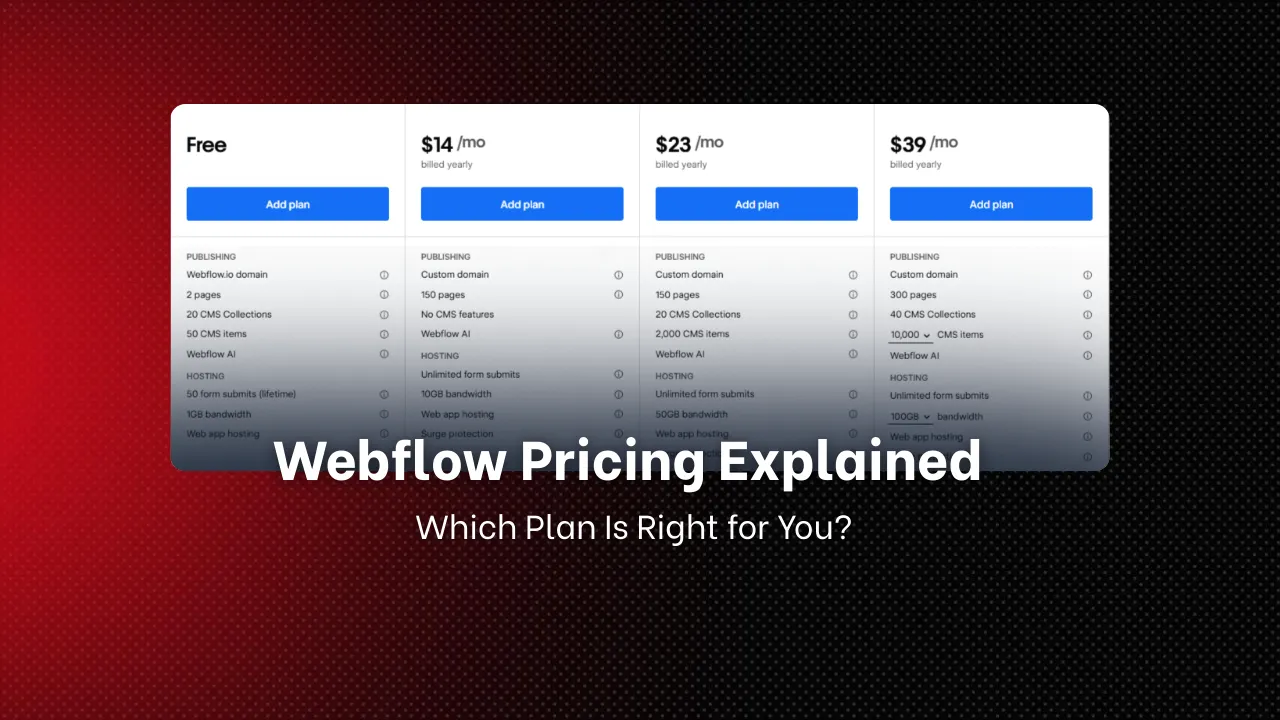
Sandeep Singh Sisodiya
February 4, 2026
This guide explains each Webflow plan in detail, including Basic, CMS, Business, and Ecommerce options, along with workspace plans for freelancers and agencies. It highlights key features, limitations, and ideal use cases to help readers avoid overpaying or choosing a plan that restricts growth.
Webflow has become one of the most powerful website building platforms for businesses that want complete design freedom without sacrificing performance or scalability. Unlike traditional website builders, Webflow combines visual design tools, a robust content management system, and enterprise grade hosting in a single platform. This makes it especially attractive for startups, growing companies, and digital teams that want more control over their online presence.
Despite its popularity, Webflow pricing is often misunderstood. Many users struggle to choose the right plan because Webflow offers multiple pricing layers, each designed for different use cases. Selecting the wrong plan can result in unnecessary costs or limitations that impact future growth.
This blog explains Webflow pricing in detail. You will learn how Webflow plans work, what each plan includes, and which option is best for your business goals. By the end, you will have complete clarity on how to choose a plan that fits your needs today and supports your growth tomorrow.
Webflow pricing is divided into two main categories. Understanding this structure is essential before selecting a plan.
Site plans are applied to individual websites. These plans include hosting, bandwidth, CMS capacity, traffic handling, and ecommerce functionality. A site plan is required when you want to publish a website on a custom domain.
Workspace plans are designed for individuals, freelancers, teams, and agencies. These plans control how many projects you can create, how teams collaborate, and how websites are handed off to clients.
In many cases, businesses use a combination of both. For example, a company may use a workspace plan for collaboration and a site plan for publishing the final website.
Webflow site plans are ideal for businesses that want reliable hosting, strong performance, and flexible content management.
The Basic plan is designed for static websites that do not require dynamic content or a CMS.
- Custom domain hosting
- SSL security
- Fast global hosting
- Up to 150 static pages
- Limited form submissions
- Personal websites
- Simple business websites
- Landing pages
- Portfolio sites
- No CMS functionality
- Not suitable for blogs or frequently updated content
The Basic plan is best when content changes are minimal and dynamic features are not required.
The CMS plan is one of the most commonly used Webflow plans and is ideal for content driven websites.
- Dynamic content collections
- Up to 2000 CMS items
- Advanced SEO controls
- Higher traffic capacity
- Custom domain and hosting
- Blogs and resource centers
- Service based business websites
- Marketing focused websites
- Content heavy company sites
- No ecommerce functionality
- CMS item limit may restrict large publishers
This plan is ideal for businesses that rely on content marketing and SEO as growth channels.
The Business plan is designed for websites that experience high traffic or rapid growth.
- Up to 10000 CMS items
- High bandwidth limits
- Advanced performance optimization
- Priority support
- Enterprise level hosting
- High traffic websites
- Fast growing startups
- Large content platforms
- Media and publishing websites
The Business plan offers scalability and stability for companies that cannot afford downtime or performance issues.
Webflow ecommerce plans are built for businesses selling products online. These plans include storefront management, checkout features, and payment processing.
The Standard plan is designed for small ecommerce stores.
- Up to 500 products
- Custom checkout experience
- Integrated CMS product management
- No additional transaction fees from Webflow
This plan is suitable for small brands and startups entering ecommerce.
The Plus plan supports growing ecommerce businesses.
- Up to 1000 products
- Advanced shipping rules
- Abandoned cart recovery
- Higher monthly order limits
This plan works well for brands that are scaling their online sales.
The Advanced plan is built for large ecommerce operations.
- Up to 3000 products
- High order volumes
- Advanced integrations
- Enterprise level performance
This plan is best for established ecommerce businesses with consistent sales volume.
Workspace plans are ideal for professionals building and managing multiple websites.
This is a free plan designed for learning and experimentation.
- Beginners
- Students
- Testing Webflow features
The Core plan is suitable for freelancers and small teams.
- More project slots
- Basic collaboration tools
- Client ready workflows
The Growth plan is designed for professional teams.
- Unlimited projects
- Advanced collaboration
- Improved client management
The Agency plan is built for professional teams and agencies.
- Team permissions
- White labeling
- Client handoff tools
- Advanced billing options
Many businesses working with a Webflow development agency prefer this plan due to its scalability and client management capabilities.
A Basic or CMS site plan paired with a Starter or Core workspace plan is usually sufficient.
A CMS or Business site plan provides the flexibility needed for growth and content marketing.
Choose an ecommerce plan based on product count and expected sales volume.
A Growth or Agency workspace plan combined with appropriate site plans is the most scalable option. Many companies collaborate with a Webflow development agency to ensure the setup aligns with long term business goals.
- Start with the minimum required plan
- Upgrade only when limits are reached
- Choose annual billing to reduce costs
- Regularly review unused features
- Consult a Webflow development agency when planning large scale migrations
- Overpaying for unused CMS capacity
- Choosing a Business plan too early
- Ignoring ecommerce product limits
- Misunderstanding workspace versus site plans
Webflow may seem expensive compared to basic website builders, but it replaces multiple tools including hosting, CMS, security, and performance optimization. For businesses focused on scalability, design control, and long term value, Webflow delivers a strong return on investment.
Working with a Webflow development agency can further improve efficiency by reducing setup errors and ensuring the platform is used to its full potential.
Webflow pricing is flexible and powerful when understood correctly. The key to choosing the right plan is aligning your current needs with future growth rather than selecting the most expensive option upfront.
Whether you are building a simple website, managing a content platform, or scaling an ecommerce store, Webflow offers a plan that fits your goals. With careful planning and the right expertise, Webflow can serve as a long term foundation for your digital presence.
He is the CEO of Appsrow and a Webflow leader based in Ahmedabad, India.
He leads strategy, growth, and overall business direction.
Yes, he actively contributes to the Webflow ecosystem in India.
SaaS, AI, and enterprise businesses.
Growth strategy, digital transformation, and conversion optimization.
By aligning website strategy with business goals and improving conversions.
From brand identity to Webflow development and marketing, we handle it all. Trusted by 300+ global startups and teams.
.webp)
.webp)
.webp)
.webp)