



June 11, 2026
# min


.webp)
The decision between Webflow and WordPress is one of the most consequential choices a B2B SaaS company will make in its early and mid stages of growth. Your website is not just a digital brochure. It is the first impression for enterprise buyers, the backdrop to your product demos, the platform for your content marketing engine, and often the last thing a prospect reviews before signing a contract. Getting the platform wrong means months of rebuilding, engineering debt, and missed pipeline. Getting it right means moving fast, converting efficiently, and scaling without friction.
As of 2026, both platforms have matured considerably, and the conversation has moved well beyond surface-level comparisons about ease of use or plugin availability. Webflow has grown into a genuinely powerful visual development environment with robust CMS capabilities, native animations, and an expanding ecosystem of integrations. WordPress, meanwhile, continues to power a staggering share of the internet and has doubled down on its block editor, site health tooling, and hosting ecosystem. Neither platform is going away, and neither is obviously superior for every use case.
What has changed is the type of team that succeeds on each platform. B2B SaaS companies are not typical websites. They need to move at startup speed, maintain brand precision that enterprise buyers expect, support aggressive SEO programs, integrate with complex marketing stacks, and often coordinate between marketing, design, and engineering teams who all have competing priorities. These requirements put a very specific lens on the Webflow versus WordPress question, and that lens reveals some genuinely surprising answers.
This comparison will walk through every dimension that matters for a B2B SaaS company: design and brand control, developer experience, content operations, SEO capabilities, performance, security, integrations, total cost of ownership, and the very real question of team fit. We will be honest about the limitations of both platforms and clear about the scenarios where each one wins. By the end, you should have a concrete answer for your specific company rather than a hedged non-recommendation that leaves you more confused than when you started.
Let us start with the most fundamental question: what kind of team do you actually have, and what kind of website do you actually need?
WordPress was built in 2003 as a blogging platform and has evolved over two decades into a general-purpose content management system. Its foundational philosophy is openness. Virtually every aspect of a WordPress site can be modified, replaced, or extended through its theme and plugin architecture. This openness is its greatest strength and its most significant liability. For a developer who knows the ecosystem well, WordPress can do nearly anything. For a marketing team without dedicated engineering support, WordPress can become an unpredictable system of dependencies that breaks at inconvenient moments.
Webflow was founded in 2013 with a fundamentally different philosophy: give designers the power to build production-ready websites without handing off to developers for every change. It is built on a visual canvas that generates clean HTML, CSS, and JavaScript. The trade-off is intentional constraint. Webflow is not infinitely extensible, but everything that works within its system works well, predictably, and without the plugin dependency hell that plagues many mature WordPress installations.
For B2B SaaS companies specifically, this philosophical difference has enormous practical consequences. Your marketing team will change headlines, swap hero sections, launch landing pages for campaigns, and update case study layouts on a weekly basis. The platform that enables this workflow without requiring a developer for each iteration has an enormous compounding advantage over time.
Brand precision matters enormously in B2B SaaS. Enterprise buyers make judgments about your company's reliability and attention to detail based on your website's visual polish. A misaligned button color, an inconsistent typeface hierarchy, or a layout that breaks on a 1440px monitor can erode confidence in a way that is hard to measure but very real in competitive deals.
Webflow gives designers pixel-level control over every element on the page. You can define global style variables, maintain consistent spacing scales, build reusable components called symbols, and enforce design systems that propagate changes across the entire site when updated. If your brand guidelines specify a 16px line height at 1rem with a specific letter-spacing on body copy, Webflow will maintain that precisely and permanently.
WordPress design control depends entirely on the theme and page builder you choose. With a custom theme built by an experienced developer, you can achieve comparable precision. With a commercial theme like Divi, Elementor, or Avada, you are working within that theme's design system, which may conflict with your brand guidelines in subtle ways. The more you customize, the more complex the theme becomes, and the more maintenance burden accumulates over time. Many B2B SaaS companies running WordPress eventually find themselves with a theme so heavily modified that updates from the theme vendor become risky or impossible.
For design-forward B2B SaaS brands that care deeply about visual execution, Webflow is the clear winner in this category.
WordPress has the most extensive developer ecosystem of any CMS on the planet. There are over 60,000 plugins in the official repository, a global community of developers, and decades of documentation covering virtually every use case imaginable. If you need a specific integration, a custom post type structure, a complex authentication flow, or a deeply custom checkout experience, WordPress can almost certainly accommodate it. The question is always whether the cost and complexity of building it are justified.
Webflow's developer story is more constrained but has improved meaningfully. Webflow Logic allows for basic conditional content, form routing, and simple automation without code. The Webflow API enables external systems to read and write CMS content programmatically, which opens up interesting possibilities for data-driven pages. Custom code can be injected at the page level or site level, meaning developers can augment Webflow with JavaScript, embed third-party scripts, and build interactions that go beyond the native toolkit. Webflow Apps, released in 2023 and expanded in 2024 and 2025, allow approved third-party extensions to integrate directly into the Webflow designer interface.
The honest answer is that WordPress wins on raw extensibility, particularly for complex or unconventional requirements. But many B2B SaaS websites do not need unconventional requirements. They need clean component architecture, reliable performance, and the ability for non-engineers to make changes safely. Webflow's constraints are often a feature rather than a limitation in this context.
It is worth noting that teams completing a wordpress to webflow migration often report significantly reduced maintenance overhead, with engineering time redirected away from platform upkeep and toward product work. This is not a universal experience, but it is a common one for companies that were previously running highly customized WordPress installations.
B2B SaaS content teams are typically publishing at high velocity. Blog posts, case studies, customer stories, product feature pages, comparison pages, integration pages, changelog entries, resource center content, and webinar landing pages all need to move quickly through production. The CMS that makes this workflow smooth and reliable is worth its weight in developer hours.
WordPress has a content editing experience that most writers and marketers know instinctively. The Gutenberg block editor, which has matured significantly since its rocky 2018 launch, provides a flexible writing interface with reusable blocks, custom block patterns, and a publishing workflow that includes draft, review, and scheduled states. WordPress also has excellent editorial workflow plugins like PublishPress that add approval flows, editorial calendars, and multi-author management for larger content teams.
Webflow's CMS editor has improved substantially and now offers an in-page editing experience that allows content editors to make changes while seeing exactly how the page looks in production. Collection items, which are Webflow's structured content type, allow for consistent schema-driven content like blog posts, case studies, or team members. The editor interface is clean and approachable for non-technical users, though it remains less familiar than WordPress to people who have spent years in publishing environments.
One meaningful limitation in Webflow is the CMS collection item limits. Depending on your plan, collection item counts are capped, which can become a constraint for large content libraries. Companies with tens of thousands of blog posts or product pages should evaluate this carefully before committing to Webflow. WordPress, running on your own infrastructure, has no such limits.
For most B2B SaaS companies producing hundreds or low thousands of content items, Webflow's CMS is entirely sufficient. For companies with very large existing content libraries or very high publishing volume, WordPress has an edge.
SEO is one of the most contested topics in the Webflow versus WordPress debate, largely because many of the assumptions people bring to this comparison are outdated. Let us address the most common ones directly.
WordPress with Yoast SEO or Rank Math has historically had the best SEO tooling of any CMS, and that remains true in certain dimensions. These plugins provide real-time on-page analysis, XML sitemap generation, schema markup controls, breadcrumb management, and canonical URL configuration that are deeply integrated into the content editing experience. For large content teams that want every writer to have immediate SEO feedback as they draft, this workflow is genuinely superior.
Webflow's native SEO controls cover all the fundamentals well. Title tags, meta descriptions, Open Graph settings, canonical URLs, 301 redirects, structured data markup, and XML sitemaps are all configurable without plugins or code. Webflow generates clean semantic HTML by default, which means the underlying code quality that Google evaluates is generally excellent out of the box. Pages built in Webflow tend to have strong Core Web Vitals performance as well, since Webflow serves assets through a global CDN and automatically handles image optimization for modern formats.
The reality for B2B SaaS SEO in 2026 is that technical SEO hygiene, page experience, and content quality matter far more than which plugin you use to edit your meta descriptions. Both platforms can support a serious SEO program. WordPress has richer tooling for teams that want it. Webflow has better default technical performance for teams that do not want to think about it. The choice here is more about workflow preference than capability.
Performance and security are areas where the platforms diverge significantly in their architecture, and these differences have real consequences for B2B SaaS companies.
Webflow is a hosted platform, meaning Webflow manages the infrastructure, server updates, SSL certificates, CDN configuration, and uptime. Your marketing team never needs to think about server patches, PHP version compatibility, or WordPress core update sequencing. Sites are delivered from Webflow's global CDN, which means consistently fast load times regardless of where your visitors are located. Security vulnerabilities are Webflow's problem, not yours. This is an enormous operational advantage for companies that do not have dedicated DevOps resources for their marketing website.
WordPress is self-hosted, meaning you are responsible for your hosting environment, server configuration, and keeping WordPress core, themes, and plugins updated. WordPress sites are by far the most commonly targeted websites for security attacks, largely because of their ubiquity. A WordPress site running outdated plugins or hosted on an under-resourced shared server is genuinely vulnerable. Managed WordPress hosting providers like WP Engine, Kinsta, and Flywheel have reduced this burden considerably by handling updates, providing security scanning, and offering performance-optimized server environments. But managed WordPress hosting comes at a cost, and the operational overhead never fully disappears.
For performance specifically, both platforms can achieve excellent Core Web Vitals scores with proper configuration. Webflow achieves this more automatically. WordPress requires deliberate work with caching plugins, image optimization tools, lazy loading configuration, and careful plugin management to avoid performance regressions. If your team has the engineering resources and expertise to maintain this configuration, WordPress performance can match Webflow. If your team does not, Webflow will be faster in practice.
B2B SaaS marketing teams run complex technology stacks. HubSpot or Marketo for marketing automation. Salesforce or HubSpot CRM for lead management. Clearbit or ZoomInfo for data enrichment. Segment or Rudderstack for analytics. Intercom or Drift for live chat. Hotjar or FullStory for session recording. The website needs to play nicely with all of these systems.
Both platforms handle most of these integrations through JavaScript snippets. Any tool that provides a tracking script or embed code can be added to Webflow or WordPress with equal ease. The meaningful differences emerge at the level of deeper, native integrations. WordPress has dedicated plugins for HubSpot, Salesforce, Mailchimp, and dozens of other common marketing tools, which can simplify configuration for non-technical users. Webflow integrates with many of these tools natively or through Zapier and Make, and its Logic feature handles simpler workflow automation without code.
For most B2B SaaS marketing stacks, both platforms will get the job done. The edge cases where WordPress pulls ahead are scenarios involving deeply custom integrations, complex form routing logic, or integrations with legacy systems that require custom API connections. In these cases, WordPress's open architecture and development community provide more options.
The cost comparison between Webflow and WordPress is more nuanced than it first appears, because the sticker price of each platform tells only part of the story.
Webflow pricing in 2026 runs from approximately $23 per month for a basic site plan up to $212 per month for enterprise-tier CMS plans, billed annually. There are no additional costs for hosting, SSL, CDN, or basic security. Third-party integrations through Webflow Apps vary in cost. Professional design and build work from a webflow development agency typically runs from $15,000 to $80,000 for a full B2B SaaS site depending on scope and complexity. Annual ongoing costs for editorial updates and minor improvements are generally lower than WordPress equivalents because the platform itself requires less maintenance.
WordPress software itself is free, but the true cost includes managed hosting at $30 to $300 per month depending on traffic and provider, premium plugins at $200 to $2,000 per year for a typical SaaS marketing stack, a premium theme or custom theme development at $5,000 to $40,000, and ongoing engineering time for maintenance, updates, and new feature development. Security incidents, which are unfortunately common on WordPress, can add significant unexpected costs. For a well-resourced company with internal WordPress expertise, the total cost can be competitive. For a company outsourcing all of this work, the costs often exceed Webflow equivalents over a three year horizon.
The key insight is that WordPress's free software cost is often an illusion. The real cost is the engineering and maintenance time required to run it well. Companies that have a dedicated WordPress developer on staff or a strong relationship with a WordPress agency can manage this cost effectively. Companies that are cobbling together maintenance from a part-time contractor and occasional internal help will find WordPress more expensive than Webflow in practice.
If you take nothing else from this comparison, take this: the best platform is the one your team will actually use effectively. Both Webflow and WordPress are capable platforms. The question is which one matches how your team actually works.
Webflow is the better choice if your team is primarily design-led, if your marketing team needs to make layout and visual changes independently without waiting on developers, if you are starting from scratch or rebuilding and want a clean modern foundation, if your content volume is in the hundreds rather than tens of thousands of items, if you do not have dedicated WordPress engineering resources, and if your brand identity and visual precision are core to how you compete in your market.
WordPress is the better choice if your team has existing WordPress expertise that would be expensive to retrain, if you have a very large existing content library that would be difficult to migrate, if you need deeply custom or unconventional functionality that falls outside Webflow's capabilities, if you have a dedicated WordPress developer or agency relationship that provides reliable support, and if your SEO program relies heavily on editorial-level optimization tooling like Yoast's real-time feedback.
The pattern that emerges consistently in the market is that early-stage and mid-stage B2B SaaS companies that are building or rebuilding choose Webflow at a high rate, while established companies with large WordPress installations and internal expertise tend to stay. This is rational behavior: the migration cost is real, and the operational advantages of Webflow are most apparent when you are building fresh rather than comparing against a mature, well-maintained WordPress site.
One factor that deserves its own dedicated discussion is iteration speed, because it has compounding effects on conversion rates and growth that are easy to underestimate at the start of a platform evaluation.
In B2B SaaS, your homepage messaging, your pricing page structure, your demo request flow, and your case study format are all hypotheses that need to be tested against real traffic. The team that can spin up a new landing page in two hours, test three variations of a hero section in a week, and restructure a pricing page based on sales feedback in a single afternoon has a structural advantage over a team that needs a two-week sprint to accomplish the same thing.
Webflow's visual editor, combined with its component and symbol system, makes this kind of rapid iteration genuinely accessible to designers and marketing managers without developer involvement for most changes. Adding a new section to a landing page, restructuring the navigation, or creating a new campaign-specific page can happen in an afternoon. WordPress with a page builder like Elementor can approximate this speed, but the visual editor often introduces additional CSS specificity conflicts, loading overhead, and unpredictable rendering behavior that slows things down in practice.
Over a 12 to 18 month period, the difference in iteration velocity between a well-configured Webflow site and a heavily customized WordPress site can translate to dozens more conversion experiments, meaningfully better positioning, and a website that is noticeably more aligned with current market conditions. This is one of the most undervalued arguments for Webflow in the B2B SaaS context.
For companies currently on WordPress that are evaluating a move, the migration question is where theory meets reality. A wordpress to webflow migration is not a trivial undertaking, and anyone who tells you otherwise is not being fully honest. The complexity depends heavily on the size of your content library, the sophistication of your current WordPress setup, the number of custom integrations you have built, and how carefully you need to preserve historical URLs and redirect chains.
For companies with fewer than 500 pages and a relatively standard WordPress setup, the migration is manageable over a period of six to twelve weeks with proper planning. Content can be exported from WordPress and imported into Webflow's CMS with some manual restructuring. Redirects can be managed through Webflow's redirect manager. The design rebuild is typically done from scratch, which is an opportunity to modernize the visual identity rather than a burden.
For companies with thousands of pages, complex taxonomies, multi-site WordPress networks, or deeply custom post type structures, the migration requires more careful planning and may not be justified by the benefits. In these cases, incremental approaches, such as migrating the marketing pages and new campaign work to Webflow while keeping the blog on WordPress, can deliver some of the benefits of each platform without the full migration risk.
After examining both platforms across every dimension that matters for a B2B SaaS website, the honest conclusion is that neither Webflow nor WordPress is universally superior. They are built on different philosophies, they serve different team compositions, and they reward different working styles. The question is not which platform is objectively better, but which platform is better for your company right now given your team, your content strategy, your budget, and your growth trajectory.
Webflow wins for design precision, operational simplicity, iteration speed, performance reliability, and security. It is particularly well-suited to companies with strong design cultures, marketing teams that need editorial independence, and organizations that want to minimize the engineering overhead associated with their marketing website. If you are building a new B2B SaaS website in 2026 and do not have strong internal reasons to choose WordPress, Webflow should be your default consideration.
WordPress wins for extensibility, content at scale, editorial workflow maturity, and scenarios where existing expertise and infrastructure make staying the rational choice. If your company has invested years in a WordPress ecosystem that is working well, has a large content library that is driving meaningful SEO traffic, and has reliable technical resources to maintain it, the case for migrating is weaker. WordPress can be an excellent B2B SaaS platform when it is managed well and kept modern.
The most common mistake companies make in this evaluation is choosing a platform based on what a blog post told them was industry standard rather than what their specific team will actually execute well on. A beautiful Webflow site that your marketing team can iterate on every week will outperform a technically superior WordPress site that requires a developer for every change and accumulates six months of backlogged requests. Conversely, a WordPress site maintained by a skilled dedicated team will outperform a Webflow site that nobody on the team knows how to use confidently.
Start your evaluation by mapping your actual workflows. Who makes changes to the website today? Who should be able to make changes without a developer? What is the biggest friction point in your current process? What does your content volume look like at a two-year horizon? What does your marketing team look like: design-led, content-led, or engineering-supported? These questions will point you toward the right answer more reliably than any feature comparison matrix.
The B2B SaaS website is a living asset that needs to evolve as quickly as your market does. In 2026, with buyer expectations at an all-time high and attention windows at an all-time low, the companies that win are the ones that can test, iterate, and improve faster than their competitors. The platform that enables that velocity for your specific team is the right platform. Everything else is secondary.
Take the time to run a meaningful pilot before committing. Build a section of your site in Webflow and measure how your team interacts with it. Audit your WordPress installation honestly, including total plugin count, last update dates, and engineering hours spent per month on maintenance. Talk to your marketing team about where they feel blocked. The right answer will emerge from that process. Trust it over the consensus of internet debates that were written for a different company in a different situation.
Your website is one of the most important growth assets your company owns. It deserves a platform decision made with the same rigor you apply to your product roadmap, your pricing strategy, and your go-to-market motion. Both Webflow and WordPress can serve you well. The question is which one will serve you best.
Webflow outperforms WordPress for B2B SaaS marketing sites because it delivers faster page speeds, cleaner code, no plugin vulnerabilities, and a visual editing experience that lets marketing teams update content without developer dependency. B2B SaaS companies benefit from Webflow's ability to create conversion-focused landing pages, integration-rich CMS structures, and pixel-perfect brand experiences. Appsrow specializes in building high-converting B2B SaaS websites on Webflow that outrank and outperform WordPress competitors.
WordPress retains advantages in scenarios requiring massive content archives, complex plugin ecosystems, or deep custom backend functionality that Webflow does not natively support. However, for marketing-focused B2B SaaS sites where design, speed, and conversion are the priorities, Webflow is almost always the superior choice in 2026. Appsrow has migrated dozens of B2B SaaS companies from WordPress to Webflow and can assess whether the switch makes sense for your specific situation.
Webflow wins the B2B SaaS marketing site comparison because it allows marketing teams to ship new landing pages and feature updates in hours rather than days, integrates natively with HubSpot, Intercom, and Segment for the full SaaS marketing stack, and produces 90+ PageSpeed scores by default that support both organic SEO and paid campaign performance. Appsrow specializes in B2B SaaS Webflow sites that are engineered for both conversion performance and marketing team autonomy.
A B2B SaaS Webflow site should include a conversion-focused homepage with a clear ICP-targeted value proposition, a solutions or use cases section showing product fit across buyer personas, a pricing page built in Webflow CMS for easy updates, an integration or tech stack page, a blog and resource center for SEO, and a case study library demonstrating measurable customer outcomes. Appsrow builds every B2B SaaS Webflow site with this proven information architecture that aligns with how SaaS buyers research and evaluate solutions.
Webflow integrates with the core B2B SaaS marketing stack including HubSpot for CRM and marketing automation, Intercom for customer messaging, Segment for analytics data routing, Clearbit for visitor enrichment, Google Analytics 4 for behavior tracking, and Hotjar for heatmaps and session recordings. All of these can be connected without custom development using embed codes or Tag Manager. Appsrow configures complete SaaS marketing stack integrations on Webflow sites, ensuring all your tools work together from day one of launch.
Migrating a B2B SaaS site from WordPress to Webflow typically takes four to eight weeks depending on content volume, number of pages, integration complexity, and whether a full redesign is included alongside the platform migration. The process includes content audit, URL mapping for SEO preservation, design rebuild in Webflow, integration setup, and thorough QA before go-live. Appsrow manages B2B SaaS WordPress to Webflow migrations end-to-end with zero SEO disruption and zero downtime using a carefully staged cutover process.
Webflow's CMS makes it easy for B2B SaaS marketing teams to maintain a high-frequency blog, publish customer case studies, update pricing and feature pages, and spin up new campaign landing pages without developer involvement. This marketing velocity is critical for SaaS companies that run continuous paid and organic campaigns requiring rapid iteration on landing page messaging. Appsrow builds Webflow CMS structures for B2B SaaS sites that are optimized for marketing team speed and self-sufficiency after launch.
The best B2B SaaS Webflow sites balance technical credibility signals like integration partner logos, security certifications, and API documentation links with emotional trust signals like founder stories, team photos, and genuine customer testimonials from recognizable companies. Getting both right simultaneously is what separates high-converting SaaS sites from mediocre ones. Appsrow designs B2B SaaS Webflow sites that strategically balance technical and emotional trust signals to convert skeptical enterprise buyers.
Transform your website with expert Webflow development
From brand identity to Webflow development and marketing, we handle it all. Trusted by 50+ global startups and teams.
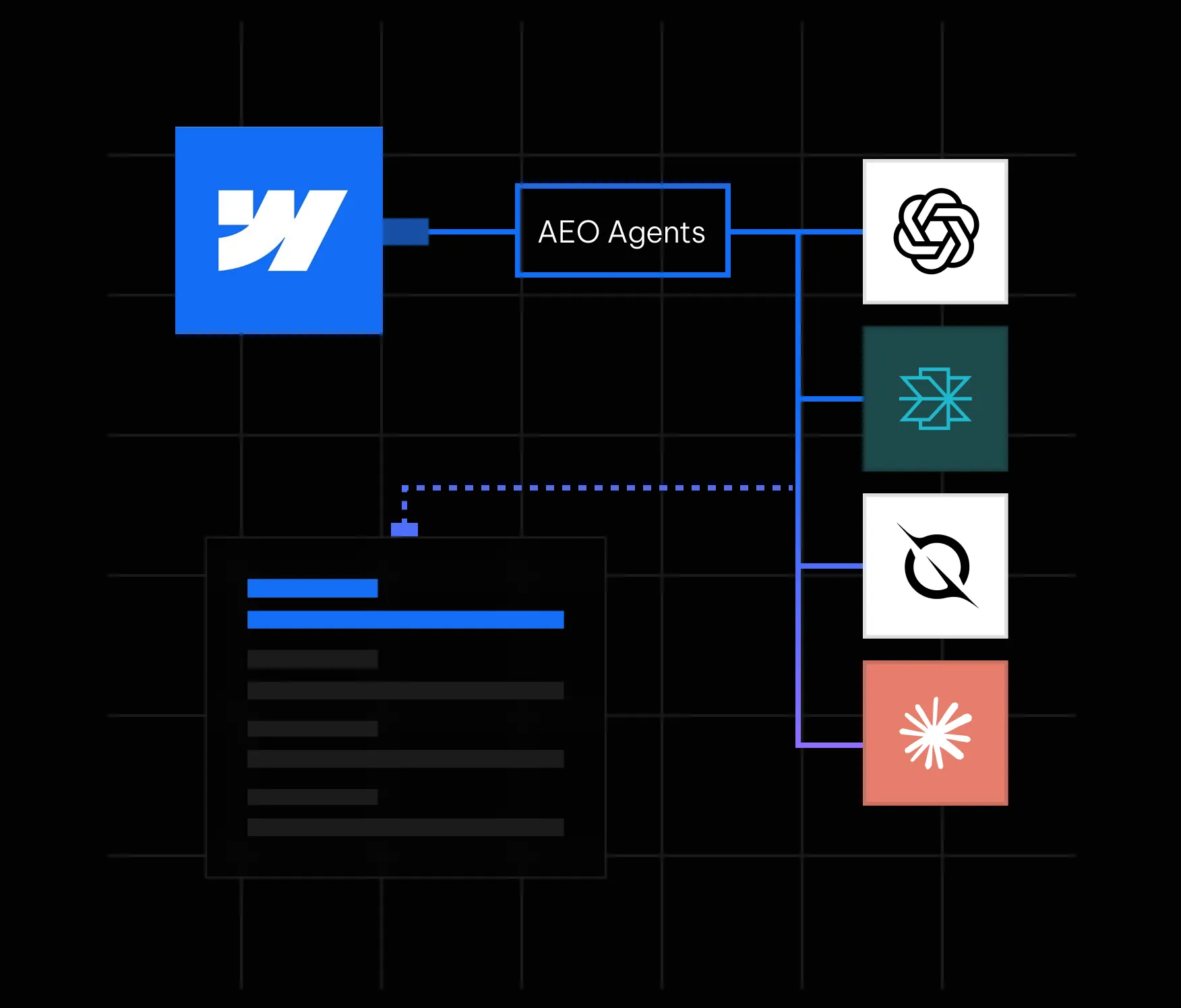
Here is something most marketing teams have started to notice: people are not always clicking search results anymore. They are asking ChatGPT, Perplexity, Google AI Overviews, and other AI-powered tools a question and getting a direct answer. No scrolling. No clicking. Just an answer, often with one or two brand citations buried inside it. If your brand is not one of those citations, you are functionally invisible to a growing segment of your audience, regardless of how well you rank on page one of Google.
This is the reality that answer engine optimization (AEO) addresses. And in May 2026, Webflow made it significantly easier to act on by launching AEO agents natively inside its platform. If your site is on Webflow, you now have one of the most powerful AEO toolsets available built directly into the same interface where your site lives. In this guide, we walk through everything you need to know: what Webflow AEO agents actually do, how the closed-loop system works, how to get started, and what best practices will help you earn consistent citations in AI answers.
Answer engine optimization is the practice of making your website content easy for AI systems to find, understand, and cite. Where traditional SEO focuses on ranking on a results page, AEO focuses on being the source that an AI tool references when it constructs a direct answer for a user.
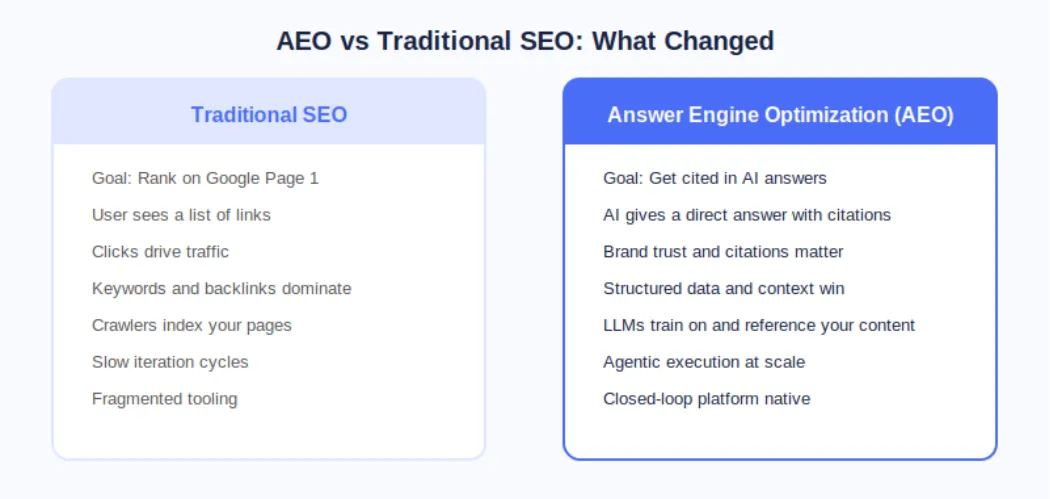
The distinction matters because AI answer engines operate fundamentally differently from search engines. A search engine crawls, indexes, and ranks pages. An AI answer engine does all of that, but it also synthesizes information and presents a curated response. The brands that show up are not necessarily the ones with the most backlinks; they are the ones whose content is structured, authoritative, technically clean, and contextually relevant to the question being asked.
According to Webflow's own research cited at launch, 93% of marketing leaders now consider AEO important for their brand. That number reflects a fundamental shift in how buyers discover and evaluate products and services before ever landing on a company website.
On May 21, 2026, Webflow made AEO agents generally available as part of its new Team and Enterprise Platform plans. This was a meaningful step beyond what most AEO tools offer because Webflow's agents do not just flag problems; they help you fix them at scale inside the same platform where your site is built and published.
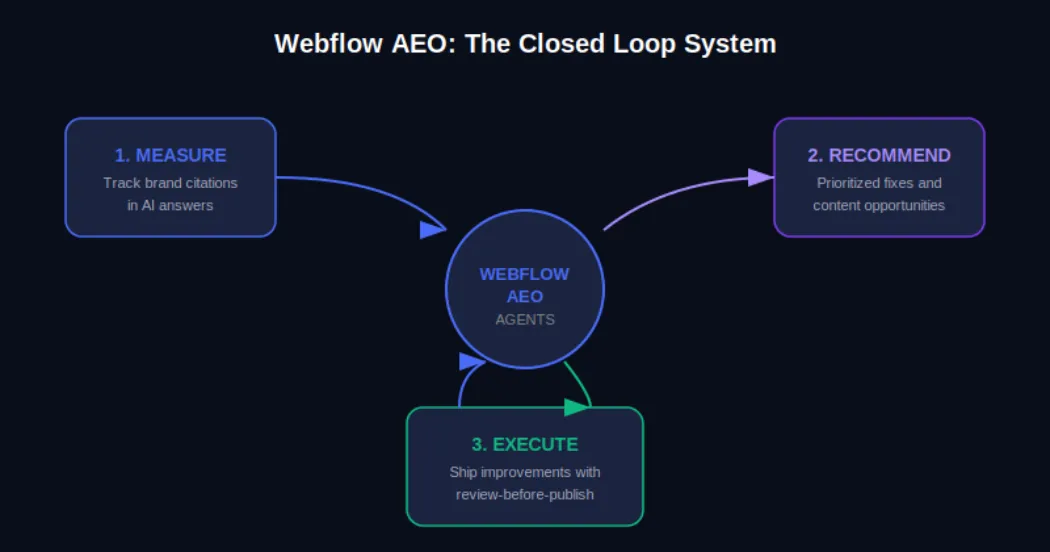
The Webflow AEO system operates around a closed loop with three distinct functions. First, it measures how your brand appears across AI answer engines. Second, it surfaces prioritized recommendations for improvement. Third, it helps your team execute those improvements and publish them directly from within Webflow, with a review step built in so nothing goes live without your approval.
AEO Analytics via Webflow Analyze: Teams can now track how often their brand is cited in AI answer engines, which prompts trigger those citations, and how AI-driven visibility connects to on-site engagement and conversions. No data instrumentation or separate analytics tool is required.
AEO Agents for Technical and Content Recommendations: The agents scan your Webflow site and surface a prioritized list of improvements, including broken links, outdated metadata, missing schema markup, and content gaps tied to the prompts you are actively tracking.
Review-Before-Publish Execution: Your team reviews each recommendation before anything changes on the live site. You can accept, edit, or dismiss suggestions individually or in bulk, and then publish directly from Webflow's centralized dashboard.
The Team plan bundles AEO agents alongside 10 seats, 100 CMS Collections, Localization, page branching, single-page publishing, publishing workflows, and 30TB of bandwidth. The Enterprise plan extends this further for larger organizations needing custom governance and dedicated support.
Webflow's own CPO Rachel Wolan described the launch this way: Webflow allows customers to work inside a system that already knows their brand, their voice, and what they are trying to say. The platform closes the loop between insight and shipped improvement automatically, so teams move from analysis to live changes without switching tools.
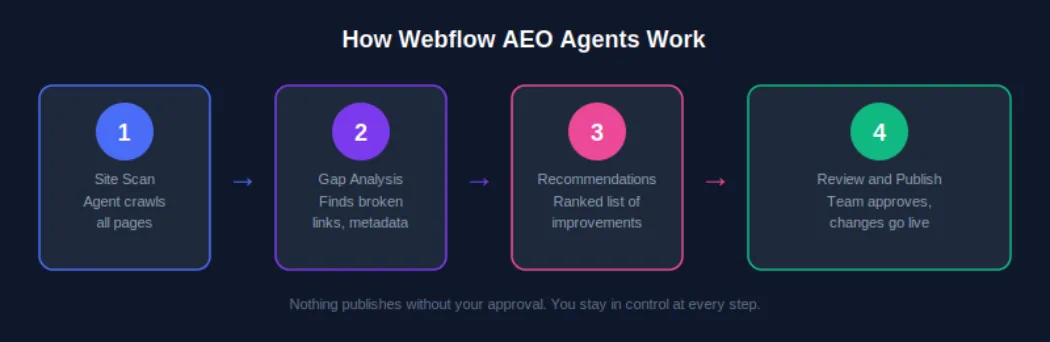
Understanding the mechanics of Webflow AEO agents helps you get more out of them from day one. Here is how the system moves from site scan to published improvement.
AEO agents require a Team or Enterprise Platform plan. Once you are on the correct plan, navigate to your Workspace settings and confirm that the Workspace AI toggle is enabled. This is the master switch that activates all Webflow AI features, including AEO agents. If you are managing multiple sites under one Workspace, enabling this once covers all sites under that plan.
Once AEO is activated, the agents perform an initial crawl of your site. This is not a surface-level check. The scan evaluates technical elements such as metadata completeness, schema markup presence, internal link health, and page structure, and it also assesses content-level signals like how clearly your pages answer specific question formats that AI systems are trained to respond to.
After the scan, you receive a ranked list of recommendations inside the Webflow dashboard. These are not generic suggestions. Because Webflow already holds your brand context, site structure, and content, the recommendations are specific to your pages and tied to the AI prompts you are tracking. A recommendation might be as straightforward as updating a meta description on a key service page, or as strategic as creating a new FAQ section for a product category that is generating AI-driven queries.
For each recommendation, your team has full control. You can accept it as-is, edit the suggested change before applying it, or dismiss it if it does not align with your brand voice or strategy. This step matters because AEO optimization is not purely mechanical; what reads well for an AI system also needs to read well for a human. Webflow's review step keeps your team in the editorial seat.
Once you have reviewed and approved changes, you can publish them individually or in bulk from the centralized view. For enterprise teams managing hundreds of pages, this bulk publishing capability is one of the most practically valuable aspects of the system. Work that previously required a developer or a week of manual edits can now be reviewed, approved, and live within a single session.
Executing AEO agent recommendations uses AI credits, which are now bundled with every Workspace plan from Core through Enterprise. Teams should monitor credit usage via the new AI usage dashboard, particularly after the credit enforcement window that began June 29, 2026. More details are available on the Webflow AEO overview page at Appsrow.
Measurement is where effective AEO strategy starts, and Webflow Analyze now provides the visibility data your team needs to understand where you stand in AI-generated search before you start optimizing.
From the Analyze dashboard, you can see which AI answer engines are sending traffic to your site, which prompts are triggering your brand citations, how citation frequency is changing over time, and how AI-driven traffic correlates with on-site engagement metrics like time on page and conversion events.
The practical value of this data is that it transforms AEO from a guessing game into an iterative improvement cycle. You can see what is working, identify gaps, feed those gaps back to your AEO agents as new prompt targets, and measure whether your changes produce the citation uplift you expected.
Webflow AEO agents handle the technical layer. The content layer is equally important, and it requires a deliberate writing strategy. AI systems do not just favor authoritative content; they favor content that is structured in a way that makes extraction and summarization easy.
Direct answer paragraphs: Lead each section with a clear, self-contained answer to the question the heading implies. If someone asks 'What is Webflow AEO?', your first paragraph should answer that in two to three sentences before elaborating.
FAQ sections: Structured question-and-answer formatting maps directly onto how AI systems construct responses. Every key landing page and blog post should have a FAQ section covering the most common queries in your topic area.
Listicles and how-to steps: Numbered steps and bulleted lists are among the most commonly extracted content formats in AI-generated answers. When describing processes, always default to structured list formats.
Expert opinion and proprietary data: AI systems increasingly favor sources that offer unique insight. Original research, survey data, case studies, and expert opinions are more likely to be cited than repackaged information that already exists at scale elsewhere.
Structured schema markup: FAQ schema, HowTo schema, Article schema, and Organization schema all help AI systems understand the structure and authority of your content. Webflow AEO agents will flag missing schema and suggest implementations, but having a proactive schema strategy speeds up your AEO results significantly.
For a deeper look at content strategy for AEO, see the Appsrow AEO content guide which covers format-specific tactics for B2B and B2C brands.
Content strategy matters, but AI systems will not reliably cite a site with significant technical issues. Webflow AEO agents surface technical problems as part of their initial scan, but understanding why these issues matter will help your team prioritize fixes intelligently.
Webflow's built-in AI SEO tools introduced at Webflow Conf 2025 already handle auto-generation of alt text, meta descriptions, and schema markup for many content types. Webflow AEO agents extend this by evaluating the output of those tools in the context of your current AEO performance and recommending targeted corrections. For a complete technical AEO checklist, explore the Appsrow technical AEO resources.
One of the less discussed but increasingly important aspects of AEO is entity recognition. AI systems do not just parse individual pages; they develop an understanding of what a brand is, what it does, who it serves, and what it is known for. The more consistently and clearly this information is represented across your site and across the web, the more likely AI systems are to treat your brand as a credible citation source.
Consistent brand descriptions: Every page that references your company should describe it in consistent terms. Your tagline, your core service description, and your value proposition should not vary significantly across your homepage, about page, and blog author bios.
Wikipedia and knowledge graph presence: For established brands, a Wikipedia page and Google Knowledge Graph listing are among the strongest authority signals for AI citation systems. If your brand does not yet have these, building toward them through press coverage and third-party mentions is a long-term AEO investment worth making.
Consistent NAP data: For local or regional businesses, Name, Address, and Phone consistency across directories, your Webflow site, and third-party citations builds the kind of entity coherence that AI systems use to verify brand legitimacy.
Author entity markup: If your team publishes content under named authors, adding Person schema and linking to author profiles with consistent credentials strengthens the E-E-A-T signals that AI systems use to evaluate content trustworthiness.
These brand signals take time to build, but the Webflow AEO agent recommendations will increasingly point you in this direction as your technical foundation strengthens. Track progress through the AEO analytics dashboard and measure citation growth month over month.
AEO agents are available on both the new Team and Enterprise Platform plans that Webflow launched in May 2026. Understanding what is included in each tier helps you plan the right investment for your team's scale.
The Team plan is Webflow's new mid-market offering designed for fast-growing teams that have outgrown self-serve plans but are not yet ready for a full Enterprise commitment. It is annual billing only and includes: AEO agents and AEO analytics, 10 seats, 100 CMS Collections, Localization, page branching, single-page publishing, publishing workflows, site activity log, custom SSL certificates, security headers, and 30TB of bandwidth. For teams managing a primary marketing site with a content team of five to ten contributors, the Team plan gives access to the full AEO agent system without requiring Enterprise-level negotiations.
Enterprise adds competitive AEO benchmarking, advanced governance controls, custom publishing workflows, dedicated support, and the ability to manage AEO across multiple sites at scale. For organizations with dozens or hundreds of pages across multiple properties, Enterprise is the tier where the closed-loop AEO system delivers its full value. Enterprise customers were also the first to access AEO in the initial rollout, meaning the system has been refined based on real-world usage at scale before broader availability.
To understand which plan makes sense for your team and how to structure your AEO deployment, the Appsrow Webflow consulting team offers a free AEO readiness assessment for brands considering the upgrade.
Do not try to optimize your entire site at once. Identify the five to ten pages that address the questions your ideal customers are most likely to ask AI tools, typically your homepage, key service or product pages, and your most trafficked blog posts. Run AEO agent recommendations on those first, implement the changes, and measure the citation impact before expanding to the full site.
Webflow AEO analytics tracks which prompts trigger your brand citations. Make sure you are actively tracking the prompts that matter most to your business, not just broad category keywords. For a B2B software company, the difference between tracking 'project management software' and 'best project management software for remote engineering teams' is the difference between vanity metrics and pipeline-relevant visibility.
AEO is not a one-time setup. AI systems update their training data and citation algorithms regularly. Plan a monthly review of your AEO analytics data, run a fresh agent scan, and process new recommendations. Teams that build this into their regular content operations cadence see compounding citation growth over time rather than a one-time spike followed by stagnation.
Every new piece of content you publish should be evaluated through an AEO lens before it goes live. Webflow AEO agents will catch technical issues after publication, but building AEO-friendly structure, FAQ sections, and schema markup into your content creation workflow reduces the remediation work significantly. For practical templates and workflows, see the Appsrow AEO content playbook.
Enterprise customers have access to competitive AEO benchmarking inside Webflow Analyze. Use this to identify specific prompts where competitors are earning citations that you are not. These gaps represent the highest-value content and technical optimization opportunities because they confirm there is an AI-generated audience for that topic and that your competitors are already capturing it.
Several standalone AEO tools have emerged alongside the shift toward AI-mediated search. Most operate as separate analytics dashboards that identify citation gaps and recommend content changes. What makes Webflow AEO different is the native closed loop.
Standalone tools typically require you to export their recommendations, translate them into actionable tasks, hand them off to a developer or content editor, wait for changes to be made in your CMS, and then re-import analytics to measure the result. Each of those handoffs is a friction point where execution slows down or breaks entirely.
Because Webflow AEO operates inside the platform that already holds your site, content, and brand context, the step from recommendation to published change is compressed into a single review-and-publish action. For teams that are already using Webflow, this is a structurally meaningful advantage over any external tool that requires platform switching.
Adobe LLM Optimizer, announced at Adobe Summit 2026, offers a comparable agentic approach for Adobe Experience Manager customers. For brands not on Webflow, that may be a relevant alternative. For Webflow users, the native integration makes the comparison straightforward. Explore more at appsrow.com/blog/webflow-aeo.
The May 2026 launch is a foundation, not a ceiling. Based on Webflow's stated platform roadmap and the direction of the AEO market, several developments are worth watching.
Stay current on Webflow AEO developments by following the Appsrow Webflow and AEO blog where we publish regular updates on Webflow platform changes and AEO strategy.
AI-generated answers are already shaping how buyers discover, evaluate, and choose brands. The question is not whether AEO matters for your business; that was settled when 93% of marketing leaders told Webflow it does. The question is whether your team has the tools and the execution speed to act on it.
Webflow's May 2026 launch of native AEO agents removes the most common obstacle: the gap between knowing what to fix and being able to fix it at scale. For Webflow users on Team or Enterprise plans, the closed-loop system is available now. The brands that start building their AEO presence today are the ones that will dominate AI-generated citations when those citations become the primary discovery channel for their category.
If you are ready to start showing up in AI answers, the first step is understanding where you stand today. The Appsrow AEO readiness guide gives you a clear picture of your current citation presence, your technical gaps, and the highest-impact actions to take with Webflow AEO agents.
There is a moment every marketer remembers: the first time they asked ChatGPT for a product recommendation and realised, with a jolt, that their brand was nowhere in the answer. No link. No mention. Just someone else getting the citation. If that moment has not happened to you yet, it will. Search is no longer just Google. It is a constellation of AI engines, answer systems, and generative interfaces that are collectively absorbing more than 65% of queries without ever sending a user to a website (Similarweb, 2025). For Webflow site owners, this is both a warning and an opportunity.
The opportunity is real. Webflow's own SEO team publicly reported that 8% of all new signups now come from AI search as of June 2025, up from just 2% in October 2024. A fourfold increase in eight months is not a rounding error. It is a channel shift, and the teams who respond earliest will capture territory that takes years for late movers to reclaim.
This guide is your complete roadmap for Generative Engine Optimization on Webflow. We cover the strategy, the technical architecture, the content frameworks, and the measurement systems. We also share how Appsrow, a Webflow Premium Partner with 300+ projects delivered, approaches GEO implementation for clients from early-stage SaaS startups to scaling enterprises. By the end, you will have a clear plan, not just a reading list.
Generative Engine Optimization (GEO) is the discipline of structuring your website, content, and digital presence so that AI systems, including ChatGPT, Perplexity, Google AI Overviews, Claude, and Microsoft Copilot, understand, trust, and cite your brand when answering relevant user queries.
Traditional SEO is fundamentally about signals to a ranking algorithm: keywords, backlinks, crawlability, page speed. GEO adds a different layer. AI systems do not rank pages in a list; they synthesise answers from multiple sources and credit the ones they trust most. Getting cited requires something closer to authority-building and source hygiene than classic on-page optimisation.
Webflow GEO specifically refers to the implementation of these principles inside Webflow's visual development environment, using its native features (semantic HTML output, CMS, custom code embed, schema markup tooling) in combination with content strategy and off-site authority signals.
The numbers from 2024 to 2026 tell a clear story. Here are the figures that matter most:
Perhaps the most telling data point comes from research by GEO firm Brandlight: the overlap between top Google links and AI-cited sources has dropped from 70% to below 20%. Ranking on Google no longer guarantees a seat at the AI table. These are two separate games now, and you need to play both.
Most platforms require you to fight their technical defaults before you can optimise for AI. Webflow does the opposite. Its architecture produces clean, semantic HTML by default, which is exactly what AI retrieval systems need to parse and trust your content. Here is why Webflow gives you a structural head start.
AI engines, like search engine crawlers, rely on HTML semantics to understand the hierarchy and meaning of your content. When you use headings correctly in Webflow (H1 for the page title, H2 for major sections, H3 for subsections), the platform writes valid HTML that LLMs can parse into a coherent knowledge structure. Unlike WordPress with its plugin conflicts, or page builders that wrap everything in nested divs, Webflow's output is honest markup.
This matters because LLMs are statistically 28 to 40% more likely to cite content with clear hierarchical structure (HubSpot GEO Statistics, 2026). A Webflow site built with discipline is already ahead of the majority of the web on this dimension.
In April 2026, Webflow launched a native schema markup tool with AI-generation capability, directly inside Page Settings. You can now generate contextually relevant JSON-LD structured data for any page with a single click, then refine it and bind it to CMS fields for dynamic collection pages. This makes schema implementation at scale dramatically more accessible than custom code-only approaches.
Webflow also launched its closed-loop AEO system in April 2026, which tracks brand citations across answer engines, surfaces prioritised optimisation recommendations, and lets teams ship those improvements directly in the platform. When a tool of this scale adds these capabilities, it signals that GEO has moved from experimental to foundational.
Webflow hosts on a global CDN with automatic asset compression, clean CSS output, and lazy loading. These are not cosmetic benefits. AI platforms prefer content that is 25.7% fresher than content cited in traditional search (Dataslayer, 2025), and they tend to favour fast, consistently available pages. Core Web Vitals are a proxy for trustworthiness, and Webflow sites routinely score in the top quartile out of the box.
For a deeper technical breakdown of how Webflow's architecture supports AI visibility, the Webflow University schema markup guide is an excellent reference alongside this article.
GEO is not a single tactic. It is a system. Each pillar below addresses a different layer of how AI systems discover, evaluate, and cite your site. Miss one, and the whole structure weakens. Master all seven, and you build a compounding advantage that most competitors will not replicate quickly.
The first and most important pillar is your content structure. AI engines scan for clarity: a clear question, a direct answer, supporting evidence, and a logical hierarchy. If your content is written the way a good consultant answers a question, you are most of the way there.
Specifically, this means:
One pattern that consistently outperforms is the question-and-answer paragraph structure. Write a bold question as a short subheading, then answer it in two to three sentences. Repeat. This is not only excellent for human readers; it maps directly to how retrieval-augmented generation (RAG) systems chunk and index your content.
Schema markup is the technical vocabulary AI systems use to extract machine-readable facts from your pages. A study cited by Digidop shows GPT-4's content extraction accuracy jumps from 16% to 54% when structured data is present. That is a staggering delta, and it represents one of the highest-ROI technical investments available to a Webflow site owner.
The schema types with the greatest impact on GEO are:
In Webflow, static schema goes in the custom code section of Page Settings. Dynamic schema for CMS collection pages requires binding schema properties to CMS fields, which Finsweet's Webflow SEO guide covers in detail. Always validate your implementation with Google's Rich Results Test before publishing.
Experience, Expertise, Authoritativeness, and Trustworthiness (E-E-A-T) is Google's framework, but it maps directly to what AI engines look for in a citable source. AI systems are trained to distinguish authoritative voices from generic content farms, and the signals are remarkably similar to what a careful human editor would look for.
Building E-E-A-T on a Webflow site means:
FAQs deserve their own pillar because they are disproportionately powerful in GEO. Generative engines are fundamentally question-answering machines. When your content is structured as well-formed questions and concise answers, and those questions match the phrasing real users type, the alignment between user intent and your content is nearly perfect.
Reddit saw a 450% increase in AI citations between March and June 2025, according to HubSpot's GEO statistics. The reason is structural: Reddit threads are already formatted as questions and answers. You can replicate this format intentionally in a far more authoritative context.
Best practices for FAQ architecture in Webflow GEO:
In 2024, a community standard emerged for helping AI systems understand which pages on your site are most relevant for training and retrieval: the llms.txt file. Placed at the root of your domain (e.g., yourdomain.com/llms.txt), it provides a structured index of your most important pages, written in plain language, along with brief descriptions of what each page covers.
Think of it as a sitemap, but written for language models rather than crawlers. The format is simple: a brief introduction to your brand, followed by a list of URLs and one-sentence descriptions of the content at each URL. It is optional, but as AI systems increasingly support it, early adoption signals that your site is prepared for machine understanding.
In Webflow, you can host an llms.txt file by creating a static page at /llms.txt using a Page Embed or by uploading it as an asset. For implementation guidance, AppsRow's AEO services page includes llms.txt setup as a core part of their technical GEO implementation framework.
Performance is trust. AI systems and their users share the same expectation: a page that loads slowly, shifts during load, or responds sluggishly to interaction signals unreliability. Core Web Vitals are measurable proxies for that trustworthiness, and they matter for GEO just as they do for traditional SEO.
For Webflow sites, the key technical GEO performance tasks are:
A technically clean Webflow build will outperform a WordPress site burdened with plugin overhead on most of these metrics without requiring ongoing intervention. This is one reason Webflow clients tend to see GEO gains faster after initial optimisation.
AI systems do not only read your website. They synthesise information from across the web to form a picture of who you are and whether you can be trusted. Your off-site presence is part of your GEO stack.
The channels that most reliably feed AI knowledge graphs include:
AppsRow is a Webflow Premium Partner and Webflow Global Leader based in Ahmedabad, India, with 8 years of digital expertise and more than 300 projects delivered across SaaS, AI, healthcare, manufacturing, and e-commerce. Their clients include early-stage funded startups and scaling enterprises across the US, UK, and Europe. The agency holds a 4.8-star client rating.
What distinguishes AppsRow's approach to GEO is that it is not theoretical. As a full-service team that combines design, development, and marketing under one roof, they build the technical foundations that AI discovery depends on from the ground up. GEO is not a retrofit; it is part of the architecture from day one.
1. AI-Ready Technical Foundation
Every AppsRow Webflow build includes clean semantic HTML structure, proper heading hierarchy, and performance optimisation as baseline deliverables. Schema markup implementation covering Organization, FAQPage, Article, and Service types is standard. They also implement llms.txt during launch, ensuring the site is immediately navigable by AI retrieval systems.
2. Answer-First Content Architecture
AppsRow works with clients to restructure existing content and build new content using answer-first frameworks. This includes rewriting key service pages as question-and-answer formats, building comprehensive FAQ sections with proper FAQPage schema, and mapping content to the natural language queries their target audience asks AI systems.
3. E-E-A-T Authority Signals
The agency creates and optimises author pages for every content contributor, ensures NAP consistency across all directory listings, and implements the Organisation and Person schema types to build a coherent entity graph. For clients seeking deeper authority, AppsRow coordinates guest publishing and directory presence as part of their retainer services.
4. Webflow AEO Integration
AppsRow was among the first agencies to implement Webflow's native AEO system, launched in April 2026. They use it to monitor brand citation rates across ChatGPT, Perplexity, and Google AI Overviews, surface prioritised improvement recommendations, and track AI referral traffic through Google Analytics 4. This closes the measurement loop that most GEO implementations lack.
5. Ongoing Optimisation and Reporting
GEO is not a one-time project. AI models update their retrieval patterns, new engines emerge, and content freshness signals evolve. AppsRow offers retainer support that includes quarterly content audits, schema validation, Core Web Vitals monitoring, and AI citation tracking. For clients who want to go deeper, explore Appsrow's complete Webflow development services and their dedicated AEO and GEO optimisation offering.
'Our perspective on AEO is not theoretical. We build the technical foundations that AI discovery depends on: answer-first content architecture, structured data and schema implementation, llms.txt setup, clean and fast Webflow builds, and the kind of consistent entity and authority signals that help brands get cited.' That is how AppsRow describes their approach on their website, and it matches what their client outcomes consistently reflect.
Traditional SEO has Google Search Console. GEO does not yet have an equivalent single-pane dashboard, but the measurement landscape is maturing quickly. Here is how to track what matters.
Set up a custom channel group in GA4 to capture traffic from AI sources. The referral domains to track include: chat.openai.com, perplexity.ai, gemini.google.com, claude.ai, bing.com (which includes Copilot traffic), and you.com. Create a segment for these sources and monitor monthly sessions, conversion rate, and revenue contribution.
AI-sourced traffic currently converts at approximately 1.2 times the rate of organic search (WebFX, 2026). Users arrive with more context, more intent, and further through the decision process. Even a small volume of AI referral visits can have outsized revenue impact.
Once a month, test 10 to 15 queries that your ideal customer would realistically ask ChatGPT, Perplexity, and Google AI Overviews. Queries like 'best Webflow agencies for SaaS', 'how to optimise a Webflow site for AI search', or 'which agency should I use for Webflow AEO'. Record whether your brand appears, in what context, and with what framing. This qualitative audit complements the quantitative referral traffic data.
Use Google's Rich Results Test and Schema.org validator monthly to confirm your structured data is parsing correctly. A schema error can silently kill your AI citation potential without showing up in traffic reports until it is too late.
AI platforms prefer content that is demonstrably up to date. Set a quarterly calendar reminder to review your most important pages: update statistics to current figures, add new case studies, and refresh FAQ answers to reflect current best practices. Every update is a signal of active maintenance.
Webflow makes it easy to create stunning visual designs. It also makes it easy to use text elements styled to look like headings without actually being heading tags. If your H1 is a styled div and your visual hierarchy has nothing to do with your HTML hierarchy, AI engines see noise, not structure. Fix: audit your HTML output in browser DevTools and ensure your heading tags match your intended content hierarchy.
Schema that is added once and never validated becomes a liability. Webflow updates, CMS changes, and new page types can all break structured data without obvious visible symptoms. Fix: add schema validation to your quarterly content audit process.
GEO rewards content that answers questions the way a knowledgeable human would in conversation. Keyword-stuffed content that reads as if it was written for a 2015 search algorithm will not be cited by AI systems that have access to the entire web. Fix: rewrite your top 10 pages using the answer-first framework described in Pillar 1.
A Webflow site with perfect on-page GEO but no consistent off-site presence is a one-legged stool. AI systems triangulate authority across multiple sources. If your LinkedIn, Clutch profile, and Google Business Profile all say something different about your company, the AI cannot build a reliable entity entry. Fix: audit your brand presence across all major platforms and align your name, description, and category data.
Most teams discover their AI referral traffic is significant only after they have been ignoring it for six months. By that point, they have no baseline to measure improvement against. Fix: set up your GA4 AI channel group today, even before you begin any GEO optimisation. Data from the starting state is invaluable for demonstrating ROI later.
The search landscape of 2026 is not the landscape of 2023. The brands that appear in AI answers were not chosen randomly. They built authority, structured their content for machines as well as humans, implemented schema markup before it was fashionable, and published original research that gave AI systems something genuinely worth citing.
Webflow is an exceptional platform for this transition. Its clean output, native schema tools, performance infrastructure, and new AEO system give you a technical foundation that most platforms cannot match without significant custom engineering. The platform advantage is real. But it is only an advantage if you act on it.
The seven pillars covered in this guide, semantic content architecture, schema markup, E-E-A-T signals, FAQ architecture, llms.txt, Core Web Vitals, and multi-platform authority, are not a checklist to complete once. They are an ongoing practice. The teams that treat GEO as a compounding long-term investment will look back in two years and see a moat that took half a decade for competitors to cross.
If you are ready to implement Webflow GEO with expert support, Appsrow has delivered GEO-ready Webflow builds for 300+ clients across SaaS, AI, healthcare, and e-commerce. Their full-service team covers design, development, content architecture, and ongoing optimisation. Explore their Webflow AEO services or read their complete AEO guide to see the full scope of what is possible.
.webp)
A few years ago, ranking on page one of Google was the whole game. Today there is a quieter battle happening one layer up. When someone asks ChatGPT how to choose a VoIP provider, or asks Perplexity which Webflow agency handles enterprise builds, an answer appears in seconds. That answer was assembled from a handful of sources the model decided to trust. The question that should keep every marketing team awake is simple: was your site one of them?
We build and optimize Webflow sites for a living, and over the last year the single most common request we hear has shifted. It used to be "help us rank." Now it is "help us get cited." Those are related goals, but they are not the same goal, and the audit you run for one is not the audit you run for the other. This guide walks through exactly how we audit a Webflow site for AI-citation readiness, the checklist we work through page by page, and the 100-point scoring system we use to turn a vague feeling of "are we visible in AI" into a number you can act on and track over time.
Nothing here requires a developer to sit beside you. If you can edit pages in the Webflow Designer and read your own site critically, you can run this audit on a small site in an afternoon. Larger sites take longer, but the framework stays the same.
AI-citation readiness is the degree to which large language models and answer engines can find your content, understand it, trust it, and quote it as a source. It sits next to traditional SEO but pulls in a few extra concerns. A page can rank perfectly well in classic search yet never get pulled into an AI answer, because the model could not extract a clean, self-contained claim from it, or could not verify who wrote it, or could not parse the page at all.
Answer engines such as ChatGPT Search, Perplexity, Google AI Overviews, and Gemini do not read pages the way a human visitor does. They favor content that states a claim plainly, supports it with evidence, and is wrapped in signals that vouch for its credibility. Readiness, then, is less about keyword density and more about clarity, structure, and trust. The audit below measures all three.
It helps to separate two ideas. Visibility is whether an engine can technically access and read your page. Citability is whether, having read it, the engine considers your page worth quoting over the dozens of alternatives it also read. A complete audit grades both, because a flawless trust profile means nothing if a crawler cannot reach the page, and perfect crawlability means nothing if the content is too vague to lift.
Webflow gives you an unusual amount of control over the exact HTML that ships to a crawler, which is a genuine advantage for AI citation. You can set clean semantic headings, add custom meta and schema in page settings, control your sitemap, and publish a tidy URL structure without fighting a plugin ecosystem. Teams that use Webflow well tend to produce lean, fast, well-structured pages, which is precisely what answer engines reward.
The flip side is that the same flexibility lets problems hide in plain sight. Rich Webflow interactions can bury text inside elements that render awkwardly for extraction. Designers sometimes style a visual heading with a plain div instead of a real heading tag, so the document outline a model reads does not match what a human sees. CMS collection pages can ship without per-item schema. None of this is unique to Webflow, but it surfaces in a recognisable pattern, which is why a generic checklist tends to miss it. If you would rather hand the fixes to a specialist team, our Webflow development services cover the technical work this audit uncovers.
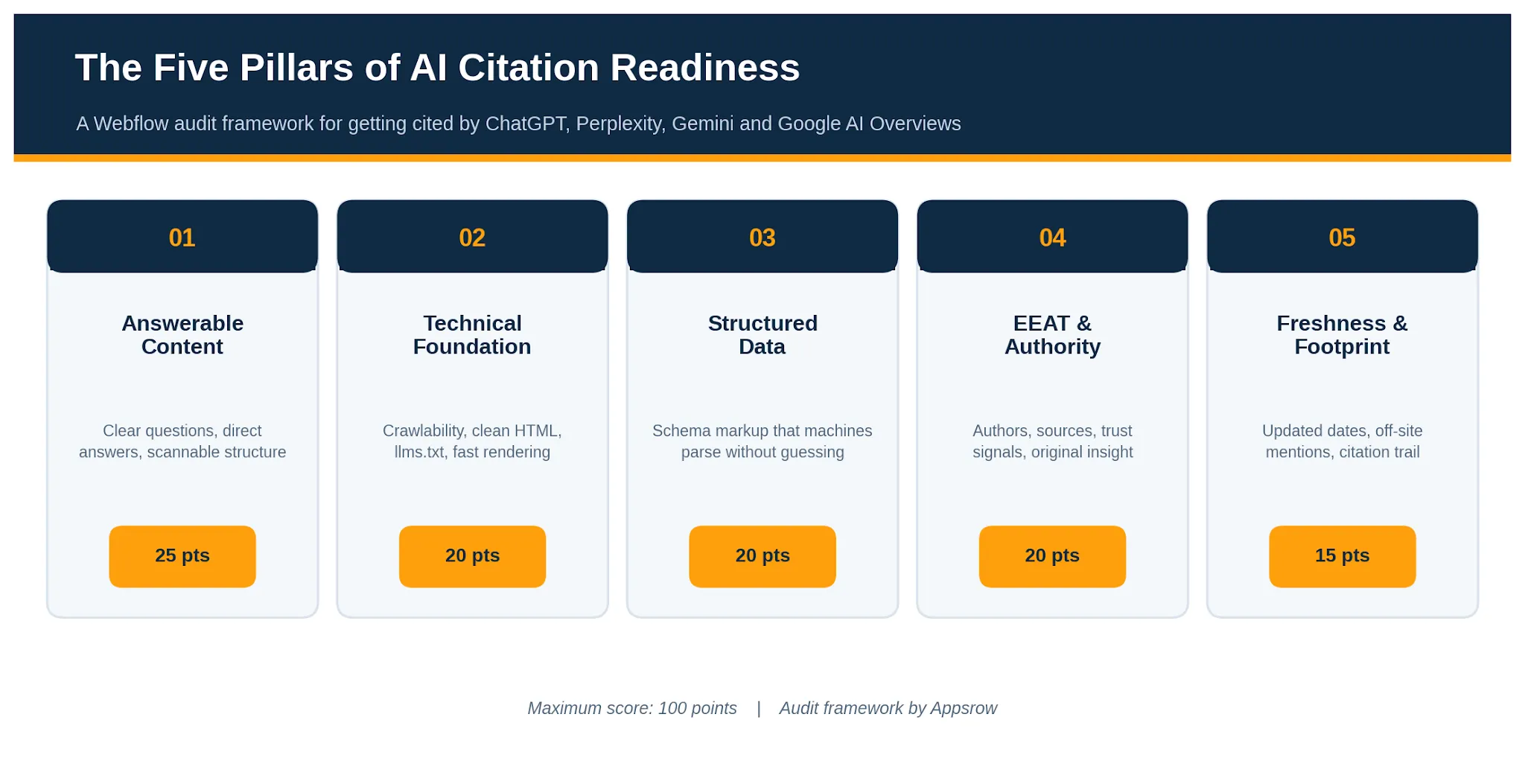
We grade every page, and the site as a whole, across five pillars. Each pillar carries a fixed weight, and the weights reflect how much each factor moves the needle on getting cited rather than merely indexed. The result is a single score out of 100 that tells you where you stand and, just as usefully, where to spend your next hour of effort.
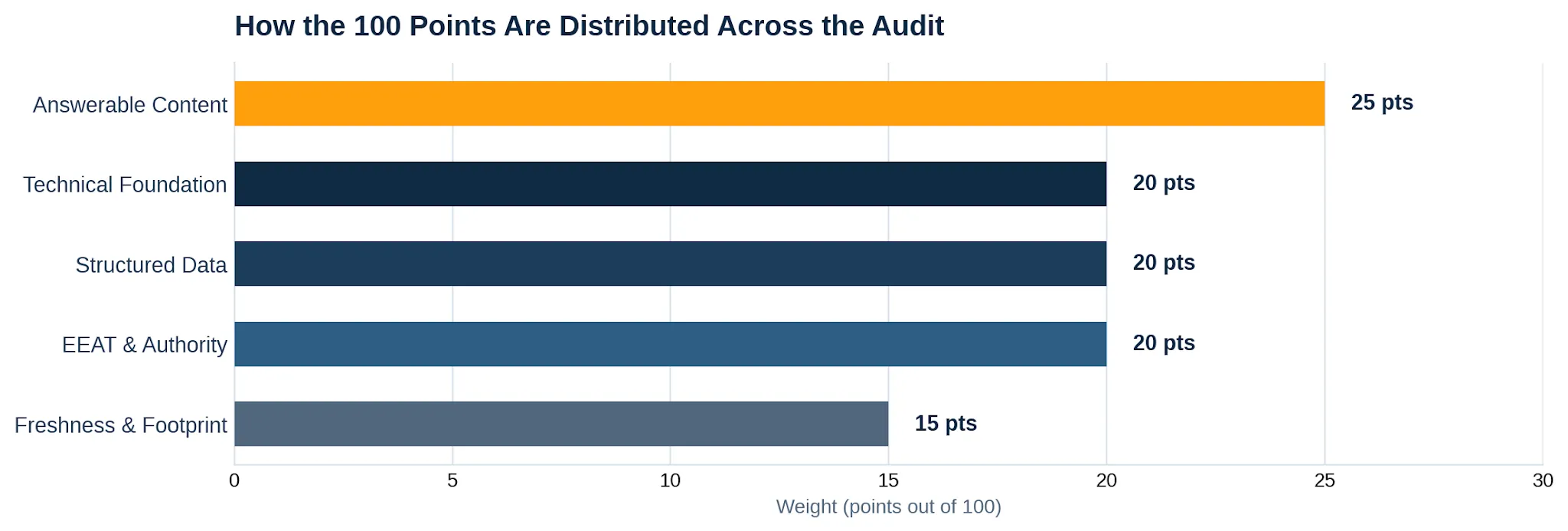
This is the heaviest pillar because it is the one most teams get wrong. Answer engines lift self-contained statements. If your page makes a reader assemble the answer from three scattered paragraphs, a model will usually skip it in favor of a competitor who said the same thing in one clean sentence. The goal is to write so that any single passage, read in isolation, still makes sense and still answers a real question.
Practically, that means leading with the answer and then supporting it, rather than building up to it. It means phrasing subheadings as the questions people actually ask. It means short, declarative claims with concrete numbers, names, and dates that a model can quote without ambiguity. Walls of qualifier-heavy prose are hard to extract, so trim them.
Work through this scored checklist for your most important pages:
If a crawler cannot reach or render your content, nothing else matters. This pillar checks that your Webflow site is open, fast, and legible to the bots that feed answer engines. Most of these checks take minutes, and most failures are quick fixes once you find them.
Start with access. Confirm your robots settings are not accidentally blocking AI crawlers, that your sitemap is published and current, and that important pages return a clean status without redirect chains. Then check legibility: real heading tags in the right order, descriptive alt text, and text that lives in the HTML rather than locked inside an image or a script-dependent interaction.
A newer signal worth adding is an llms.txt file, a plain-text map that points models to your most important content. It is easy to publish on Webflow and we treat it as a low-effort, high-clarity win. For the broader picture of how these technical signals fit together, our guide to answer engine optimization walks through the full stack.
Schema markup is how you tell a machine what your content is without making it guess. A model that can read explicit Article, FAQPage, Organization, and Author markup spends less effort interpreting your page and more confidence trusting it. On Webflow you can add JSON-LD in the page settings of static pages and bind dynamic fields on CMS templates, so even a large blog or product catalogue can carry per-item schema.
The common failure is partial coverage: a homepage with Organization schema but blog posts with nothing, or an FAQ section on the page with no matching FAQPage markup behind it. Aim for consistency. Every content page should declare what it is, who published it, and when.
If hand-writing JSON-LD across a CMS feels fragile, automating it is worth the setup. We cover that in our Webflow schema markup service, which keeps structured data in sync as content changes.
Experience, Expertise, Authoritativeness, and Trust are not abstract virtues here. They are the signals an answer engine uses to decide whether your claim is safe to repeat. A model is far more likely to cite a page that names a real author with relevant credentials, links to primary sources, and is published by an organization with a verifiable identity than an anonymous page making the same assertion.
Experience shows up as first-hand detail: original data, real screenshots, lessons from actual projects rather than recycled summaries. Expertise shows up in author bios and the depth of the writing. Authoritativeness comes from how others reference you. Trust comes from the boring but essential things: a clear about page, contact details, accurate citations, and honest, current information.
This is also where original assets matter. Custom diagrams, data, and even tasteful Lottie animations signal a page made by people who invested in it, not a thin reproduction. To learn how we operationalise these trust signals as a service, see our Webflow technical SEO page.
Answer engines lean toward recent, corroborated information. A page that was accurate in 2023 and never touched since reads as stale, and a claim that appears only on your own site is harder for a model to trust than one echoed across several reputable places. This pillar grades both how current your content looks and how widely your name travels.
Freshness is partly real and partly signalled. Genuinely update pages when facts change, and make sure the update is visible through dated content and accurate schema timestamps. Footprint is the harder, slower work: getting mentioned, linked, and quoted on sites the models already trust, so that when they assemble an answer your name keeps appearing from more than one direction.
Add the five subtotals for a single page, or average them across a representative sample of pages for a site-level view. The result lands in one of four bands. The bands are deliberately blunt, because the point is to trigger action, not to admire a decimal.
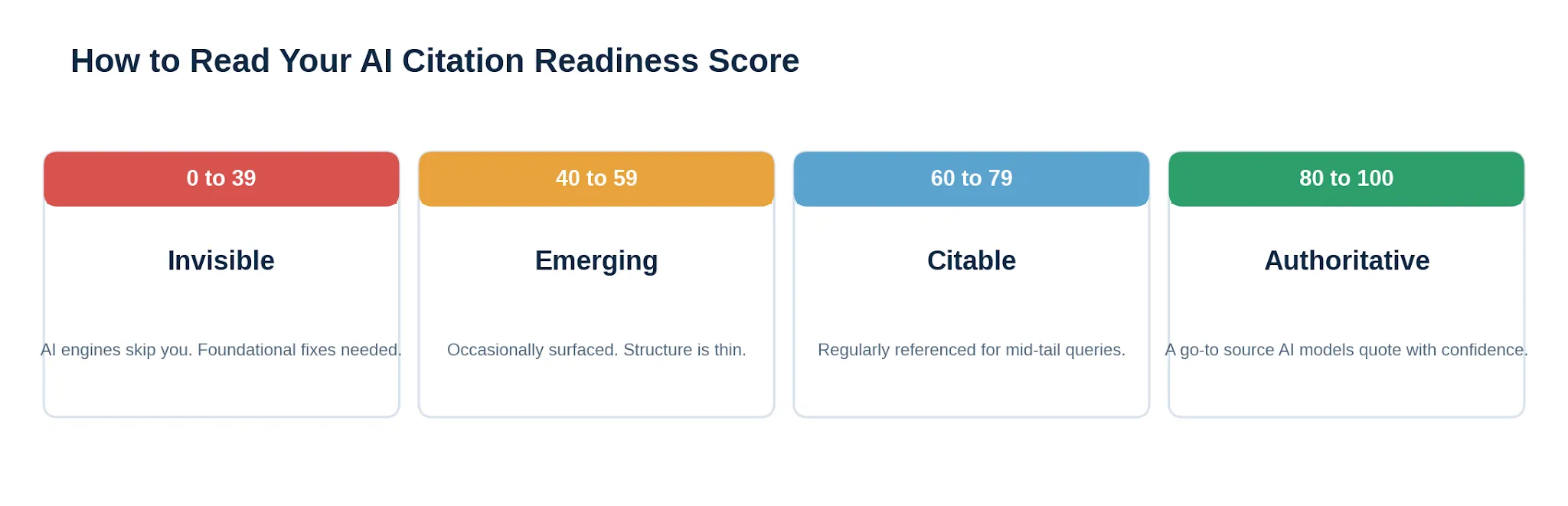
Most sites we audit for the first time land in the 40 to 59 band. They have solid content and decent SEO, but their claims are not quite quotable, their schema is patchy, and their authorship is thin. The encouraging part is that moving from Emerging to Citable rarely requires new content. It usually means sharpening what already exists: tightening answers, adding author bios, and filling schema gaps. The audit shows you exactly which of those moves earns the most points for the least effort.
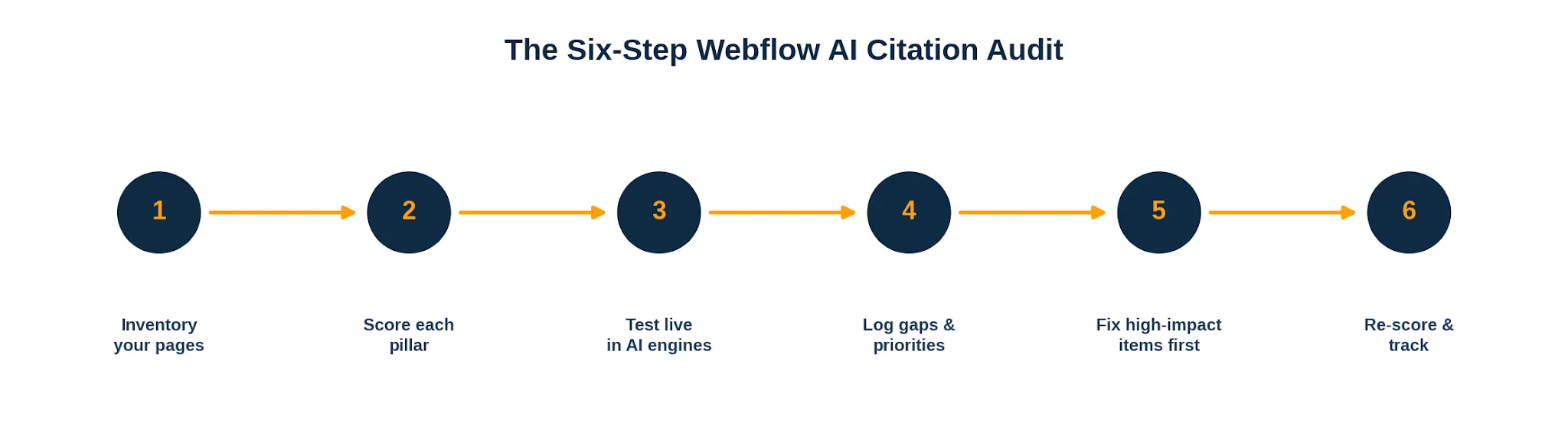
A handful of issues come up again and again, and knowing them in advance saves you a full audit cycle.
A score is only useful if it changes what you do next. Treat the number as a baseline, fix the highest-weighted gaps first, and re-measure in ninety days. If you would rather not run this manually across a large site, that is squarely the kind of work we take on, from the technical fixes to the content sharpening to the schema automation. The framework stays the same whether you run it yourself or hand it over.
From brand identity to Webflow development and marketing, we handle it all. Trusted by 300+ global startups and teams.


