

.png)
October 12, 2026
12 mins read
Webflow Global Tag Styles in Libraries: Benefits and Guide (2026)

Explore appsrow with AI
Search is no longer just a list of blue links. When someone asks ChatGPT, Google AI Overviews, Perplexity, or Claude a question today, they often get a direct answer, with only a handful of websites quoted as the source. If your website isn't one of the sites being cited, you are effectively invisible to a growing share of your audience, no matter how well you rank in traditional search results. This shift has created a new discipline called Answer Engine Optimization, or AEO, and it is quickly becoming as important as classic SEO.
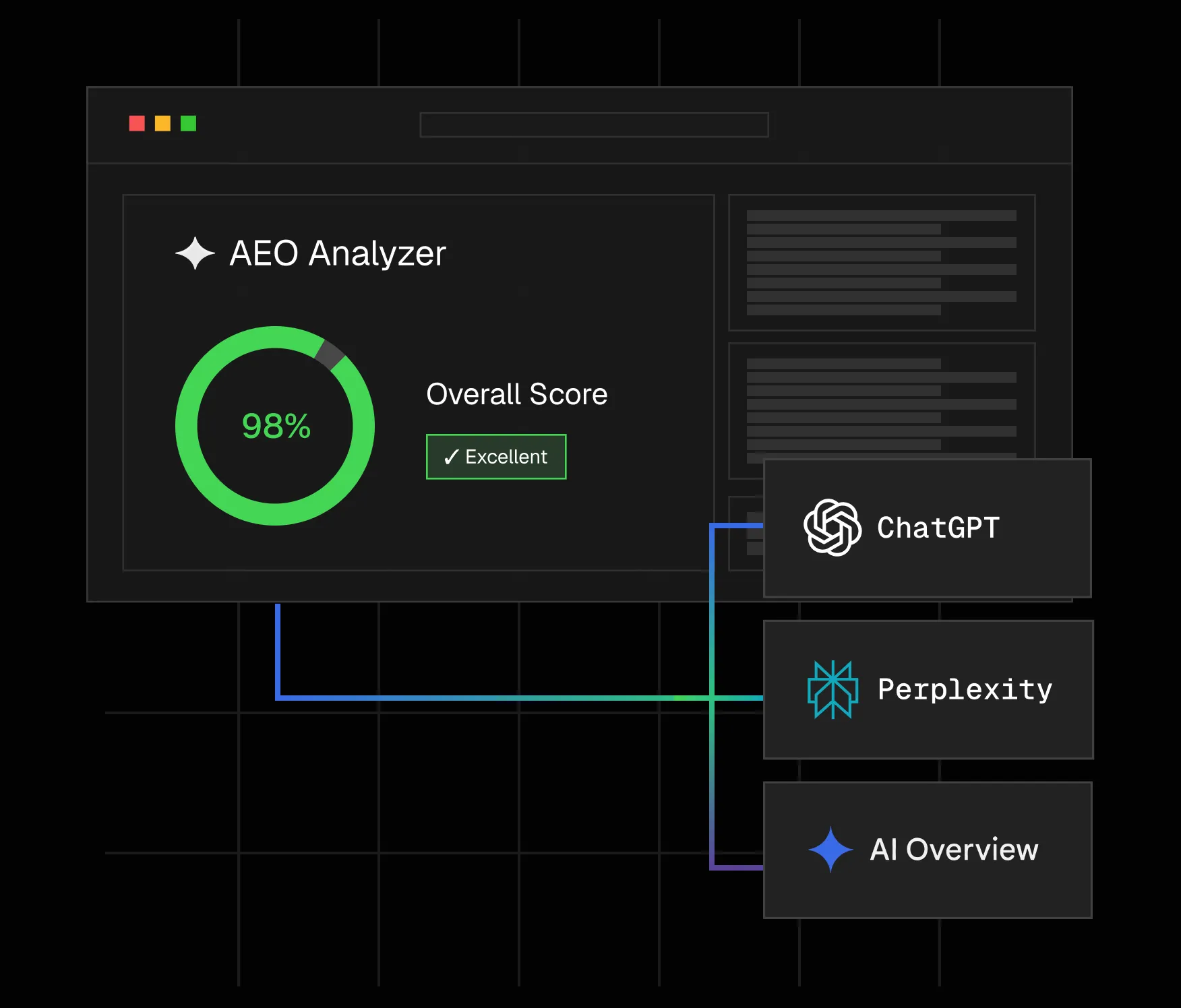
To help website owners understand exactly where they stand, Appsrow has launched an AEO Analyzer, a tool that scans any website and reports how ready it is to be found, understood, and cited by AI search engines. Whether you run a SaaS product, an agency site, or an e-commerce store built on Webflow or any other platform, this tool gives you a clear, data-backed picture of your AI search readiness in minutes, along with the specific fixes needed to improve it.
Answer Engine Optimization is the practice of structuring and writing content so that AI systems can easily find, interpret, and quote it as an answer. Traditional SEO focuses on ranking a page in a list of search results using backlinks, keywords, and domain authority. AEO works differently: AI engines look for clear structured data, well-defined entities, high readability, and content that answers a specific question directly, rather than simply counting how many links point to you.
A page can rank on page one of Google and still never appear inside an AI Overview or a ChatGPT answer if it lacks the technical and structural signals AI systems rely on. That gap between traditional ranking and AI visibility is exactly what Appsrow's tool is built to close. Instead of guessing which of your pages are AI-friendly and which are being skipped, you can run an AI search readiness audit and get a scored breakdown of the technical signals AI engines actually use to decide who gets cited.
The urgency behind AEO is not hype. A rapidly growing share of informational queries are now answered directly inside AI Overviews or chat interfaces, with users never clicking through to a traditional list of websites. For many businesses, this means the top of the funnel, the moment a potential customer first hears about a solution to their problem, is shifting from a search results page to an AI-generated paragraph with two or three cited sources. If your site isn't one of those sources, you don't just lose a click, you lose the chance to be considered at all.
Unlike traditional rankings, where slow, incremental effort can eventually pay off, AI citation tends to concentrate around a small number of well-structured, clearly authoritative sources per topic. That makes early, correct action disproportionately valuable: the sites that fix their schema, entity clarity, and readability now are positioning themselves to be the default answer AI systems reach for over the next several years, while competitors who wait will find it progressively harder to displace them.
Appsrow's AEO Analyzer tool was built by a team that has spent years designing, building, and optimizing Webflow websites, and it reflects a practical, agency-level understanding of what actually moves the needle for AI visibility. Using the tool is simple: enter your website URL and email address, click submit, and the analyzer crawls your publicly accessible pages using your sitemap.
Within moments, you receive a personalized audit that scores your site across eight AEO factors, flags specific problems, and hands you fixes you can apply immediately, including generated fix snippets you can copy straight to your developer. There is no lengthy onboarding and no sales call required just to see your numbers. If you want to see exactly how AI models currently perceive your website, you can check your AEO score in less time than it takes to read this article, and you'll walk away with a prioritized list of what to fix first.
Not all AEO tools measure the same things, and many stop at a surface-level check of your meta tags. The AEO Analyzer goes deeper, scoring your site across eight factors that determine whether AI engines trust and cite your content.
Schema Markup: The analyzer checks whether your pages carry the structured data types AI systems rely on, including Organization, WebSite, Person, Product, and FAQ schema. Missing or incomplete schema is one of the most common reasons a well-written page never gets cited.
E-E-A-T Signals: Experience, Expertise, Authoritativeness, and Trustworthiness are evaluated across your content, author information, and site credibility signals, the same qualities AI models weigh when deciding which source to trust.
Readability: AI engines favor content that answers questions in clear, direct language. The tool flags pages that are too dense, too jargon-heavy, or structured in a way that makes it hard for a language model to extract a clean answer.
Citation Potential: This factor measures how likely a given page is to be pulled into an AI-generated answer, based on how directly it addresses common questions in your niche.
Entity Coverage: The analyzer checks whether your brand, products, and key concepts are clearly defined as recognizable entities, rather than vague references that confuse AI crawlers.
Crawlability: Even great content is worthless if AI crawlers cannot access it. The tool inspects your sitemap, robots.txt, and page accessibility to confirm nothing is silently blocking AI bots.
AI Overview Presence: You'll see whether your pages are already appearing inside Google AI Overviews, and where you're being left out in favor of competitors.
Knowledge Graph Strength: This measures how well connected your brand is across the structured web, a factor that heavily influences whether AI systems recognize you as an authoritative source.
Together, these eight factors give you a genuinely complete picture, not just a vanity score. If you want a full technical breakdown of where your site is losing visibility, you can get your AEO audit and see each of these factors scored individually, along with a page-by-page inventory and a schema gap analysis.
The output isn't just a number. Each audit delivers an overall AEO score, a breakdown across all eight categories so you know exactly which area is dragging your visibility down, a page-by-page inventory showing how each URL on your site performs individually, and a schema gap analysis listing precisely which structured data types are missing or malformed. For flagged issues, the tool generates a fix you can copy straight to your clipboard and hand to a developer or paste into your CMS, so the audit ends in action rather than another static PDF nobody reopens.
It's worth noting that results are based on publicly accessible pages crawled from your sitemap, and the audit is designed as an AEO signal check rather than a full technical SEO crawl. It's built specifically to answer the question of whether AI engines can find, understand, and cite you, not to replace a broader site audit. Because scores are pulled from a live crawl rather than a cached estimate, re-running the analysis after each round of fixes gives you an honest before-and-after comparison, which is the fastest way to prove the value of AEO work to a boss, client, or stakeholder.
Every audit surfaces a familiar set of problems, and most businesses are surprised by how many are hiding on their own site. The most frequent issues include: missing or broken schema markup, particularly around Organization and Product types; thin or overly promotional page copy that never actually answers a specific question in plain language; blocked or noindexed pages that quietly keep AI crawlers out entirely; inconsistent entity naming, where a brand or product is referred to differently across pages, confusing AI systems about what it actually is; and weak internal linking, which prevents AI crawlers from understanding how your pages relate to one another.
On the technical side, the tool also flags crawl errors, slow-loading templates, and sitemap gaps that stop your best content from ever being discovered. Because the report is generated from a live crawl of your site rather than an estimate, the issues you see reflect exactly what AI engines encounter right now, not a generic checklist. You can analyze your website's AI search visibility today and get a specific list of fixes relevant to your own pages, ranked by impact.
Running your site through the AEO Analyzer pays off in ways that go well beyond a single score.
Clarity: Instead of guessing why competitors show up in ChatGPT answers and you don't, you get a specific, prioritized list of what's missing.
Speed: A technical AEO audit that would normally take an agency days to compile manually is delivered in minutes, complete with generated fixes you can copy and hand directly to a developer.
Future-proofing: As more search behavior shifts from clicking blue links to reading AI-generated answers, sites that aren't structured for AI citation will quietly lose visibility even if their traditional rankings stay flat.
Low barrier to entry: The audit requires no credit card and no sales call, just a personalized report and a few practical tips delivered straight to your inbox.
Trackable progress: Because the score is pulled from live crawl data, you can track real improvement over time, rerunning the audit after each round of fixes to watch your numbers move.
Competitive insight: The tool also doubles as a research instrument. You can compare your site against competitors using the AEO Analyzer, running the same audit on any rival's URL to see exactly where their schema, structure, or content gives them an edge, and where you can beat them.
For any business that depends on organic visibility, whether through blog content, product pages, or service pages, this kind of insight is quickly becoming as essential as keyword research once was for traditional SEO.
The AEO Analyzer is useful for a wide range of website owners: marketing teams trying to justify a content or schema overhaul, agencies auditing prospective clients before a pitch, SaaS founders who want to know why competitors keep showing up in ChatGPT recommendations, and Webflow site owners specifically, since Appsrow's team specializes in diagnosing and fixing AEO issues natively within the Webflow platform. If your site was built or is maintained on Webflow, the results from the AEO Analyzer connect directly to fixes Appsrow's team can implement without a platform migration.
Even if AI search feels like a distant concern today, the businesses that establish strong AEO signals now are the ones that will dominate AI-generated answers over the next several years, much like early SEO adopters dominated Google two decades ago.
AI search is not a future trend, it is already reshaping how people find businesses, compare products, and make decisions. Waiting to address AEO until competitors have already claimed the AI-generated answers in your niche means playing catch-up in a race that only gets harder over time. The good news is that finding out where you stand costs nothing and takes only a few minutes.
Enter your URL, claim your SEO + AEO + GEO analysis, and get a scored, actionable report you can start acting on today. Whether you fix the issues yourself or bring in Appsrow's team to handle the schema, content, and structural work, the first step is the same: start your audit today and see exactly how AI search engines currently see your website.
If your website isn't easy to understand, you're giving away opportunities
before the conversation even starts.
Get a free review of how your website appears to AI-powered search and discovery tools.

Sandeepsingh Sisodiya is the CEO of Appsrow and a Webflow leader in Ahmedabad, India. He focuses on SaaS growth, digital transformation, and building high-converting website strategies.
CURATED READING
.png)
.png)