
.png)
September 15, 2026
12 mins read
Webflow AI UX Evaluation Tools: Complete 2026 Guide

Explore appsrow with AI
Search is changing shape right in front of us. People are no longer typing five word queries into a search box and scrolling through ten blue links. They are asking full questions inside ChatGPT, Gemini, Perplexity, and Google's AI Overviews, and they expect a direct answer, often with a citation pointing back to the source. This shift has a name now: Answer Engine Optimization, or AEO. On July 28, 2026, Webflow released a new set of tools that push this trend even further forward, called AEO content optimization agents. In this article, we will break down exactly what Webflow announced, why it matters, and what it signals for every business trying to stay visible in an AI first search world, whether you build on Webflow or not.
At Appsrow, we track platform updates like this closely because they tend to be early signals of where the entire industry is heading. When a major website platform builds AI citation tracking and content generation directly into its core product, it is telling us something important: AEO is no longer a side experiment. It is becoming a permanent part of how websites are built, measured, and optimized. If you want to understand what that means for your own website strategy, keep reading.
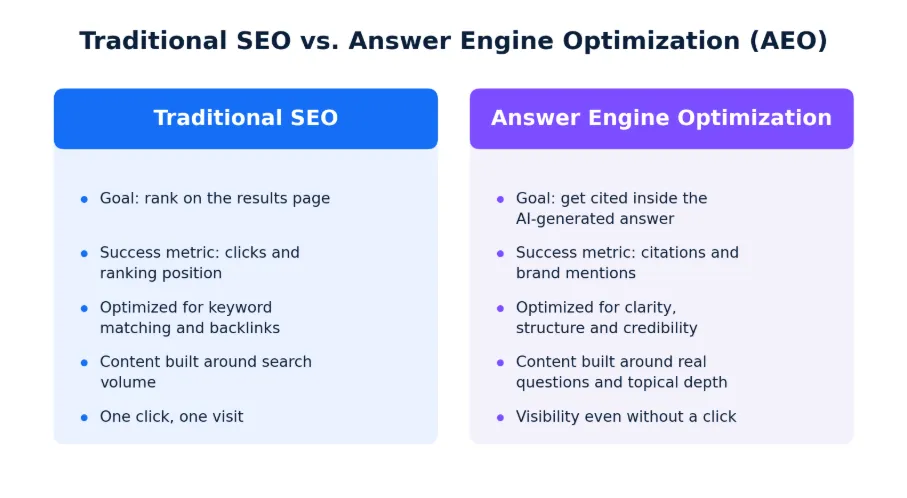
Answer Engine Optimization is the practice of structuring and writing content so that AI systems, large language models, and answer engines can understand it, trust it, and cite it directly in their responses. Think of it as the natural evolution of SEO. Traditional SEO was built around ranking a page for a search engine that returned a list of links. AEO is built around getting your brand, your data, and your expertise quoted inside an AI generated answer, sometimes with no click required at all.
This distinction matters because user behavior has already shifted. Millions of people now ask AI assistants questions they used to type into Google. “What is the best CRM for a small agency,” “how do I structure a content brief for AEO,” “which website platform supports AI powered SEO tools.” If an answer engine cannot find clear, well structured, and credible content from your brand, it will cite a competitor instead, and you will lose that visibility entirely, often without ever knowing the conversation happened.
This is exactly the problem Webflow is trying to solve with its AEO agents, and it is the same problem our team at Appsrow helps clients solve through our AEO and SEO services.
Webflow's announcement builds on a foundation the company laid earlier in the year. According to the update, when Webflow launched its original AEO product in May 2026, it delivered what it calls a closed loop solution covering measurement and execution. AEO analytics show teams how their brand is showing up (or not showing up) inside answer engines, while AEO agents help teams act on those insights and make on brand improvements across their site.
The new release adds a critical missing piece: content creation itself. Instead of only telling you where you are falling behind, the new agents actually help you produce the content needed to close the gap. Webflow states that these agents read a site's structure and existing content directly, and combine that with business context supplied by the team, so that every suggestion starts aligned with the brand's voice and positioning rather than generic AI output.
This native integration is the part worth paying attention to. Rather than bolting an AI writing tool onto a CMS as an afterthought, Webflow built the agents to operate with full visibility into the site's existing pages, structure, and analytics data. That context is what separates a genuinely useful content recommendation from a random blog topic generator.
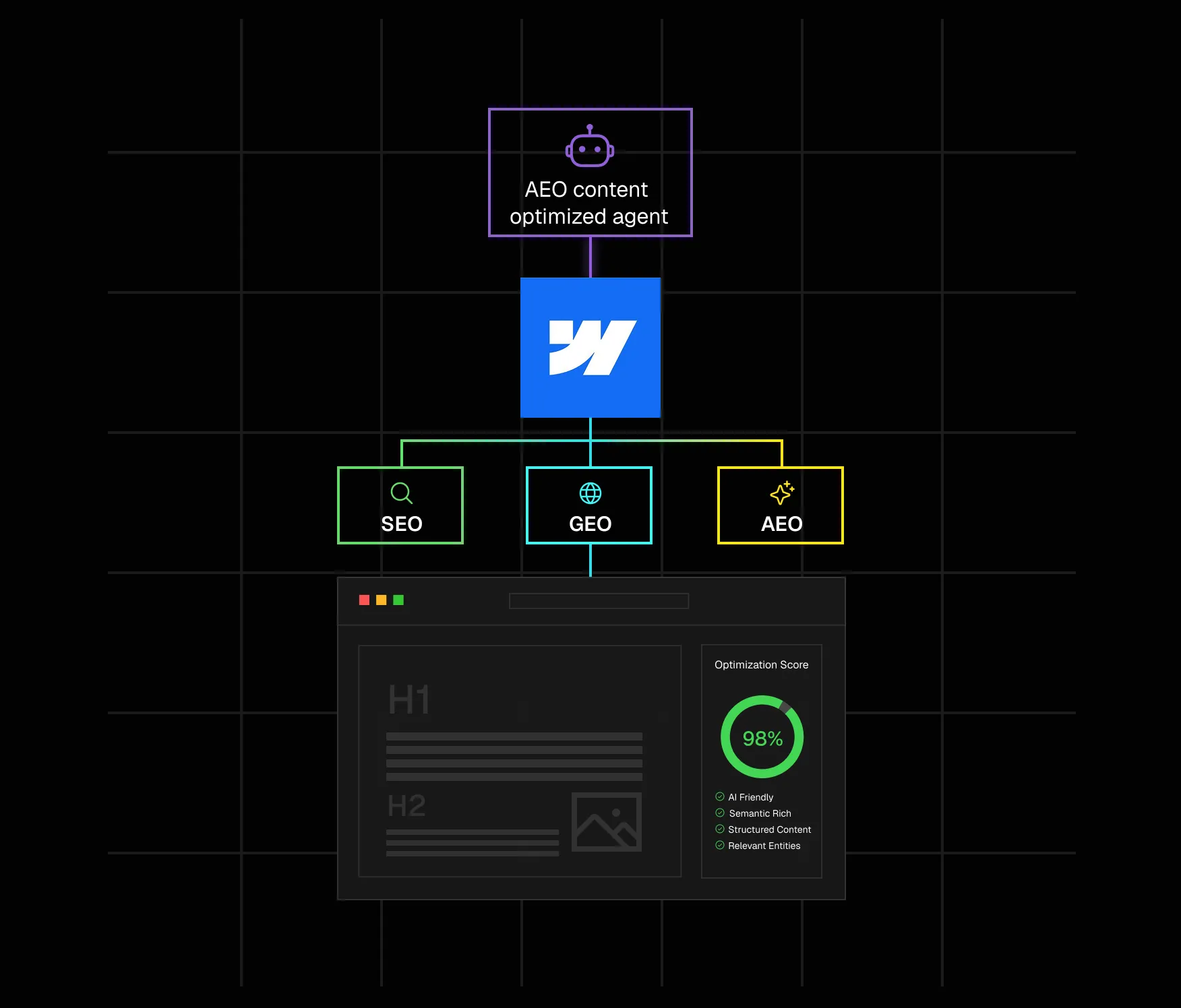
Webflow describes the new system as working in three connected steps. Understanding each step helps clarify why this is a meaningfully different approach from typical AI content tools.
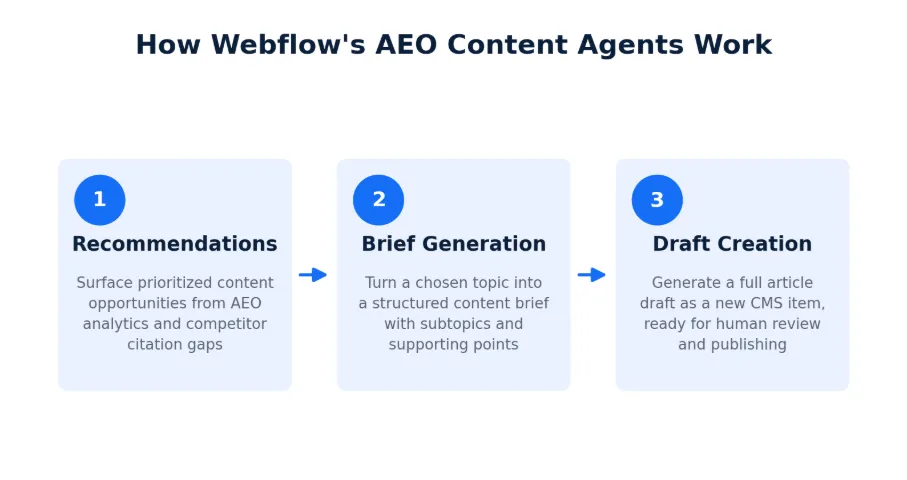
The first agent surfaces prioritized content opportunities. It does this by comparing your AEO analytics data against what is actually happening in the answer engine landscape, including cases where a competitor is being cited for a topic and your brand is not. This is a sharp improvement over guessing at content ideas or relying purely on keyword volume, because it is grounded in real citation data rather than assumptions.
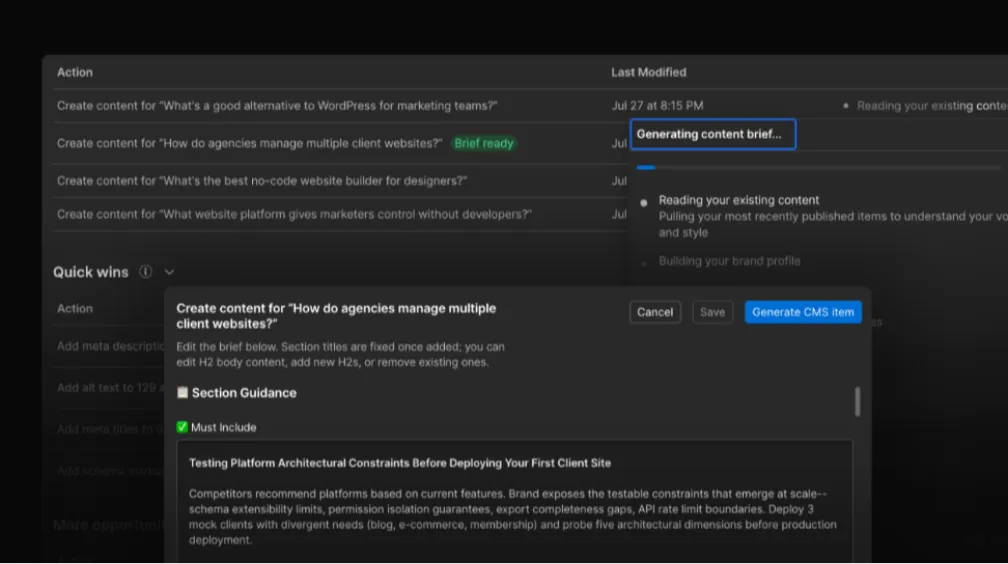
Once a topic is selected, the second agent turns that opportunity into a structured content brief. This step matters because a good brief is the difference between a page that vaguely touches a subject and one that actually answers the specific questions an AI system is trying to resolve. A structured brief typically outlines the core question being answered, the subtopics that need to be covered, and the supporting details or data points that add credibility.
The final agent takes that brief and generates a full article draft as a new CMS item, ready for a human to review. This is not a fully automated publish and forget system. Webflow is explicit that the draft is meant to be reviewed, edited, accepted, and then published, keeping a human editor in the loop at the final stage. For anyone worried about AI slop flooding the internet, this human review step is a meaningful safeguard, and it is a workflow we strongly recommend even outside of Webflow's own tools.
According to the announcement, this first set of content optimization agents is currently available to Enterprise customers who also have the Analyze add on enabled. Businesses interested in the full closed loop AEO solution are directed to contact Webflow's sales team or their account representative for more detail.
This tells us two things. First, this is an early stage rollout aimed at larger organizations with more complex content operations, the kind of teams that are already investing heavily in content strategy and have the resources to test emerging tools quickly. Second, it strongly suggests that AEO tooling will continue expanding down market over time, the same way SEO tools, analytics platforms, and AI writing assistants eventually became standard across businesses of every size. Waiting until AEO tools are available on every plan tier is not a strategy. Understanding the underlying principles now, and applying them manually or with the right partner, is what will actually protect your visibility.
Webflow also outlined the setup steps required before a business will start seeing content recommendations. Teams need to set up prompt tracking for the topics they want to be cited for, and add competitor information along with other business context inside their Organization info settings. Once those two steps are complete, recommendations begin appearing inside the Insights tab under AEO recommendations, where teams can review the reasoning behind each suggestion before editing, accepting, or publishing it.
This setup process is worth highlighting because it reveals something important about how AEO actually works, regardless of which platform you use. The system is only as good as the inputs. Prompt tracking tells the platform which questions matter to your business. Competitor context tells it who you are actually competing against for citations. Without that foundation, even the most advanced AI agent is working blind. This is precisely why our process at Appsrow always starts with a discovery and audit phase before we touch a single piece of content. You cannot optimize for citations you have not defined.
Even if your website is not built on Webflow, this launch is a signal worth paying attention to. Here is why.
You do not need to wait for your platform to build native AEO agents to start improving your visibility inside answer engines. Here are the foundational steps that apply regardless of what CMS or website platform you use.
At Appsrow, AEO is not a buzzword we bolted onto our service list after it started trending. It is a natural extension of the work we have done for years helping brands earn visibility, trust, and authority online. Our team combines deep technical SEO knowledge with a genuine understanding of how large language models retrieve, evaluate, and cite content, and we apply that understanding across every project, from website design and development to ongoing content strategy. We have built a repeatable process for auditing how brands currently appear across AI answer engines, identifying the specific citation gaps competitors are exploiting, and closing those gaps with content that is structured, accurate, and genuinely useful rather than engineered purely to game an algorithm. Whether a client comes to us needing a platform migration, a content overhaul, or a full AEO strategy built from the ground up, our approach stays grounded in the same principle Webflow's own product update reinforces: AI systems reward clarity, structure, and real expertise, and our job is to make sure that expertise is impossible for an answer engine to miss.
Webflow's investment in native AEO tooling is also a useful data point for anyone currently evaluating website platforms. As AI driven search continues to grow as a traffic and lead source, the platforms that build AEO capability directly into their core product, rather than requiring a patchwork of third party plugins, will offer a real advantage to the businesses that use them. That said, the platform itself is only ever part of the equation. Even the most advanced built in AEO agent still depends on accurate business context, well defined competitor tracking, and thoughtful human review before publishing. A powerful tool in the hands of a team without a clear content strategy will still produce mediocre results.
This is where working with an experienced partner matters. Our Webflow development team helps businesses set up and configure their sites to take full advantage of platform level features like AEO tooling, while our content and SEO strategists make sure the strategy behind those tools is sound before a single recommendation is ever accepted and published.
Whether you are already on Webflow and want to make the most of its new AEO agents, or you are on a different platform and need a strategy to compete for AI citations without built in tooling, Appsrow can help. Our process typically starts with a full AEO and SEO audit to understand exactly how your brand currently appears, or fails to appear, across major answer engines. From there, we build a prioritized content roadmap grounded in real competitive gaps, not guesswork, and we handle everything from technical structure to on brand content creation and human review.
If you want to know exactly where your website stands in the age of AI search, get in touch with our team for a free AEO visibility assessment. We will show you precisely where you are being cited, where competitors are winning the conversation instead, and what it will take to close that gap.
Webflow's new AEO content optimization agents are a strong signal that the industry has moved past treating answer engine optimization as a passing trend. Recommendations grounded in real citation data, structured content briefs, and drafts generated with full site context represent a meaningful step toward making AEO a standard, built in part of how websites are managed. But the underlying lesson applies to every business, regardless of platform: visibility inside AI answers is earned through structure, specificity, accuracy, and genuine expertise, backed by a human review process that keeps quality high.
The businesses that start building this discipline into their content strategy now, rather than waiting for every platform to ship a native tool, will be the ones answer engines trust and cite first. At Appsrow, that is exactly the kind of work we do every day, and we would be glad to help you get started.
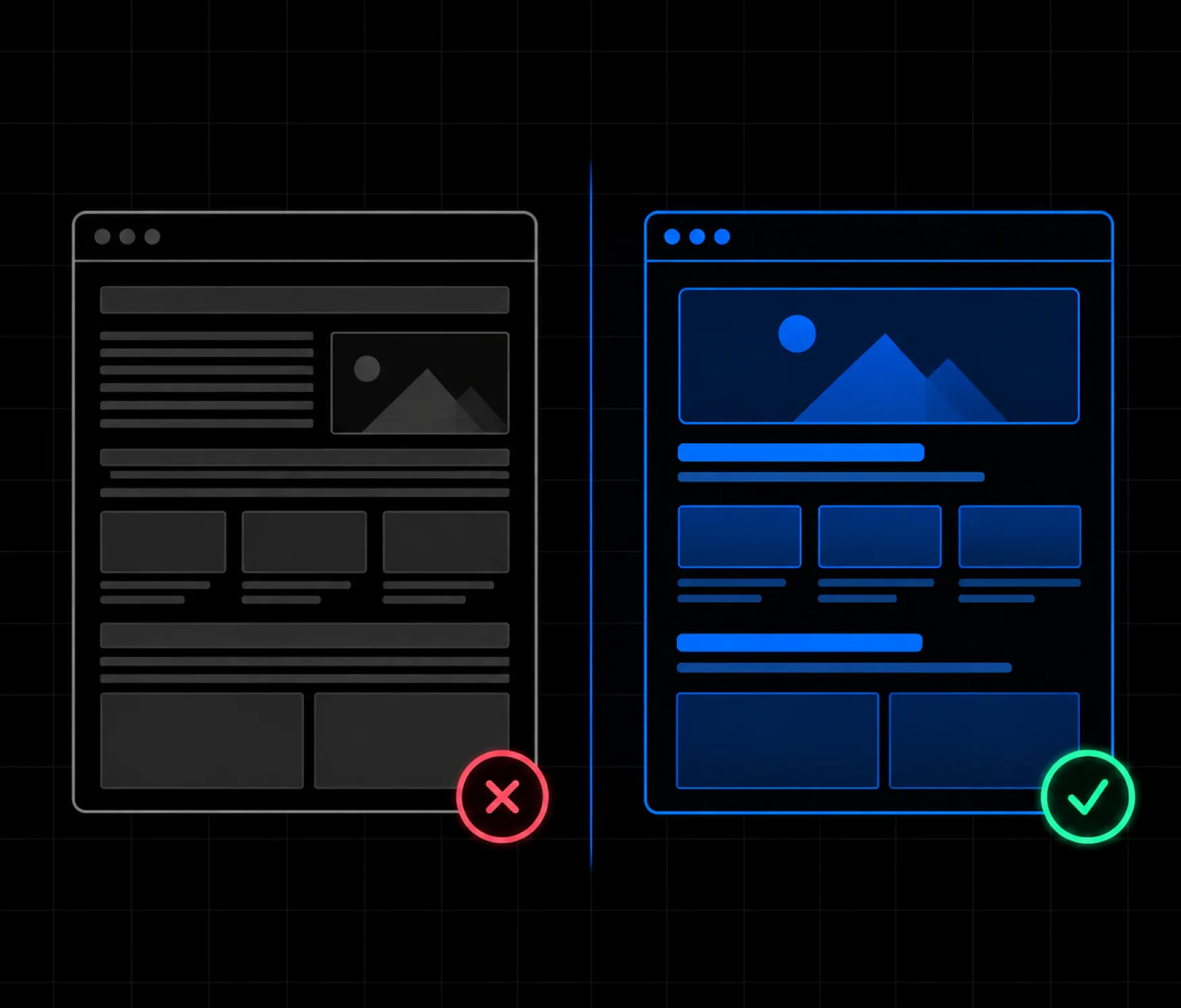
Note on screenshots: The workflow and comparison graphics above are original diagrams created to illustrate Webflow's announcement, since our environment could not reach Webflow's image CDN to download the platform's own dashboard screenshots. For the actual product screenshots, visit webflow.com/updates/aeo-content-optimization-agents and save the images directly, or capture your own screenshots once you have access to the feature in your Webflow dashboard.
Appsrow is a digital agency helping brands build, optimize, and grow their online presence in a search landscape that now includes traditional engines, AI answer engines, and everything in between. We work with businesses on website design and development, SEO and AEO strategy, and content marketing, always with a focus on measurable visibility and results rather than vanity metrics. Our team stays close to platform updates like Webflow's new AEO agents so our clients never have to guess where search is heading next. If you want a website and content strategy built for how people actually find brands today, get in touch with Appsrow and let us show you what is possible.
If your website isn't easy to understand, you're giving away opportunities
before the conversation even starts.
Get a free review of how your website appears to AI-powered search and discovery tools.
GOT QUESTIONS ?
What is the difference between SEO and AEO?
SEO focuses on ranking a webpage inside a traditional search engine results page, where the goal is a click. AEO focuses on getting your content cited or summarized directly inside an AI generated answer, where the goal is trust and visibility, sometimes without a click at all. The two disciplines overlap heavily on technical fundamentals, but AEO places more weight on clear, direct answers and structured, verifiable information.
Do I need to be on Webflow to benefit from AEO?
No. Webflow's native agents are a convenience for teams already on that platform, but the underlying principles of AEO, clear structure, direct answers, topical depth, and credible sourcing, apply regardless of your CMS. A dedicated AEO strategy can be applied manually or with other tools on WordPress, Shopify, HubSpot, or any custom built site.
How do answer engines decide what to cite?
While each AI system has its own retrieval and ranking logic, most favor content that answers a question clearly and early, demonstrates subject matter depth, is well organized with clear headings, and comes from a source that appears trustworthy and consistent across the web. Freshness and specificity also tend to matter more than raw page volume.
Is AI generated content safe to publish for AEO purposes?
It can be, as long as a knowledgeable human reviews, fact checks, and edits every draft before publishing. Webflow's own workflow keeps a human review step before content goes live, and that same discipline should apply no matter which tool produces the first draft. Publishing unedited AI output tends to hurt credibility rather than help it.
How long does it take to see results from an AEO strategy?
Timelines vary depending on your starting point, your industry, and how established your brand already is. Some businesses see early citation improvements within a few weeks of restructuring key pages, while building broader topical authority across a competitive space typically takes a few months of consistent, well targeted content work.
How can Appsrow help my business with AEO?
Our team runs a full AEO visibility audit, benchmarks your brand against competitors inside major answer engines, and builds a content and technical roadmap to close the gaps we find. From there we can handle everything from website structure and development to ongoing content creation, so you are not left guessing about what to publish next.
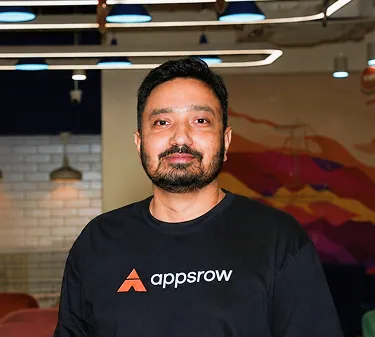
Parth Parmar is a Webflow Expert and Co-Founder & CTO at Appsrow Solutions. He has delivered 300+ Webflow projects for 25+ global B2B brands, helping SaaS companies, AI startups, and tech businesses build conversion-focused websites with scalable CMS, AEO-ready architecture, and measurable growth.
CURATED READING