

.png)
September 15, 2026
12 mins read
Webflow AI UX Evaluation Tools: Complete 2026 Guide

Explore appsrow with AI
Sellers Umbrella is a full-service Amazon ecommerce marketing agency built around a simple pitch: most agencies for Amazon sellers start with a pitch deck, Sellers Umbrella starts with a question. Over nine years the team has generated more than 200 million dollars in client revenue across 350-plus brands, operating as an Official Amazon Ads Partner and Amazon Service Provider Network partner, with a sister company, MerchantXporter, handling product sourcing and export compliance.
That range of services, account management, PPC, creative, listing optimization, product launches, sourcing, and strategic consulting, meant the website carrying it all needed to do two things at once: explain a genuinely complex service stack clearly, and stay current with an industry that changes on Amazon's schedule, not the agency's. Amazon policy shifts, marketplace updates, and advertising changes all needed to make it into the site's Insights and What's New sections quickly, since sellers researching an agency check exactly that kind of content to judge whether a team is actually paying attention.
Sellers Umbrella's previous site had two problems pulling in opposite directions. It was content-heavy, with frequent updates and repetitive service sections that needed real restructuring for readability, but it also needed strong visual engagement to compete in a market full of agencies making similar claims, and neither improvement could come at the cost of page performance.
Underneath the visual problem sat an operational one. A team publishing regular policy updates, case studies, and service content needs a CMS structure that makes fast publishing possible, and a workflow that does not force a strategist to hand-build every post from scratch. Solving the surface-level design problem without solving that underlying publishing bottleneck would have left the same content team stretched thin the moment the new site launched.
Appsrow's scope covered the full rebuild: brand identity and logo work, UI and UX design, GSAP-powered animation, and full Webflow development. The result is an animation-rich site that leads with clarity rather than density, breaking Sellers Umbrella's seven core services into individually scannable sections while still supporting the deep case study and Insights content the agency needed to keep publishing.
None of that visual work came at the expense of the metrics that actually matter for a marketing agency's own site. At launch, Sellers Umbrella scored 92-plus on speed, 90 percent on Webflow's performance audit, and a full 100 percent on accessibility, proof that an animation-heavy, content-heavy site does not have to trade one property for the other when it is built by a team that treats performance as a requirement rather than an afterthought.
The CMS architecture underneath the visible design is what made the second half of this project possible. Service pages, case studies, and Insights posts all live in structured Content Collections with consistent fields, which matters enormously once an AI agent needs to work with that content directly rather than a person formatting each post by hand.
It would have been possible to connect Claude to the old site's CMS structure directly and skip straight to automation. Appsrow deliberately sequenced the project the other way, rebuilding the Insights and What's New collections with clean field names, a consistent category taxonomy, and proper reference relationships before introducing any agentic workflow on top of them. An agent working against a messy, inconsistently structured collection produces messy, inconsistently structured drafts. An agent working against a well-designed schema produces drafts that already match the site's editorial conventions, which is the difference between a workflow that saves real time and one that just moves the cleanup work to a different stage.
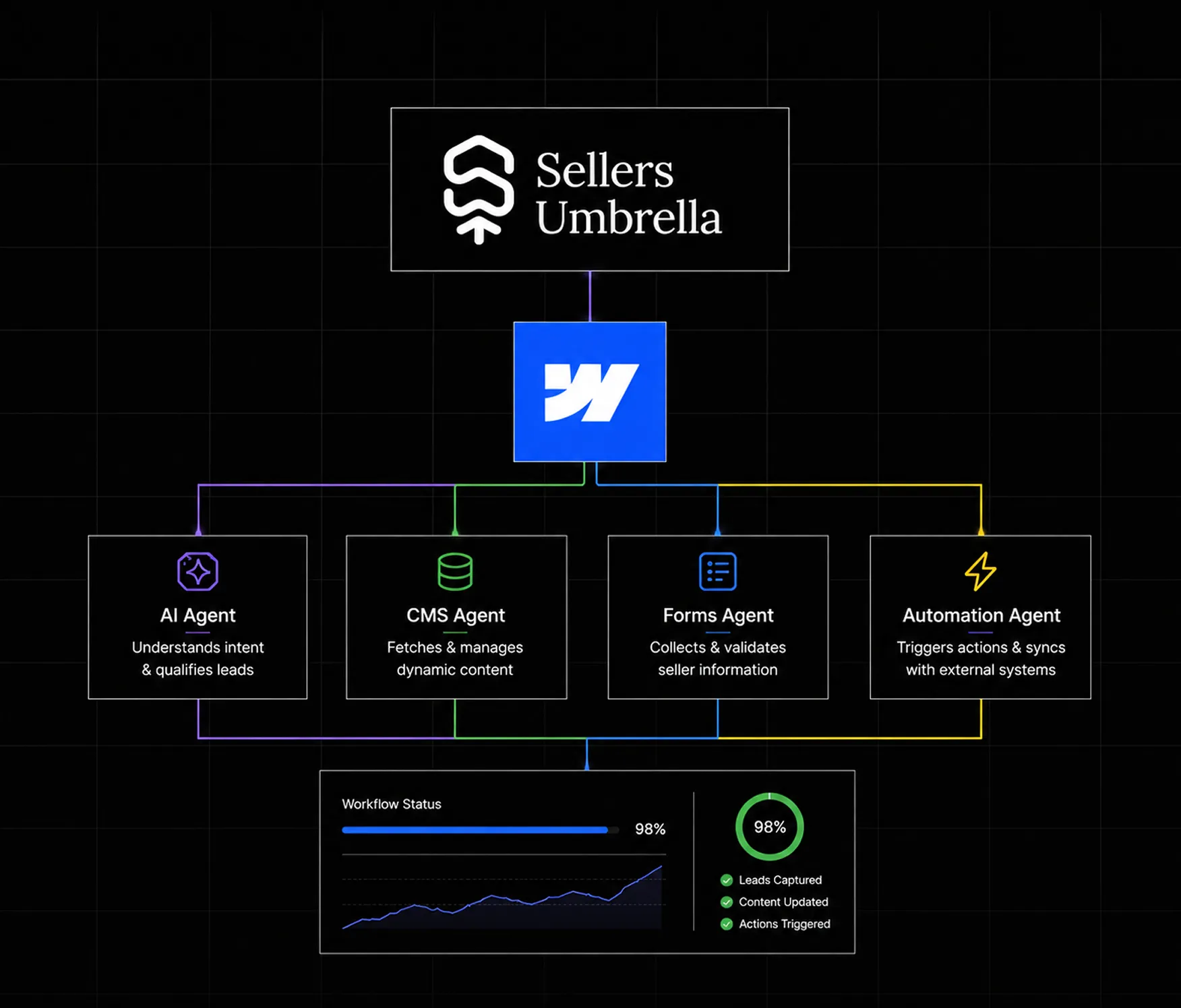
Once the Webflow foundation was in place, Appsrow connected Claude to the project using the official Webflow and Anthropic Model Context Protocol integration, following the same four-step framework Appsrow applies across its agentic Webflow development work: connect Claude, configure workflows, test and validate, then scale operations.
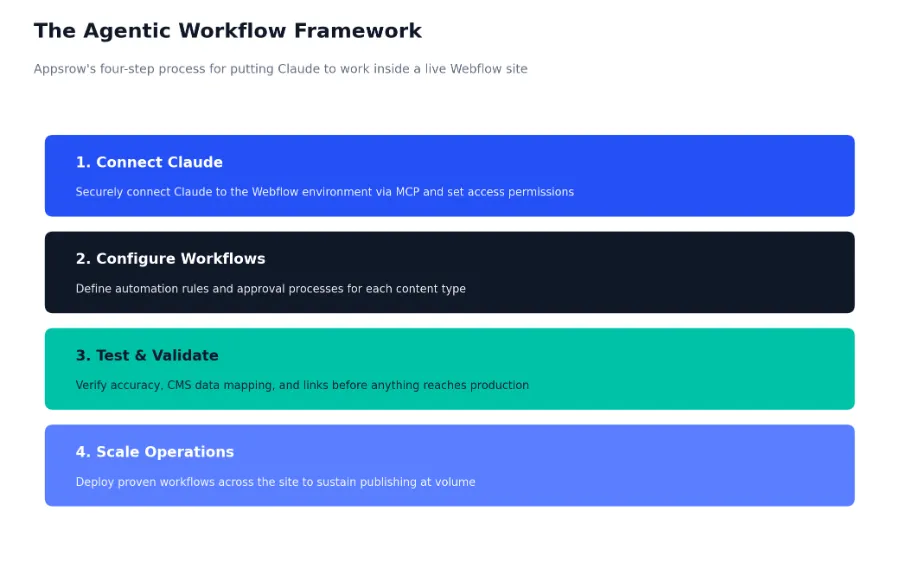
For Sellers Umbrella specifically, that framework was configured around the exact bottleneck the content team faced: turning fast-moving Amazon news, policy changes, and marketplace updates into published Insights and What's New posts without a strategist starting each one from a blank page.
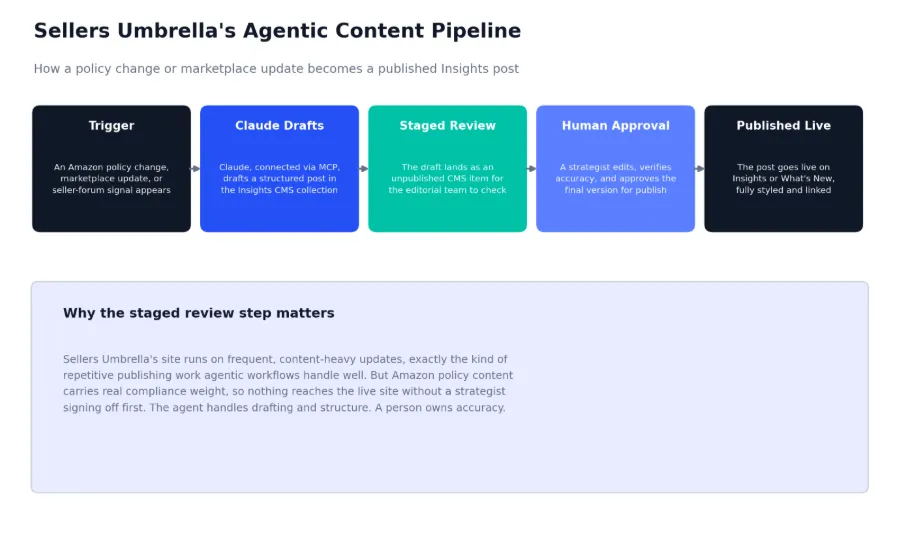
Claude, connected through MCP, drafts a new post directly into the Insights CMS collection, matching the existing field structure, category taxonomy, and formatting conventions rather than producing markup that needs to be manually reshaped. That draft lands as an unpublished CMS item, not a live page, which keeps the compliance-sensitive parts of Amazon policy content, meaning what sellers are actually told to do in response to a change, under human review before anything reaches the public site.
The underlying mechanism is close to what a Claude and MCP integration looks like on any well-structured Webflow CMS: a trigger event initiates a scoped request against a specific collection, with the resulting draft written back through the same MCP connection rather than a separate script maintained outside Webflow.
// Simplified example: drafting a CMS item through MCP
// when a new policy update is flagged for review

const draft = await mcpClient.callTool("webflow_create_cms_item", {
  collectionId: INSIGHTS_COLLECTION_ID,
  isDraft: true,
  fieldData: {
    name: topic.title,
    slug: slugify(topic.title),
    category: topic.category,       // e.g. "Amazon Marketing"
    summary: topic.summary,
    body: draftedBody,              // structured rich text
    publishedDate: null,            // stays unset until approved

  },

});

// The item now exists as an unpublished CMS entry,
// visible to editors inside Webflow for review.
This is a deliberately conservative configuration. Content teams handling high volume, well-scoped, low-risk categories could extend the same pattern toward more autonomous publishing over time, which is exactly the kind of scaling Appsrow's implementation framework accounts for in its final step. For a compliance-adjacent niche like Amazon seller services, keeping the approval gate in place was the right call for this engagement rather than a limitation to work around.
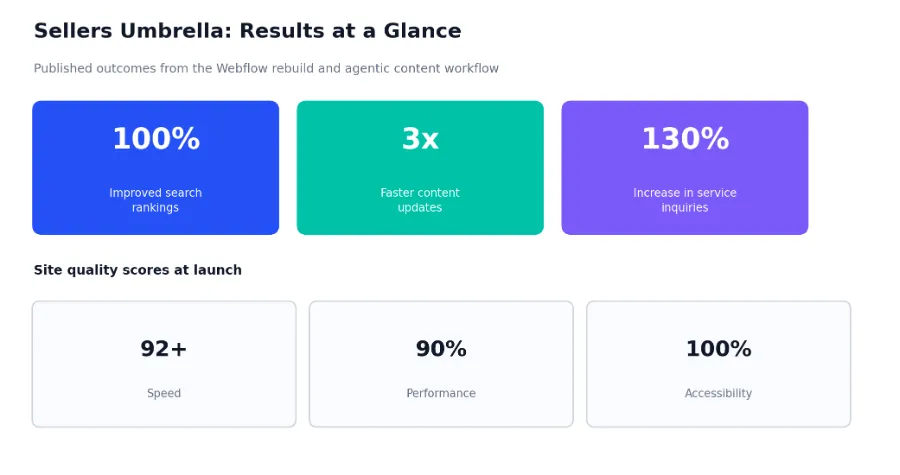
The combined effect of the rebuild and the publishing workflow shows up in both search performance and lead generation. Sellers Umbrella saw a 100 percent improvement in search rankings following the relaunch, alongside a 130 percent increase in service inquiries, the kind of outcome that reflects both a clearer service presentation and content that stays current enough to keep ranking as Amazon's own policies shift.
On the operational side, the team now publishes content three times faster than before, a direct result of Claude handling the first draft of policy and marketplace updates so the strategist's time goes toward review, accuracy, and judgment calls rather than structuring a post from a blank page every time Amazon changes something. Combined with the 92-plus speed score, 90 percent performance score, and 100 percent accessibility score the site launched with, the result is a site that is both fast to load and fast to keep current, without one coming at the other's expense.
“
Working with Appsrow felt less like hiring an agency and more like gaining a technical partner. Our website had a lot of complexity, but the team simplified everything without losing any functionality. Sandeep helped us manage our digital platform with great precision, and every deliverable came through exactly on time.
Harshank Vyas
Co-Founder & CMO, Sellers Umbrella
You can see the full build breakdown, including scope of work and additional screenshots, on Appsrow's Sellers Umbrella case study page, or visit the live Sellers Umbrella site to see the Webflow build and its Insights section in production.
Sellers Umbrella is a useful reference point precisely because its problem is not unique to Amazon agencies. Any brand whose site needs to reflect a fast-changing industry, meaning regulatory updates, product changes, or market shifts, faces the same tension between publishing speed and content quality. The pattern that worked here, a clean CMS foundation first, then a Claude-powered drafting workflow with a human approval gate, generalizes well beyond ecommerce.
Teams evaluating whether this approach fits their own site typically start with the same two questions Appsrow asked here: how content-heavy is the current publishing workload, and how much of that workload is repetitive enough for an agent to draft safely under a human review gate. Sites already running ongoing Webflow maintenance or active Webflow integrations tend to be the fastest to layer in an agentic workflow, since the underlying account structure and CMS discipline are usually already in reasonable shape.
The Sellers Umbrella project is a straightforward example of what agentic web development looks like when it is scoped correctly: a strong Webflow foundation first, a narrowly defined automation layered in second, and a human still making every final call on anything that reaches a live, public page. The visual rebuild alone would have improved the site. Pairing it with a Claude-powered publishing workflow is what let the results compound, faster content, stronger rankings, and measurably more inquiries, without adding headcount to the content team.
Appsrow is a Webflow Premium Partner agency that has delivered 300+ Webflow projects for B2B, SaaS, and ecommerce brands since 2018. The team handles the full stack behind projects like this one, from brand identity, Webflow design, and Webflow development through to agentic Webflow workflows built on Claude and MCP for teams that need their CMS to keep pace with a fast-moving industry.
If your site carries the same content-heavy, fast-changing publishing load Sellers Umbrella did, Appsrow can scope both the Webflow foundation and the agentic layer on top of it. Browse more outcomes in Appsrow's case studies, or explore Webflow AEO and SEO and CRO services for the conversion side of a rebuild like this one.
If your website isn't easy to understand, you're giving away opportunities
before the conversation even starts.
Get a free review of how your website appears to AI-powered search and discovery tools.
GOT QUESTIONS ?
Does Claude publish content directly to the live Sellers Umbrella site?
No. Every draft Claude produces through the MCP connection lands as an unpublished CMS item first. A strategist reviews it for accuracy, particularly on anything related to Amazon policy, before it goes live. The workflow speeds up drafting, not the decision to publish.
Why not automate the whole publishing process end to end?
Amazon seller compliance content carries real consequences if it is wrong, so Appsrow scoped this engagement to keep a human approval gate in place rather than removing it for the sake of speed. The four-step framework's final stage, scaling operations, leaves room to extend automation further into lower-risk content categories over time, without requiring that decision on day one.
How long did the full project take, from rebuild to agentic workflow?
The Webflow rebuild, covering branding, UI and UX design, animation, and development, was scoped and delivered first as a complete, standalone project. The agentic layer was configured afterward, once the new CMS structure was live and stable, following the same connect, configure, test, and scale sequence Appsrow applies across its agentic Webflow engagements.

Parth Parmar is a Webflow Expert and Co-Founder & CTO at Appsrow Solutions. He has delivered 300+ Webflow projects for 25+ global B2B brands, helping SaaS companies, AI startups, and tech businesses build conversion-focused websites with scalable CMS, AEO-ready architecture, and measurable growth.
CURATED READING