

.png)
October 2, 2026
12 mins read
Webflow Algolia Search and Sync App: What You Need to Know

Explore appsrow with AI
Most software still ships the same way it did a decade ago: one interface, designed around an average user who does not actually exist, handed to a marketer, a designer, and a developer alike and expected to fit all three. Settings pages are the industry's attempt at tailoring, and anyone who has spent an afternoon in one knows how little they can actually adjust.
Webflow's own leadership recently made the case, in a piece published on the company blog, that this off-the-rack model was never really a design philosophy. It was an economic constraint. Building a genuinely tailored interface for every role and team used to be too expensive to justify, so the industry standardized instead, the same way ready-to-wear clothing became the default once true tailoring stopped scaling to a mass market.
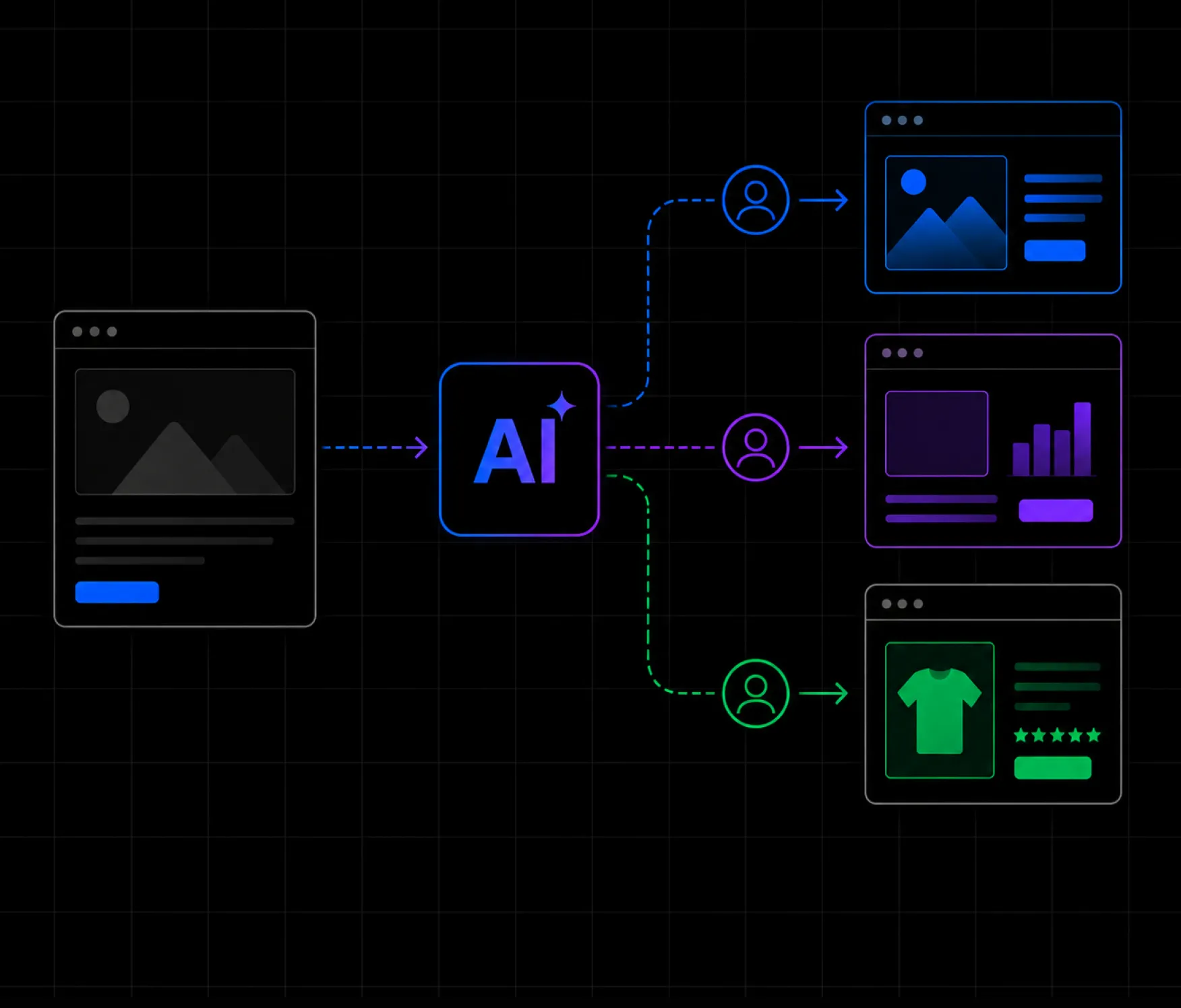
Their argument is that AI agents change that economics permanently, not by replacing software, but by making it cheap to shape a working interface around a specific role, team, or task without a full product cycle behind it. That is an interesting idea in the abstract. It becomes genuinely useful once it gets translated into something a real Webflow site owner can act on, which is what the rest of this guide sets out to do.
This is written for people who actually build and maintain Webflow sites at some scale, marketing teams managing a growing component library, design leads deciding how much structure to enforce, and technical teams evaluating where agentic tools genuinely help versus where they just add noise. If you run a five-page site with one editor, most of this will stay theoretical for a while longer. If your team is already juggling multiple brands, a growing CMS, or the early stages of connecting AI tools to your Webflow workflow, the ideas here are worth applying directly.
The core shift is worth stating plainly: software no longer has to choose between one fixed interface for everyone and total, unmanaged configurability. For most of software's history, those were the only two realistic options, and most products correctly chose the first one, since a coherent, opinionated product usually beats an endlessly configurable one that never quite fits anybody.
What changes with capable AI agents is that a third option becomes viable: a stable core that stays decided, with an interface layer around it that adapts to the work at hand. Not infinite configuration a user has to build themselves, and not one rigid screen everyone is forced into, but a system where the underlying rules, standards, and building blocks hold steady while the specific view assembled from them can flex to fit a role, a team, or a single task.
For a Webflow site, this is not an abstract idea. Webflow already ships the exact architecture this requires: a stable design system layer, Variables, Components, and Shared Libraries, sitting underneath pages and sections that can be assembled, edited, and recombined without touching that underlying source. What's new is the ability to have an AI agent do meaningful parts of that assembly work directly, rather than a person manually dragging every element into place.
The most important idea in this shift is also the easiest to overlook: none of this works if the underlying source drifts every time someone shapes a new view from it. A tailor can alter a garment's fit endlessly because the fabric, the stitching standards, and the pattern stay consistent underneath every alteration. Take that consistency away and every alteration becomes a one-off, disconnected from everything else in the shop.
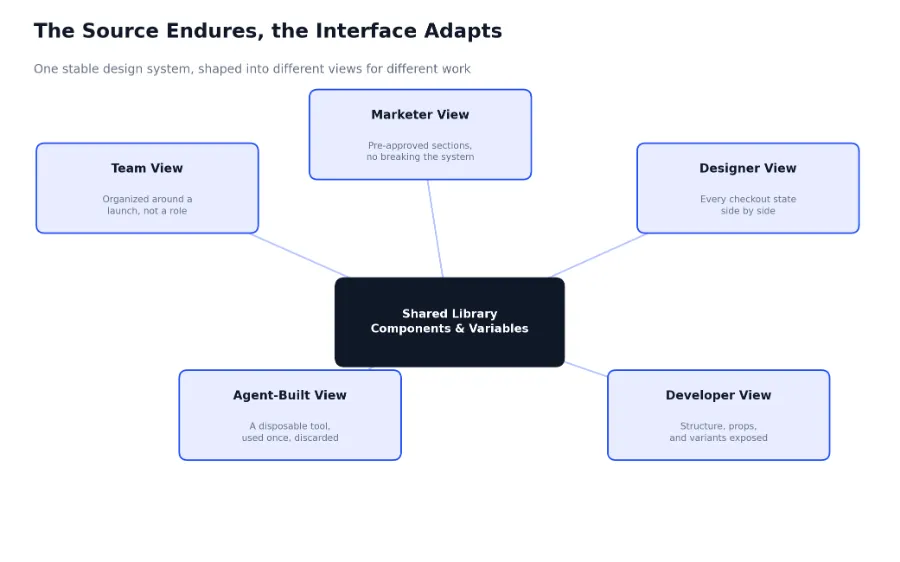
On a Webflow site, the source is the design system: Variables holding your color, spacing, and typography tokens, Components encapsulating reusable patterns with their props, slots, and variants, and Shared Libraries keeping that system consistent across every site in a workspace rather than letting each one drift independently. That layer is exactly what has to stay disciplined and well-governed, since it is what every task-specific view gets assembled from.
Skipping this discipline is the single most common way teams get the made-to-measure idea backward. Letting every team build its own one-off components, outside the shared system, produces exactly the fragmentation the old off-the-rack model was designed to prevent, just with more tools generating the mess faster. The view is allowed to be disposable. The source cannot be.
It is worth being specific about what makes a source genuinely durable rather than durable in name only. A design system that exists as a style guide document nobody references day to day is not really a source of truth, it is documentation that drifts out of sync with the actual product the moment someone ships a page without checking it. A source that endures in the way this idea requires has to be live: enforced through actual Components and Variables inside Webflow, versioned through Shared Libraries when multiple sites depend on it, and checked against, not just referenced, every time something new gets assembled from it.
Stripped of the metaphor, here is what made-to-measure interfaces actually translate to in day-to-day Webflow work:
Webflow already supports hiding complex or technical components from teammates with a Marketer role, keeping their component list focused on pre-approved, on-brand building blocks. That is a small, existing example of the same underlying idea: the same shared system, presented differently depending on who is using it and what they need to get done.
Building a temporary view that shows every state of a checkout flow side by side, purely to make a design decision, is a disposable tool in the truest sense. It exists to help someone judge something clearly, and once the decision is made, there is no reason for it to persist as a permanent part of the product.
Connected through MCP, an agent working inside a Webflow project can pull from existing Components and Variables to assemble a new section or page that already matches the site's design system, rather than generating markup that ignores what's already built. Appsrow's Webflow and Claude integration work is built around exactly this pattern: agents that extend an existing system instead of working around it.
Not every useful view maps to a single role. A product launch might need a view that pulls together marketing copy status, design assets, and a publishing timeline in one place, organized around the work itself rather than any one person's job title. The underlying content and components stay exactly where they belong in the CMS and design system either way.
It helps to see the mechanics of this as a simple, repeatable loop rather than a one-off engineering project each time.
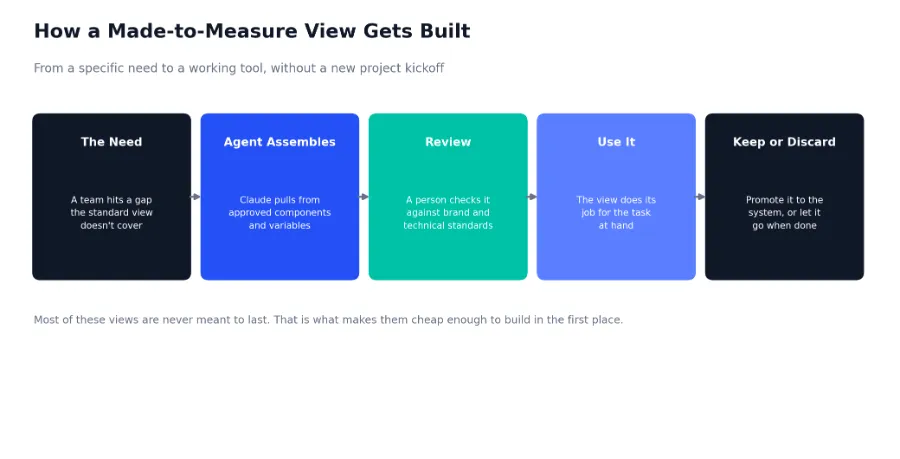
A gap surfaces, a marketer needs a view the standard CMS interface doesn't offer, a designer needs to compare options nobody has built a way to compare. An agent, working from the existing Shared Library rather than starting blank, assembles a working version. A person reviews it against brand and technical standards before it goes anywhere near production. It gets used for exactly as long as it's useful. Then it either gets promoted into the permanent system, if it turns out to be broadly valuable, or it gets discarded without ceremony, since most of these views were never meant to last.
That last step is the one most teams skip instinctively, and it's worth resisting the instinct. A tool that is cheap to build should also be cheap to throw away. Treating every agent-assembled view as a permanent addition to maintain defeats the entire point, which is that judgment, not construction, is now the expensive part of the process.
It is easy to read the made-to-measure argument as being purely about design tooling, buttons, layouts, component libraries, but the same logic applies just as directly to how a site's content gets managed. A Webflow CMS collection is itself a source that has to endure: consistent fields, a defined taxonomy, and reference relationships that every page and every automated workflow depends on staying stable.
Once that CMS foundation is genuinely solid, the same made-to-measure flexibility becomes available on the content side. A marketing team can get a view of blog performance organized around campaigns rather than publish dates. A sales team can get a version of case study content filtered and formatted for a specific vertical, assembled on demand rather than manually duplicated into a separate page every time. None of this requires new content types or a CMS redesign. It requires a CMS structured cleanly enough that a view can be shaped from it without anyone touching the underlying data model.
This is precisely the pattern behind well-scoped agentic CMS workflows: an agent drafting or restructuring content works safely only when the collection it is working against already has clean, well-named fields and sensible relationships. A messy CMS produces messy agent output at the same speed a clean one produces useful output, which is why the sequencing matters as much here as it does on the design system side.
If assembling a view gets cheap, the valuable skill on a team stops being how fast someone can build something and becomes how well they can judge whether what got built actually fits. That is a real shift in what a design or development role is worth on a team, not a minor adjustment to daily tasks.
Practically, this means the standards a team writes down, what a component's states must cover, what accessibility bar every view has to clear, what brand rules are non-negotiable, become more important, not less, once agents are doing more of the construction. Those standards stop being documentation nobody reads and start being the thing an agent is actually working against every time it assembles something. Design systems that were treated as a reference document tend to need rebuilding as active, enforced infrastructure once agentic assembly enters the picture.
There is a useful parallel here to how senior engineering roles have already shifted around AI coding agents: the most valuable person on a team is increasingly not the fastest builder but the person who can look at generated output and immediately spot what is subtly wrong with it. That same skill, pattern recognition built on real experience with what good looks like, is exactly what a design or development lead brings to reviewing an agent-assembled Webflow view. It is not a lesser skill than building by hand. It is arguably a harder one to develop, since it requires enough hands-on history with the craft to recognize a plausible-looking mistake instantly.
This is also where the review step earns its place permanently, not as a bottleneck to eliminate but as the actual point of the whole system. A well-structured Webflow design practice, with clear component standards and a real review discipline, is what makes fast, disposable, agent-built views safe to use in the first place, rather than a source of brand drift nobody notices until it's already spread across a dozen pages.
Practical Ways to Start Building Toward This
None of this requires a platform migration or a six-month project. It is mostly a sequencing question: get the source in order first, then layer adaptive tooling on top of it.
This entire shift depends on having both halves of the equation in place at once: a genuinely well-built design system, and a working agentic layer that respects it rather than working around it. Most teams already have some version of the first half without realizing it, since any serious Webflow build already involves Components and Variables. What's usually missing is the second half, done properly.
That is the specific gap agentic Webflow development is meant to close: connecting Claude to a live Webflow project through MCP in a way that respects existing components and standards, rather than generating disconnected markup that has to be cleaned up later. Paired with ongoing Webflow maintenance and integrations that keep the rest of a team's stack connected to that same source of truth, it turns the made-to-measure idea from an interesting essay into something a real team can actually run on.
The value of cheap construction disappears the moment every disposable view gets treated as a feature that now needs long-term maintenance. Most of these tools are meant to be used once and let go.
An agent assembling views from a messy, inconsistent component library will produce messy, inconsistent results just as fast as it produces good ones. The system has to be genuinely well-governed before agentic assembly makes it faster, not slower.
The speed of agent-assembled views only stays safe if a person is still checking the result against real standards. Removing that check to save time removes the one thing that keeps the whole model trustworthy.
The idea behind made-to-measure software is a genuinely useful lens for thinking about where Webflow, and web design more broadly, is heading. Not one interface for everyone, and not unmanaged configurability, but a disciplined source that stays consistent while the views built from it flex to fit whoever is actually doing the work.
For a Webflow site owner, the actionable version of that idea is straightforward even if the underlying shift is significant: invest in a genuinely well-governed design system, connect agentic tools to it deliberately rather than casually, and get comfortable treating most of what gets built on top of it as temporary by design. Teams that get the source right first are the ones positioned to actually benefit as agentic tooling keeps maturing, rather than accumulating a mess they'll need to clean up later.
Appsrow is a Webflow Premium Partner agency that has delivered 300+ Webflow projects for B2B, SaaS, and enterprise brands since 2018. The team builds the disciplined design systems this shift depends on through Webflow design and Webflow development, then connects them to real agentic workflows through Webflow and Claude integrations and dedicated agentic Webflow development services.
If your team is exploring what a made-to-measure approach could look like on your own Webflow site, from a governed component library to agent-assembled views built on top of it, Appsrow can scope both halves together. Browse recent projects to see the work firsthand.
If your website isn't easy to understand, you're giving away opportunities
before the conversation even starts.
Get a free review of how your website appears to AI-powered search and discovery tools.
GOT QUESTIONS ?
Does made-to-measure software mean every user gets a fully custom interface?
No. It means the underlying source, components, variables, and standards, stays consistent while specific views assembled from that source can flex around a role, team, or task. It is not unmanaged personalization; it is a stable system with adaptable views built on top of it.
Do I need Webflow Enterprise to build toward this?
No. Shared Libraries, Components, and Variables are core Webflow design system features available well below the Enterprise tier. What matters more than plan level is discipline: whether your team actually treats the design system as the enforced source of truth rather than a loose reference.
Is this the same thing as AI website builders that generate a whole site from a prompt?
No. AI site builders generate a starting project, typically once. The made-to-measure idea is about an ongoing pattern: agents assembling task-specific views from an already-established, disciplined design system, used repeatedly as new needs come up, not a one-time generation step.
What's the biggest risk in adopting this approach?
Skipping the design system discipline and going straight to agentic assembly. An agent working against a messy, inconsistent component library will produce messy, inconsistent results just as efficiently as it produces good ones once that foundation is solid.
Should every disposable view eventually become a permanent feature?
No, and treating them that way defeats the purpose. Most task-specific views are meant to solve a problem once and then be discarded. Only promote a view into the permanent system if it turns out to have broad, repeated value.
How is this different from just having good component libraries, which teams already do?
Good component libraries are the necessary foundation, not the whole idea. What's new is the ability to have an agent assemble task-specific views from that library on demand, rather than a person manually building every variation by hand each time a new need comes up.

Parth Parmar is a Webflow Expert and Co-Founder & CTO at Appsrow Solutions. He has delivered 300+ Webflow projects for 25+ global B2B brands, helping SaaS companies, AI startups, and tech businesses build conversion-focused websites with scalable CMS, AEO-ready architecture, and measurable growth.
CURATED READING
.png)
.png)