

.png)
October 2, 2026
12 mins read
Webflow Algolia Search and Sync App: What You Need to Know

Explore appsrow with AI
Sitemaps are one of those pieces of web infrastructure nobody thinks about until something breaks. They sit quietly at /sitemap.xml, listing every page on a site for search engines to crawl, and most site owners never look at one directly. That quiet utility is exactly why Webflow's August 20, 2026 update to how its sitemaps work is worth paying attention to, even though it shipped without much fanfare.
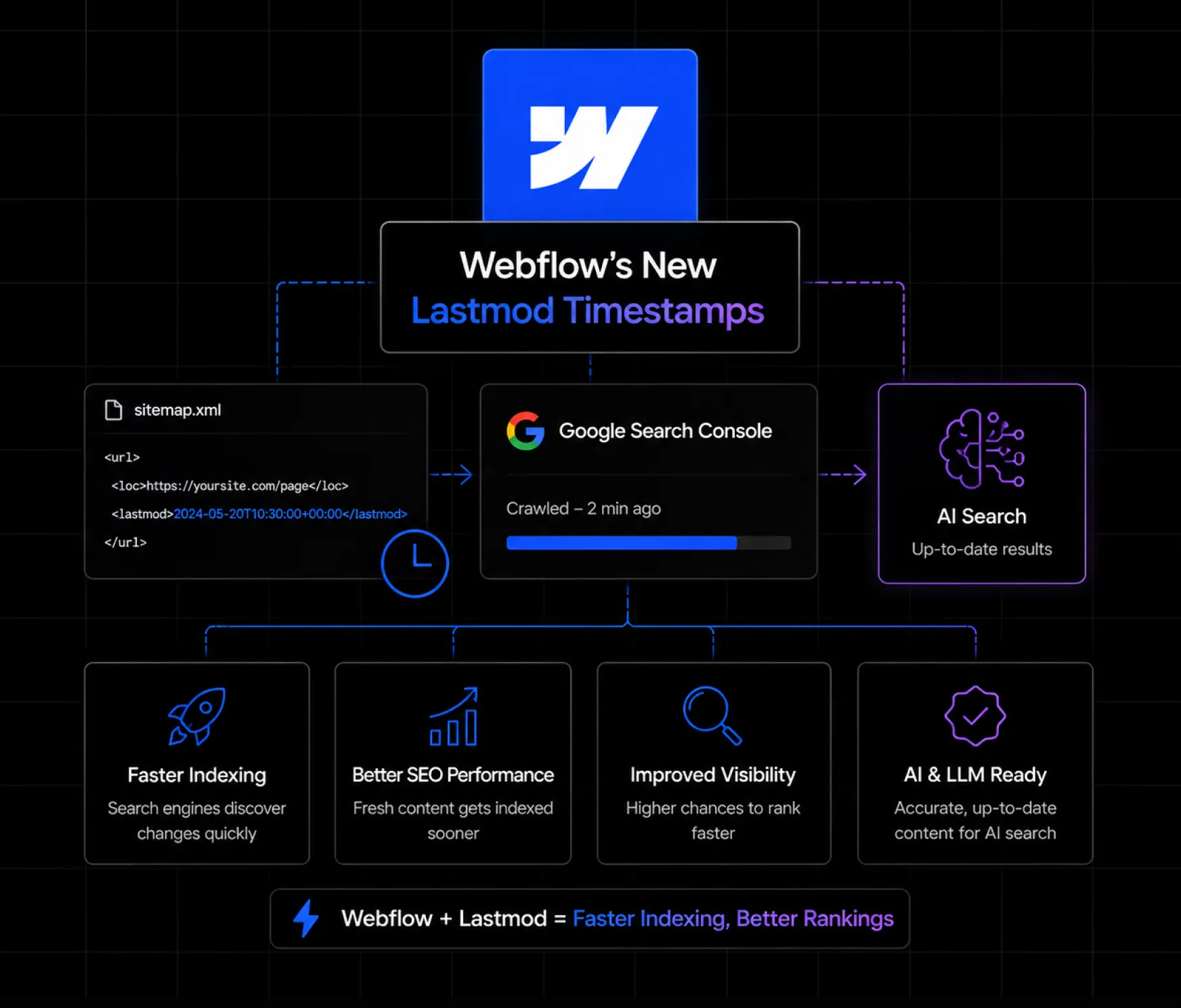
The update adds a <lastmod> timestamp to every URL in a Webflow site's automatically generated sitemap, tells search engines exactly when each page last changed, and lets sitemaps update on a single-page publish instead of requiring a full-site republish. On its own, that sounds like a minor technical tweak. In practice, it directly affects two things every Webflow site owner cares about: how fast Google indexes new content, and whether AI answer engines like ChatGPT search and Google AI Overviews cite your pages at all.
This guide walks through what the update actually does, why the timing matters as more search traffic shifts toward AI-generated answers, and what to check to make sure your site is capturing the full benefit rather than leaving it on the table.
This is written for the people who actually feel the effects of crawl delays and citation misses: marketing teams publishing regularly into a Webflow CMS, technical leads responsible for a site's search performance, and anyone weighing how much attention to put into AEO versus traditional SEO in 2026. If you run a small, rarely updated site, this update will barely register. If your team ships new pages, blog posts, or pricing updates on any kind of regular cadence, it is worth understanding in detail.
A sitemap is an XML file that lists every indexable URL on a website, submitted to search engines so they know what exists and where to find it. The <lastmod> tag is an optional field inside that file, defined in the sitemap protocol for years, that records the date a specific URL was last modified. A single entry in a sitemap file looks roughly like this:
<url>

  <loc>https://example.com/blog/your-page</loc>
  <lastmod>2026-08-20</lastmod>

</url>
The tag itself is not new. What's new is that Webflow now populates it automatically and accurately for every page, without any manual setup, and updates it the moment that specific page changes rather than only when the entire site republishes. Before this update, sitemaps generated by many platforms either omitted the tag entirely or applied one blanket date across the whole sitemap, which told crawlers nothing useful about which pages had actually changed recently.
It is worth understanding why this tag has had a mixed reputation historically. Google itself has said publicly, at various points, that it treats lastmod with some skepticism because so many sites populate it inaccurately, either applying the current date to every page regardless of whether anything changed, or leaving a stale, meaningless value in place indefinitely. A signal that lies half the time is not a very useful signal, so crawlers learned to discount it rather than trust it outright. Webflow's implementation matters specifically because it is automatic and tied to real publish events, which is the exact condition under which lastmod becomes trustworthy again rather than noise.
Three improvements shipped together in this update, and each solves a different problem:
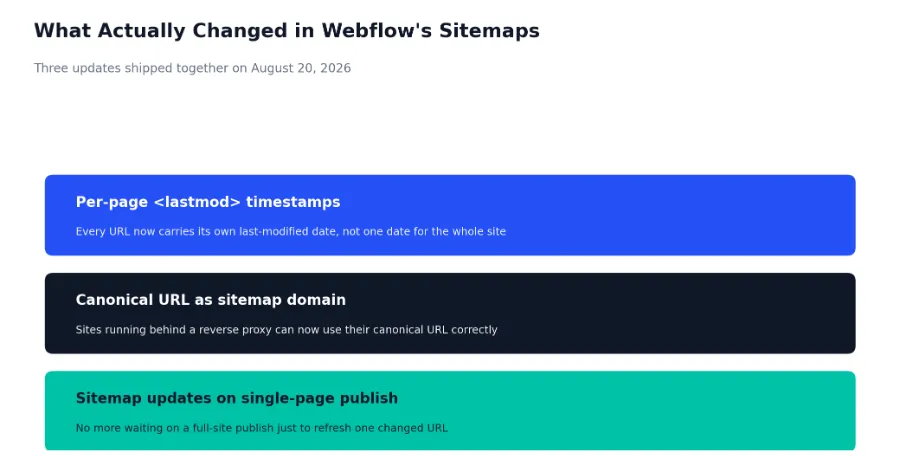
Together, these changes make the sitemap a much more precise, real-time signal of what actually changed on a site, rather than a static file that only roughly reflected reality.
Every website has a finite crawl budget, the amount of attention and resources a search engine is willing to spend crawling a given site in a given period. For small sites this rarely matters. For larger, frequently updated sites, blogs with weekly posts, CMS-driven product catalogs, or news-adjacent content, crawl budget is a real constraint, and wasting it on pages that haven't changed means slower discovery of the pages that have.
Accurate lastmod timestamps let crawlers skip unchanged pages and prioritize the ones that actually need a fresh look. That is a direct, practical improvement to how efficiently a search engine spends its limited attention on your site, and it compounds for larger sites with more URLs competing for the same crawl budget. For a company already investing in Webflow SEO and technical optimization, this update effectively upgrades a signal that was already part of the game, but had been unreliable enough that many crawlers learned to discount it.
The effect is most visible for time-sensitive content. A pricing page update, a corrected product spec, or a policy change all benefit from getting re-crawled within hours rather than days, since the cost of stale information showing up in search results is highest for exactly this kind of content. For a large e-commerce catalog or a site with dozens of CMS collections, the cumulative effect of better-prioritized crawling adds up across hundreds or thousands of URLs in a way that is easy to underestimate from any single page's perspective.
Search engines have used lastmod as one weak signal among many for years. AI answer engines depend on it far more directly, and that difference is what makes this update genuinely significant rather than a routine technical improvement.
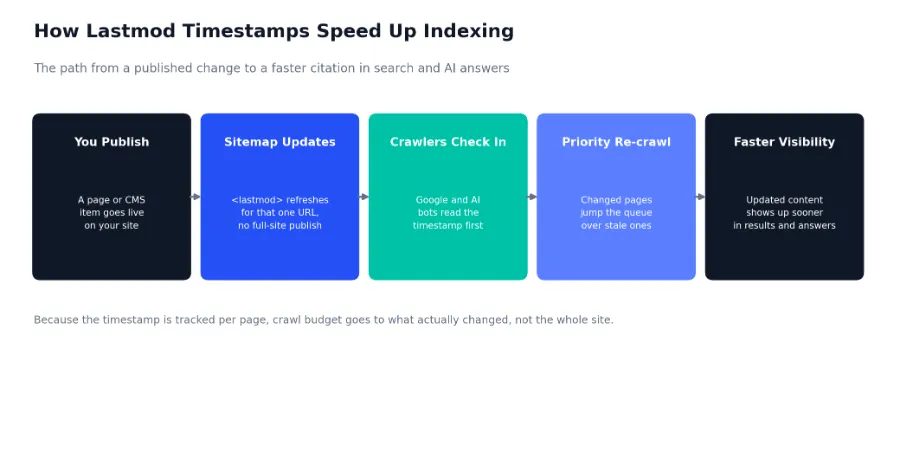
When a tool like Google AI Overviews, Perplexity, or ChatGPT search builds an answer to a user's question, it retrieves information from a set of candidate sources and has to decide, often in real time, which of those sources are current enough to trust. Without a reliable freshness signal, an AI system has no clean way to tell whether a page about a product, a policy, or an event was updated yesterday or three years ago. Content that looks similar on the surface can carry very different real-world accuracy depending on when it was last touched.
A properly maintained lastmod timestamp solves exactly that problem. It gives AI systems a structured, trustworthy way to prefer your freshest, most current content when deciding what to cite, which matters more every quarter as more discovery traffic shifts from ten blue links toward AI-generated answers. Appsrow's comparison of AEO and traditional SEO goes deeper on how these two disciplines overlap and diverge, but freshness signals like this one are a clear case where they reinforce each other rather than compete.
There is also a competitive angle worth naming directly. In the current environment, a meaningful share of sites still generate sitemaps without reliable lastmod data, whether through an older CMS, a plugin that populates the tag incorrectly, or a platform that never supported it well in the first place. A site with genuinely accurate freshness signals is, for now, competing against a field where that signal is often missing or untrustworthy elsewhere. That gap will likely narrow as more platforms catch up, which makes acting on it sooner rather than later worth more than it will a year from now.
It helps to understand roughly what happens on the other end of that timestamp, even at a simplified level. Most AI answer engines work through some version of retrieval-augmented generation, pulling candidate source pages from an index, then generating a response grounded in whatever those sources say. Freshness is one of several ranking factors used to decide which retrieved sources actually make it into the final answer, alongside relevance, authority, and structural clarity.
A page with a stale or missing lastmod signal is not automatically excluded, but it is competing at a disadvantage against a page that can prove, structurally, that it reflects current information. For topics where accuracy has a shelf life, pricing, policy changes, product specs, industry news, that disadvantage compounds quickly. Appsrow's breakdown of Webflow's AEO agent system covers the broader set of signals AI engines weigh beyond freshness alone, including structured data and content clarity.
It is worth being precise about what this signal does and does not do. A recent lastmod date does not make thin or inaccurate content suddenly citable. It simply removes one specific reason an otherwise strong page might get passed over: uncertainty about whether it reflects current information. Content quality, structure, and accuracy still have to carry the actual weight. Freshness is a gate a page needs to clear, not a substitute for everything else that makes a source worth citing.
The benefit of this update scales with how much content a site actually publishes and updates. A five-page brochure site will notice little practical difference. A site running an active blog, a large CMS-driven resource library, or frequent product and pricing updates stands to gain the most, for a few specific reasons:
This is also directly relevant for anyone planning a migration onto Webflow from another platform. A clean, accurate sitemap with correct lastmod data from day one gives a newly migrated site a stronger starting position with crawlers than one that has to earn trust in its freshness signals over time.
There is a compounding effect worth naming for content-heavy sites specifically. A blog publishing several posts a week, each with an accurate, individual lastmod entry, builds a track record of genuinely reliable freshness data over months. Crawlers and AI systems that observe a consistent pattern of accurate signals from a given domain have more reason to trust that domain's freshness claims going forward, which is a form of accumulated advantage that newer or less consistent publishers don't get to skip ahead to. Consistency, not just the presence of the feature, is what compounds here.
This update works automatically in the background, but a few practices determine whether a site actually captures its full value rather than leaving it partially on the table. None of these require developer involvement, they are closer to editorial habits than technical configuration.
Since sitemap updates now track single-page publishes, batching every small change into one big site-wide publish event undersells the improvement. Publishing the specific page that changed, when that's practical, keeps the freshness signal as precise as the update was designed to make it.
A lastmod timestamp is only a useful signal if it reflects genuine content changes. Republishing pages repeatedly with no real edits, purely to refresh the date, is the sitemap equivalent of crying wolf: search engines and AI systems that notice a pattern of cosmetic-only updates will learn to discount the signal for that site specifically.
Lastmod timestamps are one signal in a larger system. They work best alongside clean semantic structure, accurate schema markup, and a sitemap that isn't cluttered with thin or duplicate pages. Appsrow's AEO readiness checklist walks through the fuller set of technical signals worth auditing alongside this one.
Check that your sitemap is actually accessible
None of this matters if the sitemap itself is blocked, misconfigured, or missing from your robots.txt reference. It's worth confirming your sitemap is live at its expected URL and properly submitted in Google Search Console before assuming the new freshness signals are being picked up at all.
Where This Fits Into a Broader AEO Strategy
This update is a genuinely useful piece of infrastructure, but it is one piece, not a complete AEO strategy on its own. Structured data, clear content hierarchy, FAQ-formatted answers, and consistent entity signals all matter alongside freshness, and Webflow's broader AEO system is built specifically to work across all of those signals together rather than treating any single one as sufficient in isolation.
For a Webflow site owner deciding where to focus next, the practical order of operations is usually: confirm the technical foundation, sitemap health, schema markup, crawler access, is solid first, then layer in content-level AEO work like FAQ structuring and topic clustering on top of it. A dedicated Webflow SEO and AEO partner can audit both layers together rather than treating them as separate projects.
This update did not arrive in isolation. It shipped as part of a steady sequence of AEO-focused releases Webflow has pushed through 2026, and understanding that pattern helps explain why a sitemap tweak got its own dedicated announcement rather than a footnote in a general changelog.
The lastmod update fits neatly into that sequence. Each of these releases addresses a different layer of the same underlying goal: making Webflow sites easier for AI systems to find, parse, trust, and cite. Freshness signals are foundational to that goal in a way the flashier features aren't, since none of the content-level optimization work matters much if a page never gets crawled promptly in the first place.
It is easy to overlook an update like this one, since nothing about it changes how a site looks or how the Designer works. But sitemap freshness signals sit at the exact intersection of two things every Webflow site owner should care about in 2026: how quickly Google indexes new work, and whether AI answer engines trust your content enough to cite it. Webflow made that signal accurate and automatic, which is a meaningfully bigger deal than the size of the announcement suggests.
The practical takeaway is simple: keep publishing page by page rather than batching everything into full-site republishes, make sure updates reflect real content changes, and treat this as one solid piece of a larger technical AEO foundation rather than a fix on its own. Sites that already have that foundation in place are the ones positioned to get the most out of an update like this the moment it ships.
Updates like this rarely announce themselves loudly, and it is easy to let them pass by unnoticed since nothing visibly changes on the front end of a site. But the sites that consistently perform well in both traditional search and AI answers over time tend to be the ones whose owners pay attention to exactly this kind of infrastructure change, not just the features that show up in a product tour. This is one of those moments worth actually acting on rather than filing away as background reading.
Appsrow is a Webflow Premium Partner agency that has delivered 300+ Webflow projects for B2B, SaaS, and enterprise brands since 2018. The team prepares Webflow sites for both traditional search and AI discovery through dedicated Webflow SEO and AEO services, technical sitemap and schema audits, structured content architecture, and ongoing Webflow maintenance that keeps freshness signals like this one working as intended.
Curious how your current sitemap and freshness signals score today? Run a free scan with Appsrow's AEO Analyzer, explore the full Webflow AEO service, or browse recent projects to see the work firsthand.
If your website isn't easy to understand, you're giving away opportunities
before the conversation even starts.
Get a free review of how your website appears to AI-powered search and discovery tools.
GOT QUESTIONS ?
Do I need to do anything to enable lastmod timestamps on my Webflow site?
No. This update applies automatically to Webflow's built-in sitemap generation. There is no setting to toggle on for the core feature; the timestamps populate as soon as you publish changes to your pages.
Does this replace the need for good technical SEO otherwise?
No. Lastmod timestamps improve one specific signal, crawl prioritization and freshness. They don't substitute for clean site structure, proper schema markup, fast page speed, or quality content. Think of it as strengthening one input among many, not a replacement for the rest.
How is this different from just resubmitting my sitemap manually?
Manually resubmitting a sitemap tells a search engine to look at it again, but without accurate per-page lastmod data, the engine still can't tell which specific URLs actually changed. This update makes that information precise and automatic, rather than something you'd have to communicate through a blunt, whole-sitemap resubmission.
Does this update affect CMS collection pages, or only static pages?
It applies to any indexable URL Webflow generates a sitemap entry for, which includes CMS collection pages. This is particularly useful for blogs, product catalogs, and other frequently updated collection-based content.
Can I see the lastmod dates Webflow is generating for my site?
Yes. Your sitemap is publicly accessible at yourdomain.com/sitemap.xml, and opening it directly in a browser or text editor shows the raw XML, including the lastmod value for each listed URL.
Does this help with AI search platforms like ChatGPT and Perplexity specifically?
Yes, and arguably more than it helps traditional search. These platforms rely on freshness as a meaningful factor when deciding which sources to cite in generated answers, and a reliable per-page timestamp gives them a structural signal to work with that was previously unreliable or missing entirely on many sites.
Should I republish my whole site to take advantage of this update?
No, and doing so is actually counterproductive. A blanket republish resets the lastmod timestamp across every page uniformly, which erases the very distinction between recently changed and untouched content that makes this update valuable in the first place.
Does this replace the value of submitting a sitemap to Google Search Console?
No, you should still submit and monitor your sitemap in Search Console. This update improves the quality of the information inside the sitemap; it doesn't change the basic need to make sure search engines know the sitemap exists and is being read correctly.
Is this update available on every Webflow plan, or only Enterprise?
This is a platform-wide sitemap improvement, not a feature gated behind a specific pricing tier. It applies to Webflow's automatic sitemap generation broadly, unlike some of Webflow's more advanced AEO analytics features, which are positioned specifically for Enterprise workspaces.

Sandeepsingh Sisodiya is the CEO of Appsrow and a Webflow leader in Ahmedabad, India. He focuses on SaaS growth, digital transformation, and building high-converting website strategies.
CURATED READING
.png)
.png)